

 English
 中文简体
 русский
 Français
 Español
 Deutsch

Biaxial Raschel Mesh-Geogrid Warp Knitting Machine for High-Strength Reinforcement Fabrics
2026-11-16
Content
- 1 1. The Role of Biaxial Geogrids in Modern Civil Engineering
- 2 2. Product Overview
- 3 3. Working Principle of the Machine
- 4 4. Main Advantages of the YRS3-M-G
- 5 5. Comparison with Alternative Production Approaches
- 6 6. Fiber Handling and Tension Control
- 7 7. Grid Geometry and Finished Fabric Performance
- 8 8. Applications of the Finished Geogrid
- 9 9. Manufacturing Strengths and Engineering Capability
- 10 10. Quality Control and Pre-Delivery Testing
- 11 11. Installation and Line Integration
- 12 12. Operator Training, Maintenance and After-Sales Support
- 13 13. Selecting the Correct Configuration
- 14 14. Production Economics and Capacity Planning
- 15 15. Environmental and Durability Considerations
- 16 16. Why Choose a Specialized Equipment Manufacturer
- 17 17. Frequently Asked Questions
- 17.1 What materials can the YRS3-M-G process?
- 17.2 What does the 2 warp × 2 weft configuration mean?
- 17.3 What is the maximum working width?
- 17.4 Is the daily output of 15,000 square meters guaranteed?
- 17.5 How does the machine reduce fiber bending?
- 17.6 Can the machine produce different aperture sizes?
- 17.7 Can the equipment be adapted to a customer’s workshop?
- 17.8 Can the machine be connected to downstream cutting or rolling equipment?
- 17.9 What testing is carried out before shipment?
- 17.10 What training is provided after delivery?
- 17.11 What information should be provided when requesting a quotation?
- 17.12 Can the machine be used for applications outside geotechnical reinforcement?
- 18 18. Conclusion
- 19 References
- 20 Product: YRS3-M-G Raschel Mesh-Geogrid Biaxial Warp Knitting Machine
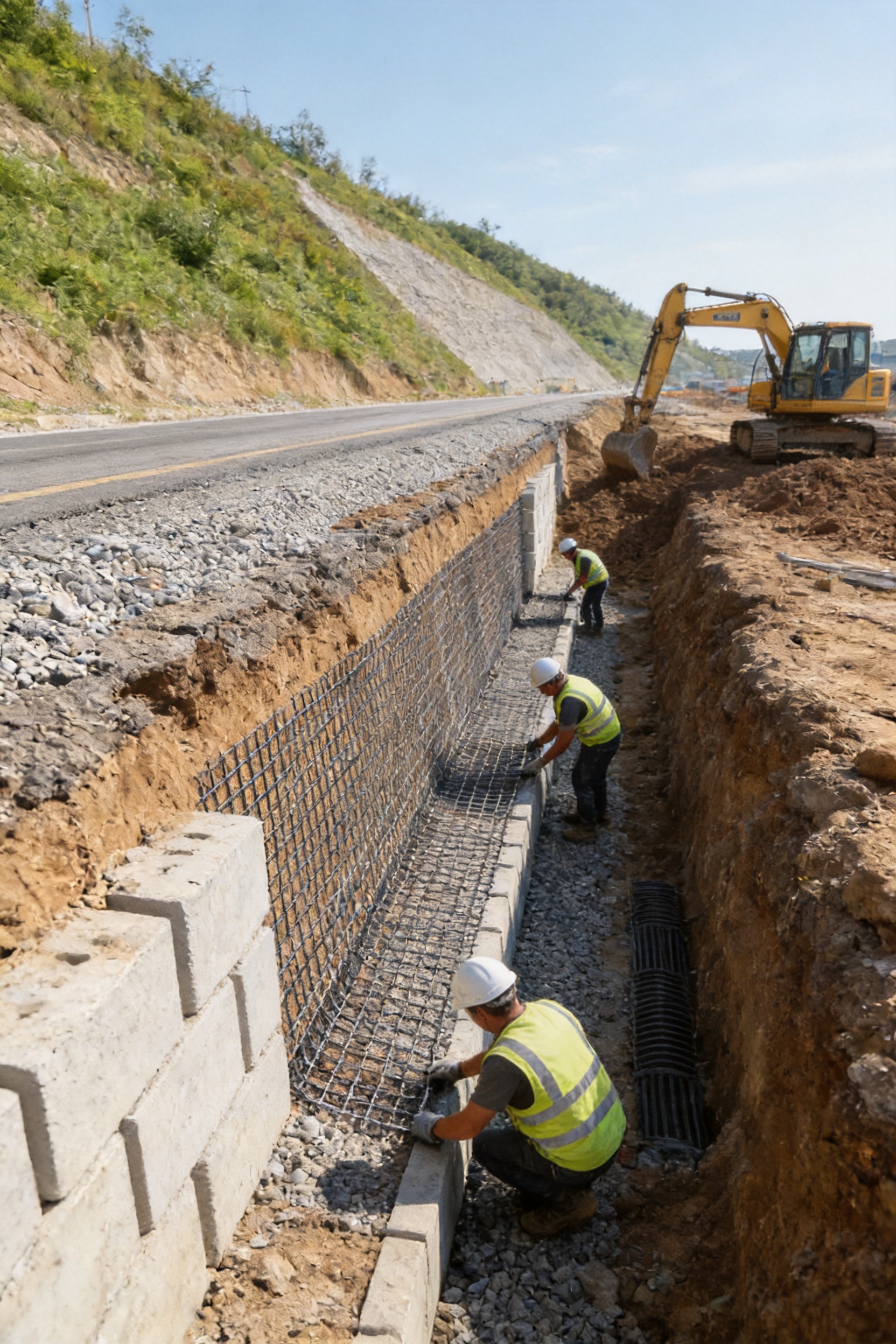
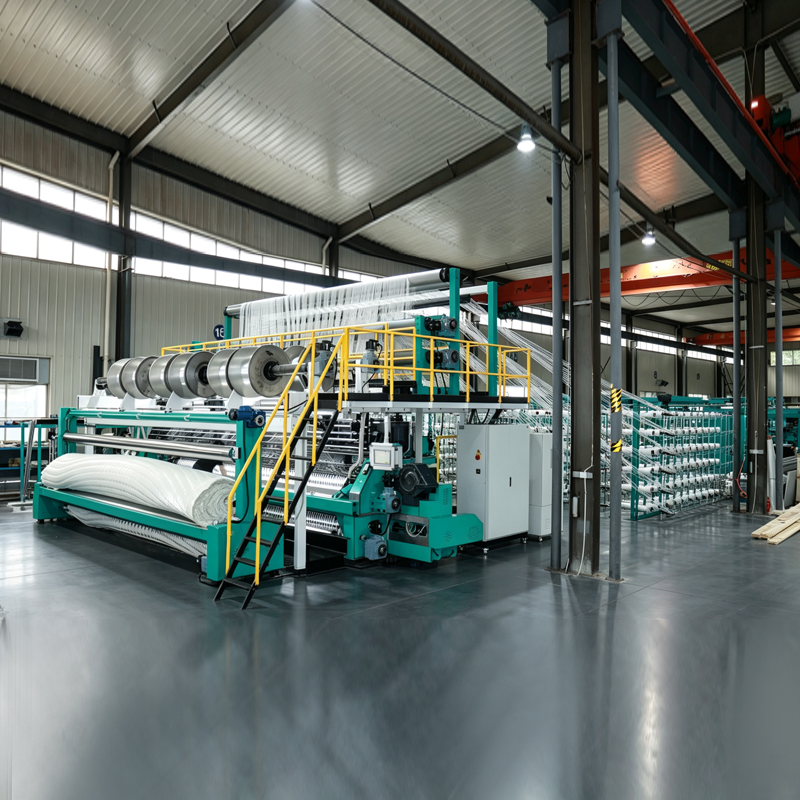
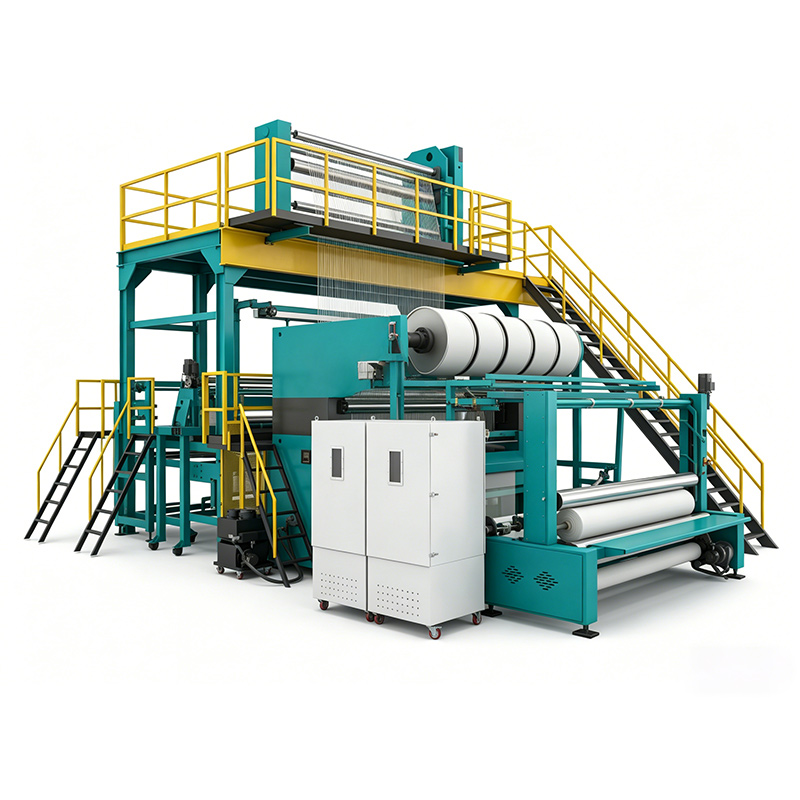
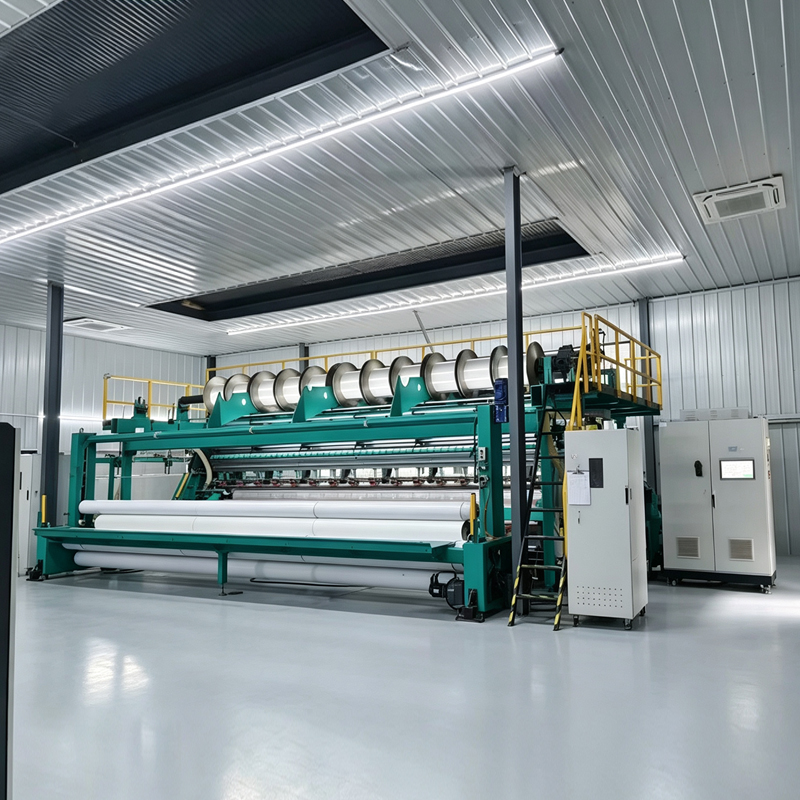
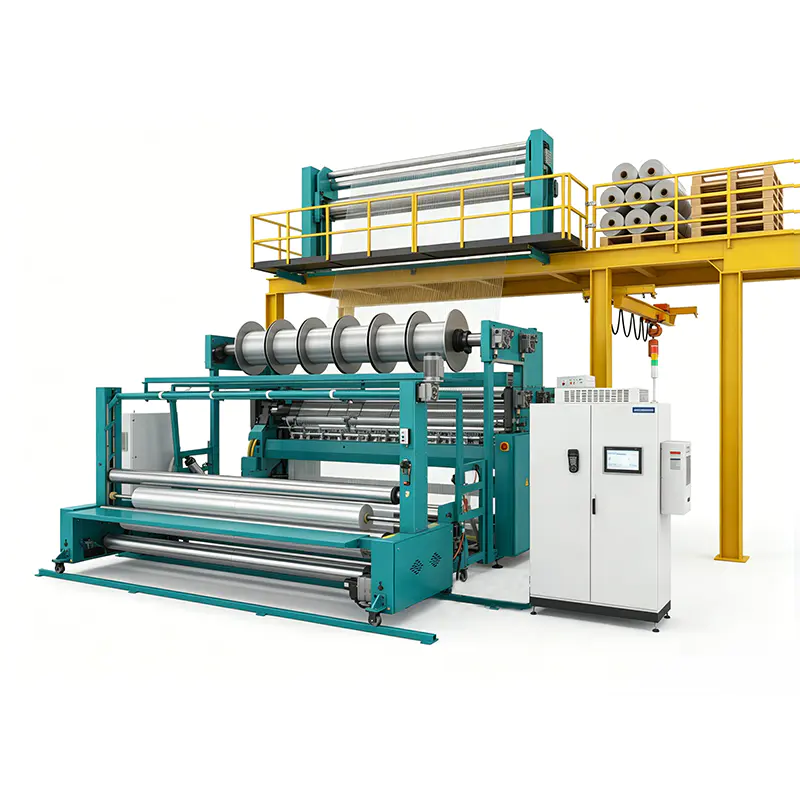
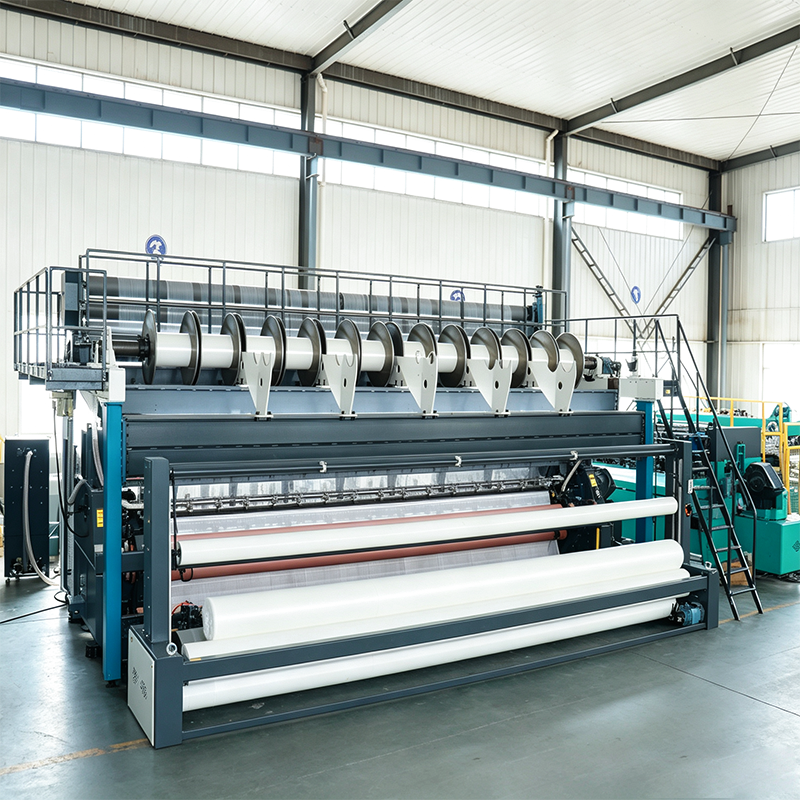
The YRS3-M-G Raschel Mesh-Geogrid Biaxial Warp Knitting Machine is designed for manufacturers producing high-strength geogrids and reinforcement grids from glass fiber and polyester. It forms a stable open-grid structure by arranging fiber bundles in both warp and weft directions and securing them at their intersections. This production method keeps the reinforcement bundles as straight as possible, helping the finished fabric transfer fiber strength efficiently in two directions.
Geogrids manufactured on this type of equipment are used in steep slope protection, soft soil foundation treatment, reinforced soil retaining walls, road construction, embankments and other civil engineering applications. Their purpose is to improve soil stability, control lateral movement and increase the load-bearing performance of weak or unstable ground. The machine is therefore more than a textile production unit: it is the central processing platform for producing engineered reinforcement materials with controlled geometry and repeatable mechanical properties.
With a reference working speed of 20–1500 r/min, a working width of 247 inches, a 2 warp × 2 weft configuration and an indicative daily output of 15,000 square meters, the machine provides a broad production range for different geogrid constructions. Actual performance depends on fiber type, bundle size, aperture, grid density, fabric construction, process settings and operating conditions.
1. The Role of Biaxial Geogrids in Modern Civil Engineering
Soil often has strong compressive performance but limited tensile resistance. When loads are applied to a foundation, slope or retaining structure, soil may move laterally, settle unevenly or shear along a weak plane. A geogrid introduces tensile reinforcement into the soil system. The grid interacts with surrounding soil through mechanical interlock, friction and confinement, helping distribute loads and limit deformation.
A biaxial geogrid is reinforced in both the machine direction and the cross-machine direction. This balanced structure is valuable where loads or soil movement may occur in more than one direction. Compared with a uniaxial reinforcement product, a biaxial grid can provide more uniform stabilization for applications such as road bases, working platforms, foundation improvement and general soil reinforcement.
The performance of a geogrid depends on more than the nominal strength of the raw fiber. Bundle alignment, intersection stability, aperture dimensions, tensile uniformity, creep behavior and resistance to environmental exposure all influence the final result. The knitting machine must therefore maintain the intended geometry while processing fiber bundles that may be relatively brittle, sensitive to abrasion or difficult to tension consistently.
The YRS3-M-G addresses these requirements through a dedicated biaxial Raschel mesh-geogrid configuration. Its warp and weft insertion systems place reinforcement bundles at defined intervals, while the binding system secures the intersections. This approach produces an open structure with continuous reinforcement paths and minimizes the bending or crimp commonly associated with woven constructions.
2. Product Overview
The YRS3-M-G is a biaxial warp knitting machine for mesh-geogrid production. It is intended for plants that need to convert glass fiber or polyester packages into wide, high-strength reinforcement grids. The machine can be configured around the required fabric rather than being limited to one fixed grid pattern or one standard downstream arrangement.
The equipment integrates the principal functions needed for production: fiber supply, warp and weft insertion, binding, drive, control and take-up. The final configuration is selected according to the required fiber package, grid pattern, aperture, bundle spacing, working width, roll format and production target.
| Item | Reference Specification | Production Significance |
|---|---|---|
| Machine type | Biaxial Raschel mesh-geogrid warp knitting machine | Creates an open reinforcement grid with warp and weft fiber systems |
| Applicable fibers | Glass fiber and polyester | Supports common reinforcement materials with suitable tension and guiding arrangements |
| Machine speed | 20–1500 r/min | Provides a broad adjustment range for different materials and fabric constructions |
| Working width | 247 inches | Supports wide-format geogrid production and efficient roll formation |
| Configuration | 2 warp × 2 weft | Provides reinforcement in two principal directions |
| Reference daily output | 15,000 square meters | Used for capacity planning; actual output depends on process conditions |
| Core product | Geogrid and mesh-geogrid reinforcement structures | Suitable for geotechnical and soil reinforcement applications |
The stated specifications should be understood as reference values for technical planning. A manufacturer should select the actual working point after reviewing the intended fiber, bundle size, grid density, aperture, roll length and quality requirements. Running at the highest possible speed is not always the best production strategy. Stable tension, accurate binding and consistent grid geometry are more important than a headline speed that cannot be maintained during continuous operation.
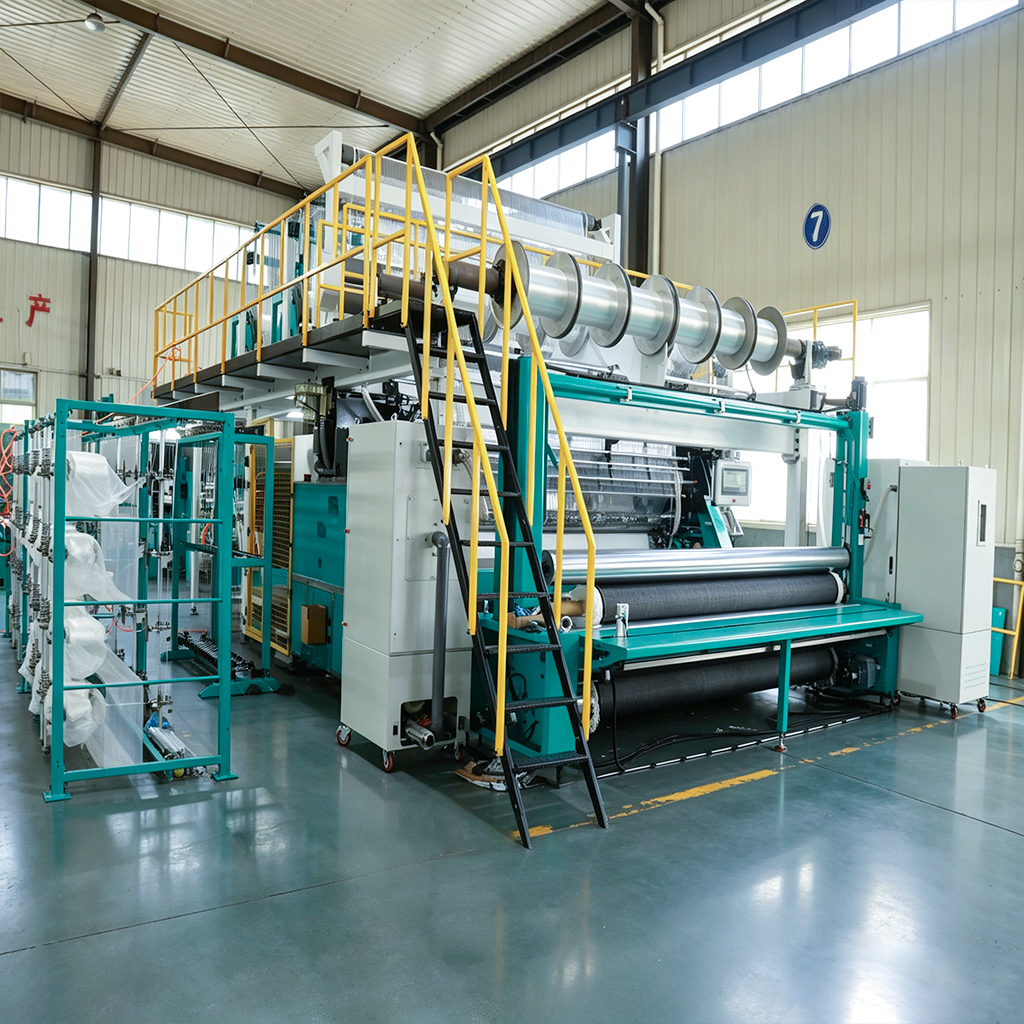
YRS3-M-G Raschel Mesh-Geogrid Biaxial Warp Knitting Machine
3. Working Principle of the Machine
The machine begins with the preparation and delivery of warp and weft fiber bundles. Warp bundles are supplied in the machine direction, while weft bundles are inserted across the width according to the specified grid pattern. The binding system then locks the intersecting bundles together at predetermined points.
This structure differs from a conventional woven fabric. In a woven fabric, warp and weft yarns pass over and under one another, which can create crimp. Crimp causes the yarn to follow a curved path rather than remaining fully straight. Under tensile loading, part of the initial deformation may be used to straighten the yarn before the fiber reaches its full load-bearing potential.
In a mesh-geogrid structure, the reinforcement bundles are arranged to remain substantially straight within the grid. The binding action holds the intersections without requiring the main fiber bundles to follow a pronounced over-under path. This helps maintain direct load paths in both directions and supports high tensile efficiency.
The production sequence can be summarized as follows:
- Fiber packages are installed on the creel or supply system.
- Warp bundles are guided toward the knitting and binding zone.
- Weft bundles are inserted at the programmed or configured intervals.
- The binding elements secure the warp and weft intersections.
- The open grid passes through the take-up and batching system.
- The finished geogrid is wound, cut or transferred according to the downstream production arrangement.
Each stage influences product quality. Incorrect tension can cause uneven apertures, broken bundles or unstable edges. Poor guiding can create abrasion and fuzzing, particularly when processing glass fiber. Inconsistent binding can reduce intersection stability. An improperly selected take-up speed can distort the grid after it has been formed. The machine configuration and process settings must therefore be considered as one integrated system.
4. Main Advantages of the YRS3-M-G
4.1 High Tensile Efficiency
The principal advantage of the biaxial mesh-geogrid structure is the relatively straight alignment of the reinforcement bundles. When the fiber remains close to its intended path, the tensile properties of the raw material can be used more directly in the finished grid. This is particularly important for glass fiber, which provides high tensile strength but is less tolerant of repeated bending and abrasion than many conventional textile yarns.
The direct warp and weft load paths help create a product that can resist forces in two directions. This is useful when soil movement is not limited to one axis or when the reinforced area must distribute loads across a broader foundation zone.
4.2 Stable Grid Geometry
Geotechnical applications require consistent aperture size, bundle spacing and intersection position. A grid that varies significantly across the width or along the production direction may not perform uniformly in the soil. The YRS3-M-G is configured to hold the intended relationship between warp insertion, weft insertion and binding.
Stable geometry also benefits downstream operations. Consistent rolls are easier to inspect, package, cut, transport and install. A controlled grid pattern simplifies quality documentation because measurements can be compared with a defined reference rather than with a fabric that changes from one section to another.
4.3 Low Creep Potential in the Finished Reinforcement
Low creep is a valuable characteristic in long-term soil reinforcement. Creep describes gradual deformation under a sustained load. The final creep performance depends on fiber selection, coating or treatment, bundle structure, temperature, load level and environmental exposure. The machine contributes by producing a stable structure with controlled alignment and secure intersections.
For projects involving long service periods, the production process must minimize unnecessary deformation caused by loose binding, uneven tension or distorted apertures. A well-configured biaxial grid provides a consistent foundation for material testing and application design.
4.4 Broad Material Compatibility
The machine is intended for glass fiber and polyester. These materials have different processing characteristics. Glass fiber is strong and dimensionally stable but can be brittle and vulnerable to damage from sharp guides or excessive friction. Polyester generally offers greater flexibility and elongation, but it requires different tension control and package management.
The YRS3-M-G can be configured with suitable creel, guide and tensioning arrangements for the intended fiber. This adaptability allows a producer to serve more than one market segment or to select the most appropriate fiber for a specific geotechnical requirement.
4.5 Wide-Format Production
The 247-inch working width enables the production of wide reinforcement fabric in a single pass. Wide-format production can reduce the number of overlaps required at a construction site and may improve installation efficiency. It also allows manufacturers to supply different roll formats after slitting, cutting or batching, depending on customer requirements.
4.6 Adjustable Operating Range
The reference speed range of 20–1500 r/min gives the producer room to adjust operation for different grid constructions. Heavy fiber bundles, narrow apertures and high reinforcement densities may require a lower stable speed. Lighter constructions may allow a higher working point.
A wide adjustment range is also useful during product development. When a customer requests a new grid pattern, the producer can evaluate tension, binding, output and quality at different speeds instead of being restricted to one operating condition.
4.7 Integration with Downstream Production
The take-up and batching arrangement can be matched to the required roll format and downstream handling system. This reduces the risk of producing a fabric that meets the grid specification but is inconvenient to package, store or deliver. Roll diameter, winding tension, cutting method and transfer requirements can be reviewed during the configuration stage.
5. Comparison with Alternative Production Approaches
Different reinforcement textile technologies are suitable for different applications. A machine should be evaluated against the required fabric rather than against a single universal performance ranking. The YRS3-M-G has particular advantages when the target is a biaxial open grid with high-strength bundles and controlled intersections.
| Production Approach | Typical Characteristics | Strength of the YRS3-M-G Approach |
|---|---|---|
| Conventional woven reinforcement | Warp and weft yarns interlace with possible crimp | Designed to keep major fiber bundles straighter and provide direct biaxial load paths |
| Uniaxial grid production | Primary reinforcement is concentrated in one direction | Provides reinforcement in both warp and weft directions for more balanced applications |
| Nonwoven reinforcement | Fibers may be distributed as a web or layer | Creates a defined open grid with controlled bundle spacing and apertures |
| Chopped-fiber composite production | Short fibers provide coverage or isotropic reinforcement | Produces continuous high-strength bundles suited to geogrid load paths |
| General-purpose warp knitting | Often optimized for apparel, technical fabrics or conventional knitted structures | Configured specifically for heavy reinforcement bundles and geogrid intersections |
The comparison does not mean that one technology replaces every other technology. Nonwoven or chopped-fiber machines may be better for filtration, drainage, mat reinforcement or composite surfaces. Multiaxial equipment may be more suitable when diagonal orientations are required. The YRS3-M-G is strongest where the production objective is a biaxial mesh-geogrid with continuous warp and weft reinforcement.
Compared with a conventional woven process, the main competitive value is the ability to produce a grid in which the reinforcement bundles do not need to follow a pronounced interlacing path. Compared with a uniaxial system, the machine offers a balanced two-direction structure. Compared with a general-purpose knitting platform, its configuration is centered on the special handling requirements of glass fiber, polyester and geotechnical grid geometry.
6. Fiber Handling and Tension Control
Fiber handling is one of the most important areas in geogrid production. A machine may have sufficient nominal speed and width, but its real production value depends on whether it can process the selected fiber without excessive breakage, abrasion or tension variation.
Glass fiber requires careful control because individual filaments can be damaged by sharp contact points, uncontrolled friction or sudden tension changes. The yarn path should be smooth, and guide elements should be selected to reduce unnecessary wear. The supply system must also maintain a consistent delivery rate as packages become smaller.
Polyester is more flexible and usually tolerates handling conditions that would be unsuitable for glass fiber. However, polyester can stretch more readily, so the tensioning arrangement must account for elongation and recovery. If the tension is not controlled, the finished grid may show variations in aperture or bundle alignment.
The appropriate configuration depends on factors such as:
- Fiber material and filament construction.
- Linear density and bundle size.
- Package type and package dimensions.
- Required warp and weft spacing.
- Target machine speed.
- Desired grid aperture and open area.
- Binding structure and intersection frequency.
- Take-up tension and finished roll format.
Effective tension control is not simply a matter of increasing or reducing tension. The objective is to maintain sufficient control for accurate placement while avoiding excessive stress on the fiber. A stable process uses the lowest practical handling force that still keeps the bundles aligned and the intersections properly formed.
7. Grid Geometry and Finished Fabric Performance
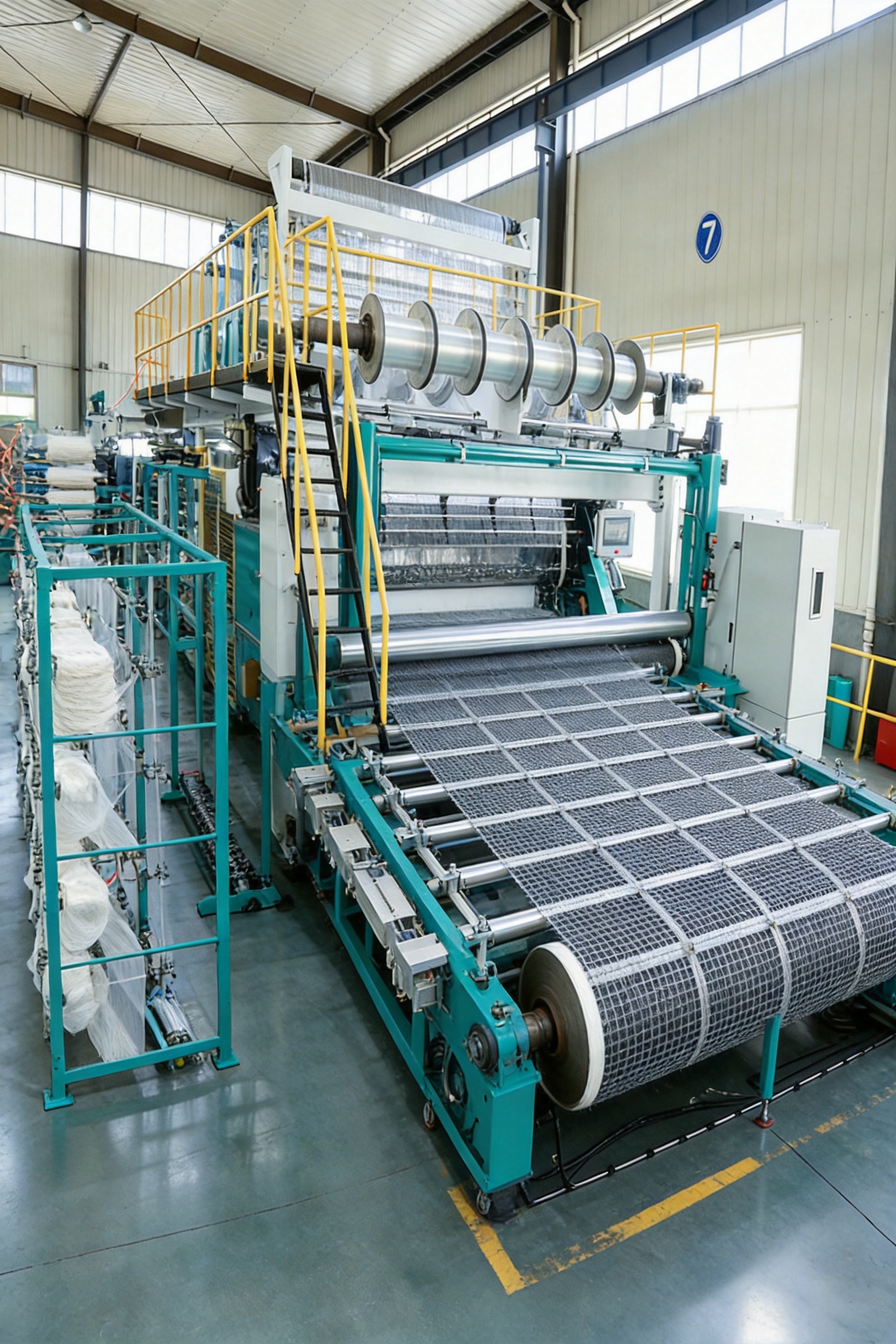
The geometry of a geogrid determines how the product interacts with soil. Aperture size affects mechanical interlock, aggregate confinement and the relationship between the grid and surrounding particles. Bundle spacing influences reinforcement density, tensile distribution and material usage. Binding frequency affects intersection stability and the ability of the grid to retain its shape during installation.
The machine configuration translates the requested fabric design into production settings. A technical discussion should normally include the following information:
- Nominal aperture length and width.
- Warp bundle spacing.
- Weft bundle spacing.
- Number and arrangement of warp systems.
- Number and arrangement of weft systems.
- Binding pattern and intersection construction.
- Finished width and edge condition.
- Required tensile performance in both directions.
- Acceptable dimensional tolerances.
- Required roll length, core diameter and packaging method.
Increasing grid density may improve reinforcement capacity, but it can also increase material consumption, tension demand and production difficulty. A larger aperture may be more suitable for certain aggregate sizes, while a smaller aperture may be required for a different soil structure. The machine must be set according to the final engineering requirement rather than according to a generic grid appearance.
The open area of the grid is also relevant. A geogrid is not intended to form a solid sheet. Its openings allow soil or aggregate to pass through and lock around the reinforcement. The correct balance between open area and reinforcement density supports the intended interaction between the grid and the surrounding material.
8. Applications of the Finished Geogrid
8.1 Steep Slope Protection
Steep slopes can experience surface erosion, sliding and progressive deformation. A geogrid can be incorporated into a reinforced soil system to improve tensile resistance and restrain movement. The biaxial structure helps distribute stress across the reinforced area, while the open grid allows soil, aggregate or vegetation-supporting layers to interact with the reinforcement.
8.2 Soft Soil Foundation Treatment
Soft soils may have limited bearing capacity and may deform under embankments, roads, storage yards or industrial platforms. A geogrid can be placed within selected reinforcement layers to improve load distribution and reduce lateral spreading. The grid does not replace proper geotechnical design, drainage or soil improvement, but it can form an important part of an engineered foundation treatment system.
8.3 Reinforced Soil Retaining Walls
In reinforced soil retaining walls, reinforcement layers extend from the facing into the retained soil. The grid helps resist outward movement and contributes to the stability of the reinforced block. Biaxial products may be selected where reinforcement is required across the width of the structure as well as along the primary direction.
8.4 Road Bases and Working Platforms
Road bases, temporary access roads and construction working platforms may be built over weak subgrades. A geogrid can help distribute traffic or construction loads, reduce rutting and improve the serviceability of the aggregate layer. The suitable grid depends on soil conditions, aggregate size, loading, installation method and design requirements.
8.5 Embankments and General Ground Reinforcement
Embankments constructed over soft or variable ground can benefit from reinforcement that limits lateral spreading and supports more uniform load transfer. The grid may also be used in earthworks where differential movement is a concern. Product selection must always be based on site conditions and engineering calculations.
9. Manufacturing Strengths and Engineering Capability
The production of special textile machinery requires more than the assembly of standard components. Geogrid equipment must accommodate unusual fiber behavior, high bundle loads, wide working dimensions and precise open-grid geometry. Manufacturing strength therefore depends on design experience, mechanical processing, assembly quality, control integration and commissioning capability.
Changzhou Yuanyang Electromechanical Technology Co., Ltd. operates as a high-tech textile machinery enterprise integrating research and development, manufacturing, sales and service. Its product range includes stitch-bonding machines, biaxial warp knitting machines, multiaxial warp knitting machines, carbon fiber multiaxial machines, powder scattering machines and web laying machines.
This product range gives the engineering team experience with different technical textiles, reinforcement architectures and difficult-to-process materials. The same project may require knowledge of yarn handling, fiber placement, binding, composite layering, powder distribution or nonwoven integration. Experience across these technologies helps support a more complete approach to machine development.
The company places particular emphasis on non-standard equipment configurations, complex fabric designs and production lines requiring long-term stability. This is important for geogrid manufacturers because the required product is often defined by a customer drawing, a construction specification or an application-specific sample rather than by a universal textile standard.
Engineering support can include machine frame design, warp and weft insertion, binding bar motion, drive configuration, control system arrangement, tension management, take-up design and workshop layout. These elements must operate together. A strong drive system cannot compensate for poor yarn guidance, and a precise binding mechanism cannot deliver a stable grid if the take-up system distorts the fabric.
9.1 Research and Development
A professional research and development team helps the manufacturer respond to new fiber materials, heavier reinforcement packages, unusual aperture requirements and higher production expectations. Development work may involve structural analysis, motion coordination, control logic, component selection and repeated production testing.
The development process is particularly valuable when customers need to process materials with different levels of brittleness, elongation or surface treatment. The machine must be adapted to the material instead of forcing every fiber through the same production conditions.
9.2 Precision Manufacturing
Machine stability depends on the quality of its mechanical components and assembly accuracy. Structural parts must maintain alignment under operating loads. Guide and binding elements must be installed accurately. Drive transmission must remain synchronized. Take-up components must provide controlled and repeatable winding.
The manufacturing process includes component procurement, machining, assembly, testing and debugging. The production base in Danyang supports machine assembly, pre-delivery verification and warehouse management. An organized production and storage system helps control components from receiving through sorting, assembly and dispatch.
9.3 Process-Oriented Customization
Customization is not limited to changing the machine dimensions. It may involve adapting the yarn path, modifying tension control, adjusting the binding system, changing the take-up arrangement or redesigning the layout around available workshop space. The purpose is to create a production solution that matches the fabric and the operating environment.
A typical customization workflow begins with drawings, fabric samples or technical specifications. The engineering team then confirms the intended grid geometry, fiber package, working width, output target and utility conditions. After design review and quotation, the process may include three-dimensional confirmation, pattern or mold work where relevant, sample approval, machine production, inspection and delivery.
10. Quality Control and Pre-Delivery Testing
Quality control begins before final assembly. Components must be checked, machined parts must meet dimensional requirements and moving systems must be assembled according to the intended alignment. During assembly, the relationship between insertion, binding and take-up must be verified.
Every machine is tested before delivery. For a biaxial geogrid machine, pre-delivery verification should include operation of the warp and weft systems, inspection of the binding action, review of fabric width and confirmation of grid geometry against the agreed sample or drawing.
Testing is more useful when it reflects the customer’s actual production objective. A machine may run smoothly with a light demonstration material but behave differently with a heavy glass fiber bundle. For this reason, the agreed fiber, grid pattern and process reference should be used whenever practical during acceptance testing.
| Verification Area | What Is Checked | Why It Matters |
|---|---|---|
| Mechanical assembly | Alignment, fastening, movement and structural stability | Supports safe and repeatable operation |
| Warp and weft insertion | Bundle delivery, spacing and synchronization | Determines the basic biaxial grid pattern |
| Binding system | Intersection locking and consistency | Maintains grid integrity during handling and installation |
| Drive and control | Speed regulation, coordination and operating response | Allows the machine to run at the selected working point |
| Take-up system | Winding tension, roll formation and batching | Prevents distortion and supports downstream handling |
| Finished sample | Width, aperture, visual quality and construction | Provides an acceptance reference for the customer |
Quality documentation can include inspection records, commissioning notes, operating parameters and recommended maintenance intervals. These records help the production team establish a repeatable process after installation.
11. Installation and Line Integration
Installation begins with a review of the workshop. Floor loading, available space, operator access, power supply, material flow and downstream equipment should be confirmed before shipment. Wide machinery requires sufficient clearance for delivery, assembly, maintenance and roll removal.
Leveling and anchoring are essential for stable operation. The machine frame must be correctly positioned so that the insertion, binding and take-up systems remain aligned. Electrical connections and control interfaces should be agreed during the configuration stage rather than after the machine arrives.
Commissioning normally includes:
- Machine positioning, leveling and anchoring.
- Electrical connection and control system inspection.
- Installation of fiber packages and threading of the yarn path.
- Adjustment of warp and weft insertion systems.
- Binding system setup and intersection verification.
- Take-up and batching adjustment.
- Trial production using the agreed material or a suitable equivalent.
- Operator instruction and maintenance training.
Integration with downstream equipment is also important. The producer may require slitting, cutting, inspection, coating, laminating, packaging or automatic roll transfer. The take-up arrangement should be selected to match the next stage of production and the delivery format required by customers.
12. Operator Training, Maintenance and After-Sales Support
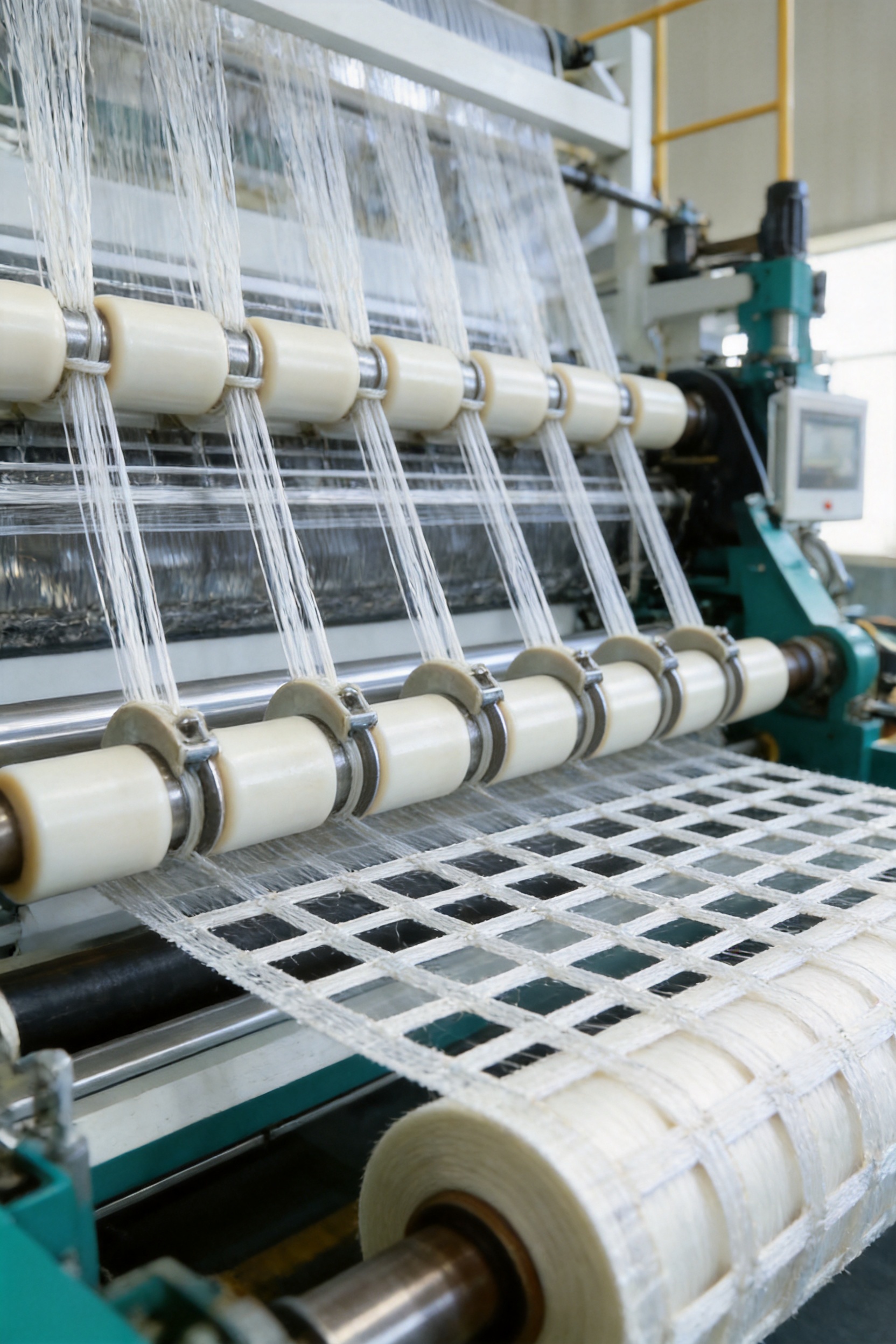
A high-performance machine reaches its potential only when operators understand the relationship between settings and fabric quality. Training should cover machine operation, threading, tension adjustment, speed selection, binding inspection, roll handling and basic troubleshooting.
Maintainers should receive instruction on guide inspection, lubrication, drive checks, fastener inspection, tension calibration and replacement of wear parts. Training should also explain how to identify early signs of production instability, such as changing aperture size, uneven edge formation, increased fiber fuzz, abnormal vibration or irregular winding.
Wear is concentrated in areas where the fiber travels, changes direction or is bound. Guide elements, yarn-contact surfaces, binding components and take-up parts should be inspected according to a planned schedule. Preventive maintenance is generally more effective than waiting for a component failure that interrupts a long production run.
A practical maintenance program may include:
- Daily cleaning of fiber residue and inspection of the yarn path.
- Regular checking of guides for wear, sharp edges or contamination.
- Verification of tension settings and sensor response.
- Lubrication of specified moving components.
- Inspection of drive belts, couplings, fasteners and transmission parts.
- Review of binding elements and intersection quality.
- Inspection of take-up alignment and winding tension.
- Periodic review of electrical cabinets, control connections and safety devices.
The service system includes on-site installation, commissioning and training. It can also include technical assistance for production issues, workshop management training, quality control support, production planning and process parameter documentation. These services help a customer move from machine delivery to stable commercial production.
13. Selecting the Correct Configuration
A geogrid machine should be specified from the fabric outward. The first question is not simply how fast the machine should run, but what fabric must be produced and what performance must that fabric provide in service.
The following information supports a reliable technical proposal:
| Customer Input | Configuration Impact |
|---|---|
| Fiber type | Determines package handling, guide selection and tension requirements |
| Fiber linear density and bundle size | Influences insertion capacity, binding conditions and sustainable speed |
| Grid aperture | Defines bundle spacing and the required fabric geometry |
| Warp and weft tensile targets | Helps determine reinforcement density and fabric construction |
| Required working width | Confirms machine width and edge arrangement |
| Target output | Supports capacity planning and working-point selection |
| Roll format | Determines take-up, batching and downstream handling requirements |
| Workshop layout | Confirms footprint, access, floor loading and material flow |
| Utilities | Defines electrical and control interface requirements |
| Sample or drawing | Provides a reference for testing and acceptance |
Providing a physical sample or drawing is especially useful. It allows the engineering team to study aperture size, bundle arrangement, binding appearance, edge condition and roll requirements. If the customer is developing a new product, the technical discussion can also address trial production, sample approval and future scale-up.
14. Production Economics and Capacity Planning
The reference daily output of 15,000 square meters provides a starting point for capacity planning, but actual output must be calculated for the selected fabric. A heavy grid with large glass fiber bundles may run at a different speed from a lighter polyester construction. More frequent binding points, narrower apertures and higher reinforcement density can also reduce the sustainable operating rate.
Capacity planning should account for more than machine speed. Important factors include startup time, package changes, threading, inspection, roll changes, maintenance, fiber breaks, trial production and rejected material. A realistic plan distinguishes between theoretical output and saleable output.
Stable operation can improve overall economics even if the nominal speed is lower. A slightly lower speed with fewer stoppages, less waste and more consistent grid geometry may produce more acceptable material per shift than an unstable high-speed process. The correct working point should be determined through trial production and quality evaluation.
Wide-format manufacturing can improve material utilization and reduce the number of production passes required for large rolls. It may also support multiple finished widths through slitting or cutting, depending on the product strategy. The best approach depends on customer demand, warehouse space, packaging requirements and the construction market being served.
15. Environmental and Durability Considerations
Geogrids are often installed in environments exposed to moisture, changing temperatures, soil chemicals, oxidation and long-term mechanical stress. Glass fiber and polyester offer different durability profiles, so the material selection must match the project conditions. The finished product may also require additional coating or treatment depending on the application.
The machine contributes to durability by maintaining a stable structure. A uniform grid reduces local stress concentrations and helps ensure that the reinforcement is distributed as intended. Secure intersections reduce the risk of the fabric losing its shape during transport, placement or backfilling.
Resistance to corrosion and oxidation is an important advantage of suitable reinforcement materials. However, performance in a specific project must be confirmed through appropriate testing and engineering evaluation. The machine itself cannot replace material qualification, environmental testing or application design.
16. Why Choose a Specialized Equipment Manufacturer
A specialized textile machinery manufacturer can evaluate the complete relationship between machine motion, material behavior and fabric performance. This is especially important for technical textiles, where a small change in yarn path or tension can affect the final product significantly.
The strengths of a specialized supplier include:
- Experience with warp knitting and reinforcement textile structures.
- Knowledge of glass fiber, polyester and other technical materials.
- Ability to design non-standard machine configurations.
- Integration of mechanical, electrical and control systems.
- Production testing before delivery.
- Installation and commissioning support.
- Operator, maintainer and workshop management training.
- Long-term spare parts and technical assistance.
Changzhou Yuanyang Electromechanical Technology Co., Ltd. combines research and development, manufacturing, sales and service. Its focus on specialized equipment allows it to support projects involving complex fabric designs, difficult materials and production lines requiring long-term stability.
The company’s broader equipment portfolio also supports technology selection. A customer producing biaxial geogrids may later need nonwoven-backed reinforcement, chopped-fiber structures, multiaxial composite fabrics or carbon fiber preforms. Having experience across related machine categories can simplify future expansion and help the customer choose equipment based on the intended fabric rather than on a single machine type.
17. Frequently Asked Questions
What materials can the YRS3-M-G process?
The machine is designed for glass fiber and polyester. The supply, guiding and tensioning arrangement should be selected according to the specific fiber package, bundle size and fabric construction. Glass fiber normally requires especially careful control of contact surfaces and tension because it can be sensitive to abrasion and bending.
What does the 2 warp × 2 weft configuration mean?
It refers to the biaxial structure in which two warp and two weft systems participate in forming the reinforcement grid. The warp and weft bundles are arranged in two principal directions and secured at their intersections. The exact fabric appearance and tensile performance depend on the selected spacing, bundle size and binding pattern.
What is the maximum working width?
The reference working width is 247 inches. The effective finished width depends on the selected edge arrangement, fabric construction, process settings and customer requirements.
Is the daily output of 15,000 square meters guaranteed?
No. The figure is a reference value for planning. Actual output depends on fiber type, bundle size, aperture, grid density, binding frequency, operating speed, package changes, maintenance and the quality requirements of the finished fabric. A project-specific output estimate should be prepared after the fabric design is confirmed.
How does the machine reduce fiber bending?
The production method arranges the main reinforcement bundles in warp and weft directions and binds them at their intersections. Unlike a conventional over-under woven structure, the bundles can remain substantially straighter within the grid. This helps reduce crimp and supports more direct load transfer through the finished fabric.
Can the machine produce different aperture sizes?
The machine can be configured and adjusted for different grid geometries within its technical range. Aperture size depends on warp spacing, weft spacing, bundle arrangement and binding conditions. The required sample or drawing should be reviewed before the final configuration is confirmed.
Can the equipment be adapted to a customer’s workshop?
Yes. Workshop footprint, operator access, floor loading, electrical supply, material flow and downstream equipment can be reviewed during the engineering stage. Layout adjustments and take-up arrangements can be designed to fit the available production environment.
Can the machine be connected to downstream cutting or rolling equipment?
Yes. The take-up and batching arrangement can be matched to the required roll format and downstream handling process. The interface should be defined during configuration so that finished rolls are compatible with cutting, slitting, inspection, packaging or automatic transfer equipment.
What testing is carried out before shipment?
Pre-delivery work includes mechanical inspection, operation of the warp and weft systems, verification of the binding action, review of control and drive functions, take-up checks and production of a sample where appropriate. The finished sample can be compared with the agreed drawing or reference fabric.
What training is provided after delivery?
Training can cover machine operation, threading, tension adjustment, speed selection, fabric inspection, troubleshooting and routine maintenance. Additional training may be provided for maintainers and workshop managers, including quality control, production planning and process documentation.
What information should be provided when requesting a quotation?
The most useful information includes fiber type, fiber specification, grid pattern, aperture, required working width, target output, roll format, workshop layout, available utilities and a fabric sample or drawing. These inputs allow the supplier to prepare a configuration based on the actual product instead of a generic machine specification.
Can the machine be used for applications outside geotechnical reinforcement?
The core configuration is intended for geogrid and mesh-geogrid reinforcement structures. Other technical textile applications may require different insertion, binding, tension or take-up arrangements. A technical review is necessary before confirming suitability for another fabric type.
18. Conclusion
The YRS3-M-G Raschel Mesh-Geogrid Biaxial Warp Knitting Machine is designed for manufacturers that require wide, stable and high-strength biaxial reinforcement grids. Its core production principle places glass fiber or polyester bundles in warp and weft directions and secures them at their intersections while keeping the main reinforcement paths as straight as possible.
This structure supports high tensile efficiency, dimensional stability, low creep potential and reliable interaction with soil. The machine’s 247-inch working width, 2 warp × 2 weft configuration, adjustable speed range and reference output provide a practical platform for commercial geogrid production. Its real advantage, however, lies in the ability to configure the machine around the intended fabric, fiber, grid geometry, roll format and workshop conditions.
Changzhou Yuanyang Electromechanical Technology Co., Ltd. strengthens this product with research and development, specialized manufacturing, quality control, pre-delivery testing, installation, commissioning and after-sales training. Its experience with biaxial, multiaxial, stitch-bonding and other technical textile machinery supports customized solutions for complex materials and demanding fabric structures.
For a successful project, the machine should be selected as part of a complete production solution. Fiber specifications, aperture, bundle spacing, tensile targets, working width, output, roll format and site conditions should all be reviewed before final configuration. When these factors are aligned, the YRS3-M-G can provide a dependable foundation for producing geogrids used in slope protection, foundation treatment, retaining wall construction, road reinforcement and other long-term civil engineering applications.
References
1. Product technical information for the YRS3-M-G Raschel Mesh-Geogrid Biaxial Warp Knitting Machine.
2. Manufacturer-provided information on biaxial warp knitting machinery, technical textile equipment and customized machine configurations.
3. General engineering principles for geogrid reinforcement in soil stabilization, foundation treatment and reinforced retaining structures.
4. General technical guidance on glass fiber and polyester handling in high-strength textile production.
5. General production principles for warp and weft insertion, binding, tension control, take-up and roll formation in technical textile machinery.
Product: YRS3-M-G Raschel Mesh-Geogrid Biaxial Warp Knitting Machine

News
-
Match the machine type to the fabric: choose a tricot Warp Knitting Machine for fine, smooth fabrics such as lining and sportswear, a raschel machine for open, patterned, and technical fabrics, a doub...
READ MORE -
Two quotations land on the same desk. Both offer a multiaxial warp knitting line, both list the same working width, both promise high output. One buyer signs and discovers six months later that the f...
READ MORE -
Two buyers open the same catalogue and both ask for a warp knitting machine. One needs a 4.5 m wide glass-fibre geogrid with 0° and 90° yarns stitched together for a soil-reinforcement contract; the ...
READ MORE -
Three quotations land on the same desk for the same polyester nonwoven line, and on paper they look interchangeable. Each is priced per metre of working width. Each quotes a similar top speed. Each c...
READ MORE
-
Contact Info.
+86-198 5534 1617
+86-134 0158 3002yuanyang@yywarpknitting.com 699#, Shengzhi West Rd, Lvcheng Town, Danyang City, Zhenjiang City, Jiangsu Province, China

-
QR Code
-
Quick Links
Home About Products Manufacturing Customization News Contact -
Product List
Machine for Chemical Fiber Textile Machine for Fiberglass Textile Machine for Carbon Fiber Textile -
About Us
Company Profile Factory Gallery Value-added Service
Copyright © 2026 Changzhou Yuanyang Electromechanical Technology Co., Ltd. All Rights Reserved.
Custom Warp Knitting Machine Manufacturers
