

 English
 中文简体
 русский
 Français
 Español
 Deutsch

FB Fiber Web Stitch Bonding Machine: High-Strength Chemical Fiber Web Production
2026-10-19
Content
- 1 1. The Role of Stitch Bonding in Modern Textile Production
- 2 2. Core Working Principle of the FB Machine
- 3 3. Main Technical Specifications
- 4 4. Advantages Compared with Binder-Based Web Bonding
- 5 5. Advantages Compared with Narrow or Single-Purpose Equipment
- 6 6. Raw Materials and Fiber Compatibility
- 7 7. Product Applications
- 8 8. Configuration and Process Engineering
- 9 9. Manufacturing Strengths and Production Control
- 10 10. Engineering and Customization Capabilities
- 11 11. Installation, Commissioning, and Operator Training
- 12 12. Maintenance and Serviceability
- 13 13. Quality Management from Component to Finished Machine
- 14 14. Operating Performance and Production Economics
- 15 15. Practical Comparison with Alternative Bonding Methods
- 16 16. Recommended Project Development Process
- 17 17. Frequently Asked Questions
- 17.1 What fibers can the FB Fiber Web Stitch Bonding Machine process?
- 17.2 Does the machine use chemical binders?
- 17.3 What is the standard working width?
- 17.4 What is the expected daily production?
- 17.5 Can the machine produce different types of fabric?
- 17.6 What applications are suitable for the machine?
- 17.7 How does the machine compare with binder-based bonding?
- 17.8 Can the machine be integrated with an existing production line?
- 17.9 What information is needed for a quotation?
- 17.10 What installation and training support is available?
- 17.11 Which components require the most maintenance?
- 17.12 Can the machine be customized?
- 18 18. Conclusion
- 19 References
- 20 Product: FB Fiber Web Stitch Bonding Machine
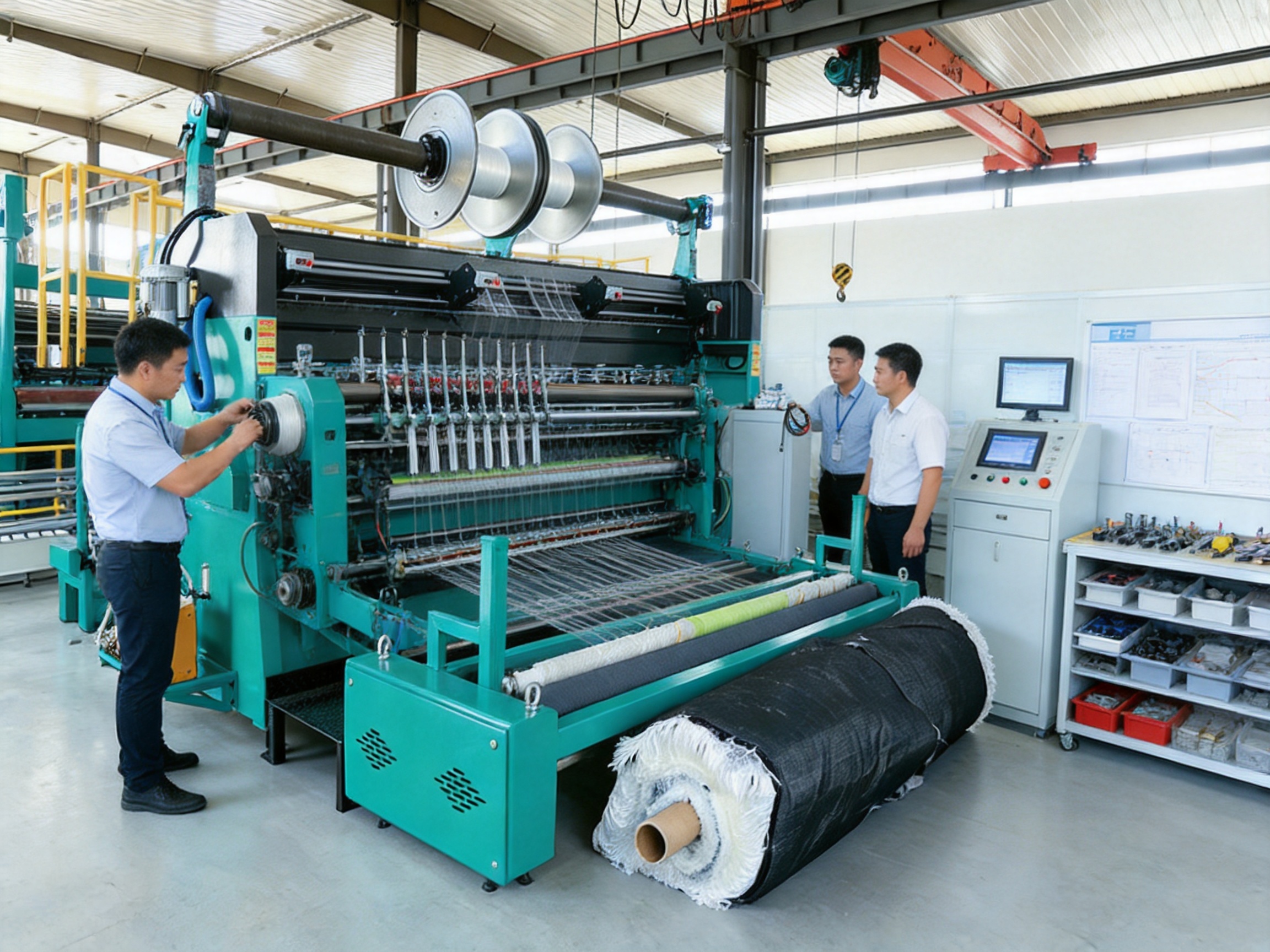
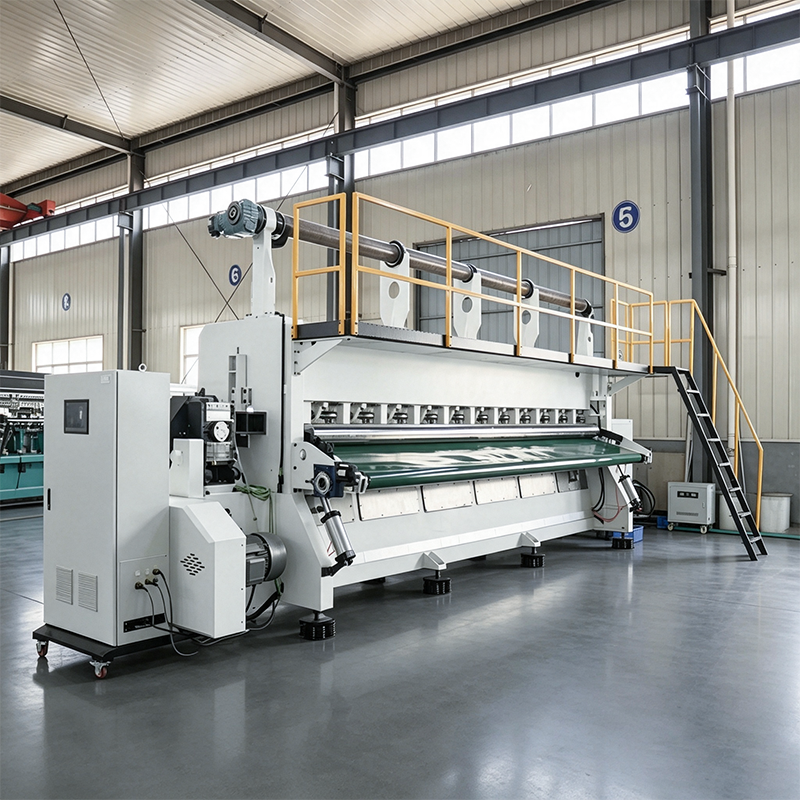
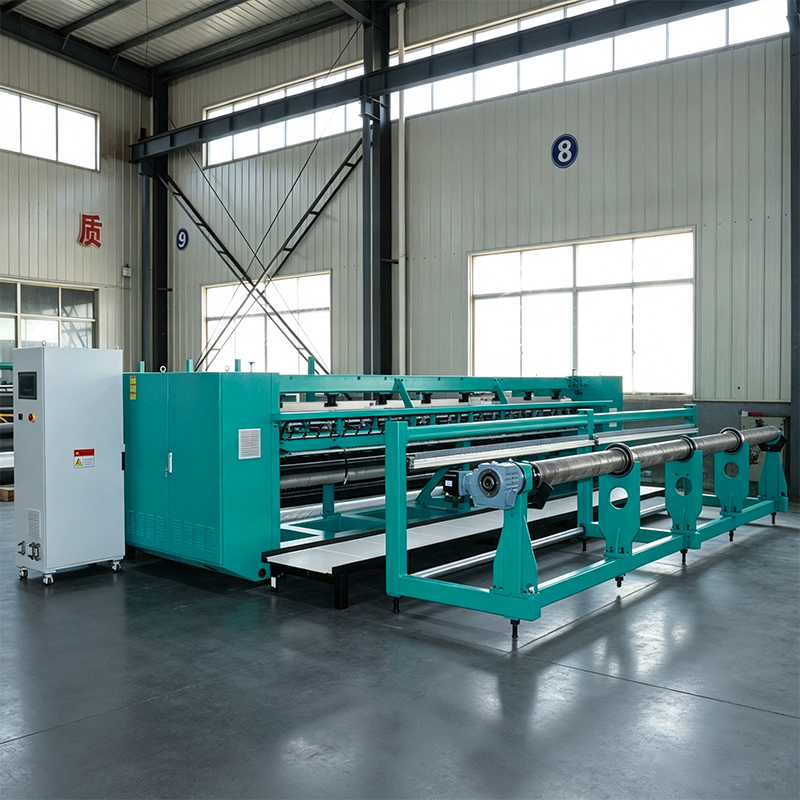
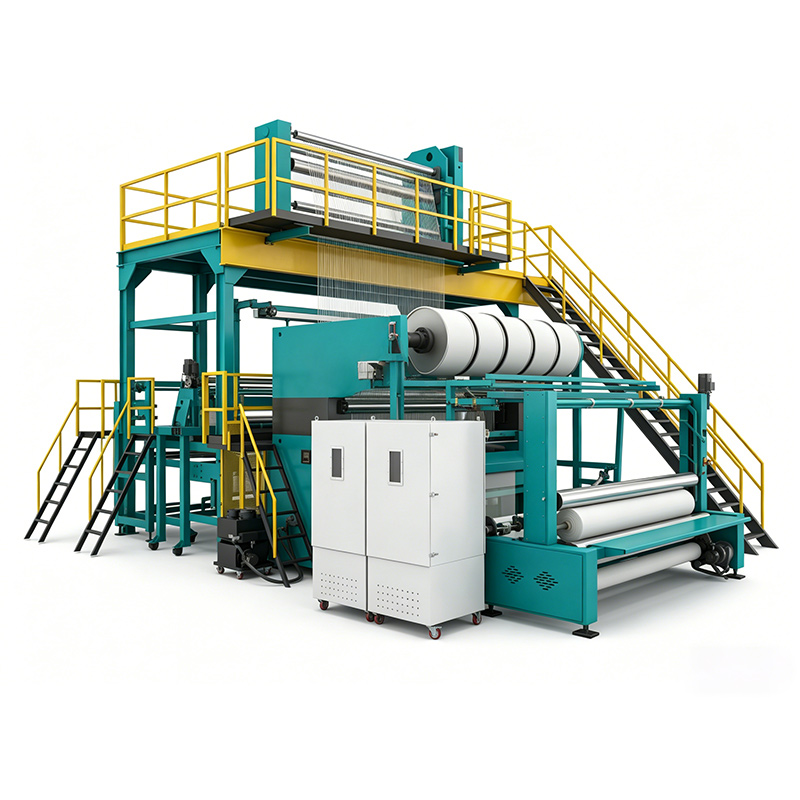
The FB Fiber Web Stitch Bonding Machine is designed for textile manufacturers that need to convert loose chemical fiber webs into stable, high-strength stitch-bonded fabrics. Using a warp-knitting loop mechanism, the machine secures a carded or air-laid web with stitching yarns, creating a coherent fabric structure without relying on chemical binders, drying ovens, or curing systems.
With a working width of up to 4400 mm, a speed range of 50–1200 r/min, and a reference production capacity of approximately 5000 m² per day for a 150 g shoe-material construction, the FB machine offers a practical balance between production flexibility, operating efficiency, fabric performance, and investment value. Its configuration can be adapted to different fiber blends, fabric weights, stitch patterns, production targets, and upstream or downstream equipment.
The machine is suitable for a broad range of applications, including Lixin fabric, wire harness tape, curtain fabrics, home textile stitch-bonded nonwovens, waterproof membrane carriers, shoe materials, interlinings, reinforcement substrates, and other technical textile products made from chemical fibers.
Manufactured by Changzhou Yuanyang Electromechanical Technology Co., Ltd., the FB platform is supported by in-house engineering, controlled production processes, pre-delivery testing, installation assistance, commissioning, operator training, and after-sales technical service. The result is not simply a standard machine, but a configurable production solution developed around the customer’s raw materials, fabric construction, line layout, and quality objectives.
1. The Role of Stitch Bonding in Modern Textile Production
Loose fiber webs are widely used as the starting material for nonwoven and technical textile production. A web may be formed by carding, air laying, or another fiber-distribution process. At this stage, the fibers have a relatively weak relationship with one another. The web may have the desired thickness and surface appearance, but it normally lacks the tensile strength, dimensional stability, tear resistance, and handling properties required for conversion or final use.
Stitch bonding strengthens this web by inserting stitching yarns through its thickness. The yarns are formed into loops by a warp-knitting mechanism and locked into a repeated structure. The resulting fabric combines the bulk and softness of the original web with the mechanical stability of a knitted reinforcement system.
Unlike many binder-based nonwoven processes, stitch bonding does not depend on resin application or thermal curing. This distinction is important for manufacturers that want to preserve the original hand, reduce chemical consumption, simplify the production line, or avoid the need for a drying and curing stage. The bonding principle is mechanical, and the fabric structure can be adjusted through yarn arrangement, stitch pattern, gauge, stitch density, line speed, and web weight.
The FB Fiber Web Stitch Bonding Machine is designed specifically for this production concept. It receives a loose chemical fiber web, guides it into the stitching area, forms warp-knitted loops through the web, and produces a continuous roll of stable stitch-bonded material. The machine can therefore serve as a central production unit between web preparation and downstream processes such as winding, coating, laminating, slitting, printing, or cutting.
2. Core Working Principle of the FB Machine
The production process begins with the preparation of a loose fiber web. Depending on the raw material and product specification, the web may be produced by a carding system, an air-laid system, or another suitable web-forming line. Uniform fiber distribution is essential because variations in basis weight, thickness, orientation, and moisture can influence stitch penetration and final fabric quality.
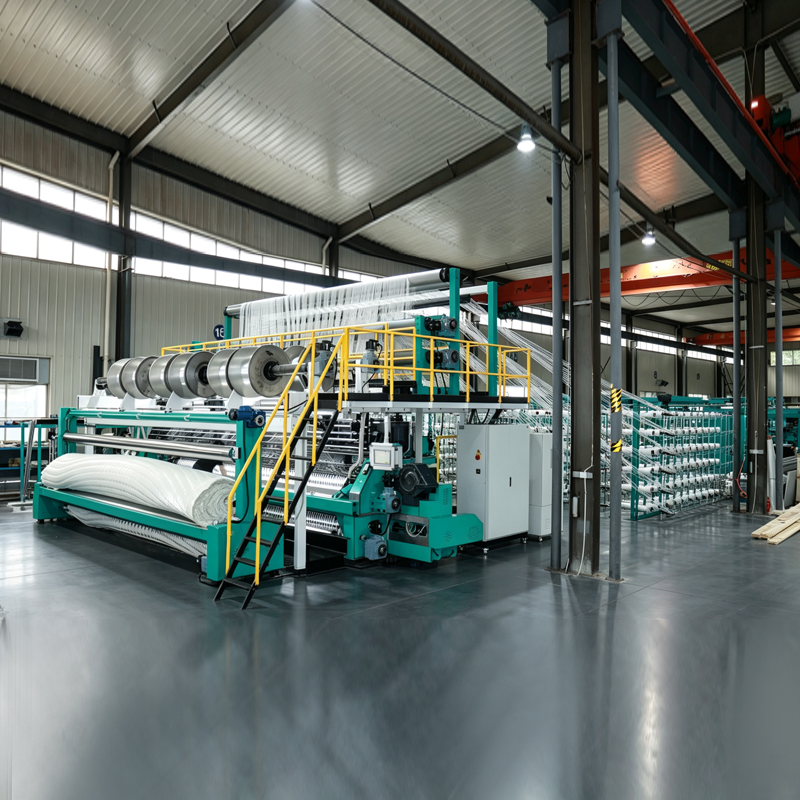
The web is guided into the working zone of the FB machine. Warp yarns are supplied through the yarn path and directed toward the guide bars and loop-forming elements. As the machine operates, the warp-knitting mechanism inserts the yarns through the fiber web and creates a regular loop structure. These loops hold the loose fibers together and distribute stress across the finished fabric.
The structure can be selected according to the required application. A more open stitch arrangement may preserve softness and bulk, while a denser arrangement can improve tensile strength, dimensional stability, and resistance to deformation. The suitable operating point depends on the combination of fiber type, web weight, target thickness, stitch density, yarn count, fabric width, and required output.
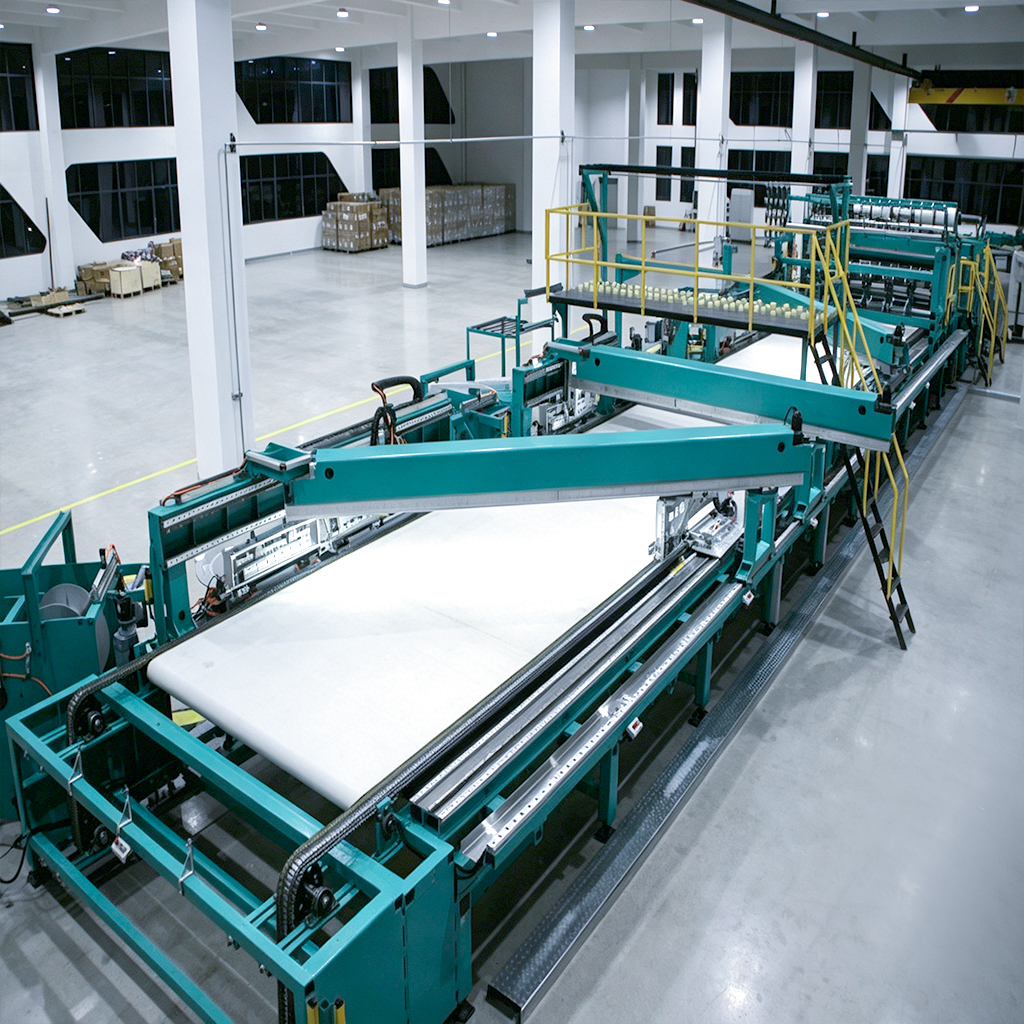
After stitching, the fabric is guided toward the take-up and winding section. The machine can be integrated into a wider production line or configured to match the customer’s existing material-handling equipment. The final roll may then be sent to coating, lamination, slitting, printing, cutting, membrane production, footwear assembly, or other finishing operations.
Because the FB machine uses a warp-knitting loop mechanism, its output is not merely a compressed or glued fiber mat. It is a reinforced textile structure in which stitching yarns provide a stable framework throughout the web. This structure can help the material maintain its integrity during handling and subsequent processing.
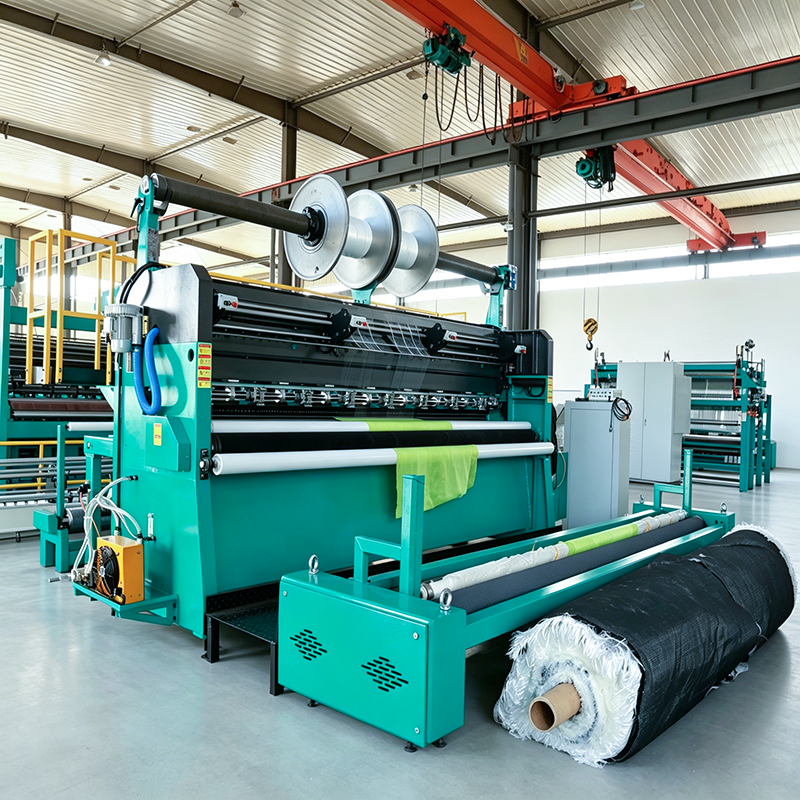
FB Fiber Web Stitch Bonding Machine
3. Main Technical Specifications
The FB Fiber Web Stitch Bonding Machine is designed as a wide-format, adjustable production platform. Its principal specifications are summarized below.
| Parameter | Specification | Production Significance |
|---|---|---|
| Applicable fibers | Chemical fibers and chemical fiber blends | Supports flexible raw-material planning and multiple product types |
| Machine speed | 50–1200 r/min | Allows the operating point to be matched to web weight, stitch density, and fabric construction |
| Working width | 4400 mm, approximately 173 in | Provides wide-format production for technical, home textile, coating, and lamination applications |
| Reference daily output | Approximately 5000 m² for a 150 g shoe-material construction | Provides a production reference; actual output depends on process conditions |
| Bonding method | Warp-knitting loop mechanism | Mechanically secures the fiber web without a chemical binder or curing stage |
| Product form | Continuous stitch-bonded roll goods | Suitable for winding, slitting, coating, laminating, and converting |
The speed range is intentionally broad. A lower operating speed may be appropriate for heavy webs, dense stitch structures, difficult fibers, or products requiring particularly stable stitch formation. A higher speed may be suitable for lighter webs and open structures when the web quality, yarn supply, and machine settings support reliable operation.
The 4400 mm working width allows the machine to produce wide fabric rolls for downstream processes. Wide-format production can reduce the number of longitudinal seams or parallel production lanes required in certain applications. It can also provide greater flexibility for slitting and cutting programs, especially when customers need several narrow finished widths from one parent roll.
The stated daily production figure is a reference value rather than a guaranteed output for every product. Output is affected by the fabric construction, web weight, stitch pattern, machine speed, shift schedule, setup time, material changes, operator practices, and quality requirements. A responsible production calculation should therefore be completed using the customer’s actual material and target construction.
4. Advantages Compared with Binder-Based Web Bonding
The most important advantage of the FB machine is its mechanical bonding principle. Binder-based processes apply chemical materials to the web and may require drying, heating, or curing. The FB machine instead uses stitching yarns and a warp-knitting loop structure to secure the fibers.
This can simplify the production route. A customer may not need a binder preparation system, chemical storage equipment, coating application section, or curing oven for the bonding stage. Reducing the number of process steps can help lower line complexity and may make process control more straightforward.
Mechanical bonding can also help preserve the characteristic hand and bulk of the fiber web. Depending on the formulation and curing conditions, chemical binders may make a material feel harder, stiffer, or less textile-like. The stitch-bonded structure allows the manufacturer to retain a degree of softness while adding strength and dimensional stability.
Another advantage is the absence of binder-related residual chemistry in the bonding stage. This may be valuable in applications where low chemical addition, clean processing, or compatibility with later coating and lamination operations is important. The suitability of the finished fabric must still be verified against the requirements of the specific application, but the machine gives manufacturers a bonding route that does not depend on resin impregnation.
The stitching system also offers structural control. By adjusting the stitching arrangement, yarn path, guide bar configuration, stitch density, and machine settings, the producer can develop fabrics with different balances of tensile strength, elongation, drape, thickness, bulk, and surface character.
Compared with a process designed for only one fixed fabric, the FB platform is more adaptable. It can be configured for different chemical fiber webs, including polyester, polypropylene, viscose, nylon, and blends. Fiber denier, blend ratio, recycled content, web weight, and surface requirements must be evaluated during configuration, but the platform is intended for a broad range of chemical fiber textile production.
5. Advantages Compared with Narrow or Single-Purpose Equipment
Many textile machinery investments are limited by narrow working widths, fixed product configurations, or a restricted range of process conditions. The FB machine is designed to provide greater flexibility in both width and production planning.
Its 4400 mm working width is suitable for manufacturers that supply wide rolls to coating, lamination, membrane, automotive, home textile, and footwear markets. The wide working area can support larger production orders and provide more options for converting the finished fabric into different widths.
The broad speed range also supports different product categories. A single machine may be used for lighter construction materials at a relatively high speed and for heavier or denser materials at a more controlled speed. This does not mean that every product can be produced at the same settings. Instead, the machine provides an operating envelope within which the customer and supplier can identify the appropriate working point.
The FB platform is also suitable for engineered customization. The machine layout can be reviewed against the positions of existing carding systems, web layers, winding units, coating equipment, and material-handling systems. This helps avoid the problems that can occur when a standard machine is installed without sufficient attention to the surrounding line.
Customization may include working width, machine structure, yarn arrangement, guide bar configuration, stitch pattern, drive system, control interface, guarding, color, and functional module integration. The objective is to achieve a practical production line rather than simply deliver a machine with a nominal specification.
These characteristics make the FB machine appropriate for manufacturers that want one versatile stitch-bonding platform capable of supporting several product families. It can be used as an entry point for chemical fiber stitch bonding and can also serve as a foundation for future product development.
6. Raw Materials and Fiber Compatibility
The FB machine is intended for chemical fibers and chemical fiber blends. Common materials include polyester, polypropylene, viscose, nylon, and combinations of these fibers. Recycled content can also be considered, although recycled fibers may have different length distributions, crimp characteristics, strength levels, and carding behavior compared with virgin materials.
Fiber denier is a major factor in configuration. Fine fibers may provide a soft surface and high coverage, but they can require careful control of web formation and stitch penetration. Coarser fibers may provide a more open or resilient structure, but they can influence thickness, needle selection, and the force needed for stable stitching.
Blend ratio is also important. A polyester-viscose blend, for example, may behave differently from a 100 percent polyester web during carding, web transport, and stitch formation. The fiber blend can affect the cohesion of the loose web before stitching and the mechanical behavior of the finished fabric after stitching.
Recycled fiber content should be considered at the beginning of the project rather than after the machine has been selected. Variations in fiber length and contamination levels may affect web uniformity, needle wear, yarn tension, and production stability. A suitable raw-material evaluation allows the machine configuration and process parameters to be selected more accurately.
The supplier normally requires information about fiber type, denier, blend percentage, recycled content, web width, web weight, target fabric thickness, and intended application. Samples of the raw web or finished fabric are especially useful for confirming the operating concept.
7. Product Applications
7.1 Lixin Fabric and Interlinings
Stitch-bonded fabric can be used for interlining and reinforcement products where dimensional stability, controlled thickness, and reliable handling are important. The FB machine can produce webs that are later coated, laminated, treated, or cut according to the requirements of apparel, industrial, or household products.
The mechanical stitch structure helps the fabric resist distortion during handling. Depending on the selected construction, the finished material can retain a soft hand while providing support to the outer fabric. The final performance depends on fiber selection, stitch density, finishing, and the specific interlining design.
7.2 Wire Harness Tape
Wire harness tape requires a consistent substrate that can be slit into narrow widths and wrapped around cable assemblies. A stitch-bonded nonwoven can provide a stable carrier for this type of product. Uniform web formation and controlled thickness are important because variations may affect slitting, winding, coating, and application around the harness.
The FB machine’s wide working width allows manufacturers to produce a parent roll and convert it into multiple narrow rolls. The stitch-bonded structure can provide the necessary cohesion for handling while maintaining a flexible textile character.
7.3 Curtain and Home Textile Fabrics
Home textile applications often require a combination of appearance, softness, strength, and dimensional stability. Stitch-bonded curtain fabrics can be developed with different surface effects, yarn arrangements, weights, and finishing treatments.
The FB machine can support fabrics that are later printed, dyed, coated, laminated, or otherwise finished. The selected fiber blend and stitch pattern influence drape, surface texture, opacity, and resistance to distortion. Process development should therefore consider the complete finishing route rather than only the stitching stage.
7.4 Waterproof Membranes
Waterproof membrane systems frequently use textile carriers or reinforcement layers. These carriers must have sufficient stability for coating and lamination, while maintaining the required flexibility and dimensional control.
A stitch-bonded web can serve as a supporting layer for a membrane structure. The machine can be integrated with downstream coating or lamination equipment, subject to the required line layout and material compatibility. The final waterproof performance comes from the membrane system as a whole, but the stitch-bonded carrier can contribute to handling strength and dimensional stability.
7.5 Shoe Materials
Shoe materials are one of the stated applications for the FB machine. The reference production value of approximately 5000 m² per day is based on a 150 g shoe-material construction. Footwear components may require a combination of low weight, flexibility, tear resistance, surface consistency, and compatibility with adhesive or lamination processes.
The FB machine can be adjusted to create the required balance between bulk and strength. The suitable construction depends on whether the material is intended for an upper component, lining, reinforcement, insole-related application, or another footwear part.
7.6 Technical Nonwoven Products
Beyond the listed applications, the machine can support other technical nonwoven products made from chemical fibers. Potential product development areas include reinforcement substrates, industrial coverings, protective layers, insulation-related carriers, filter-support fabrics, and composite textile structures.
Each application must be evaluated independently. A fabric designed for a soft home textile product may require very different yarn, gauge, stitch density, and finishing conditions from a fabric intended for automotive or membrane reinforcement.
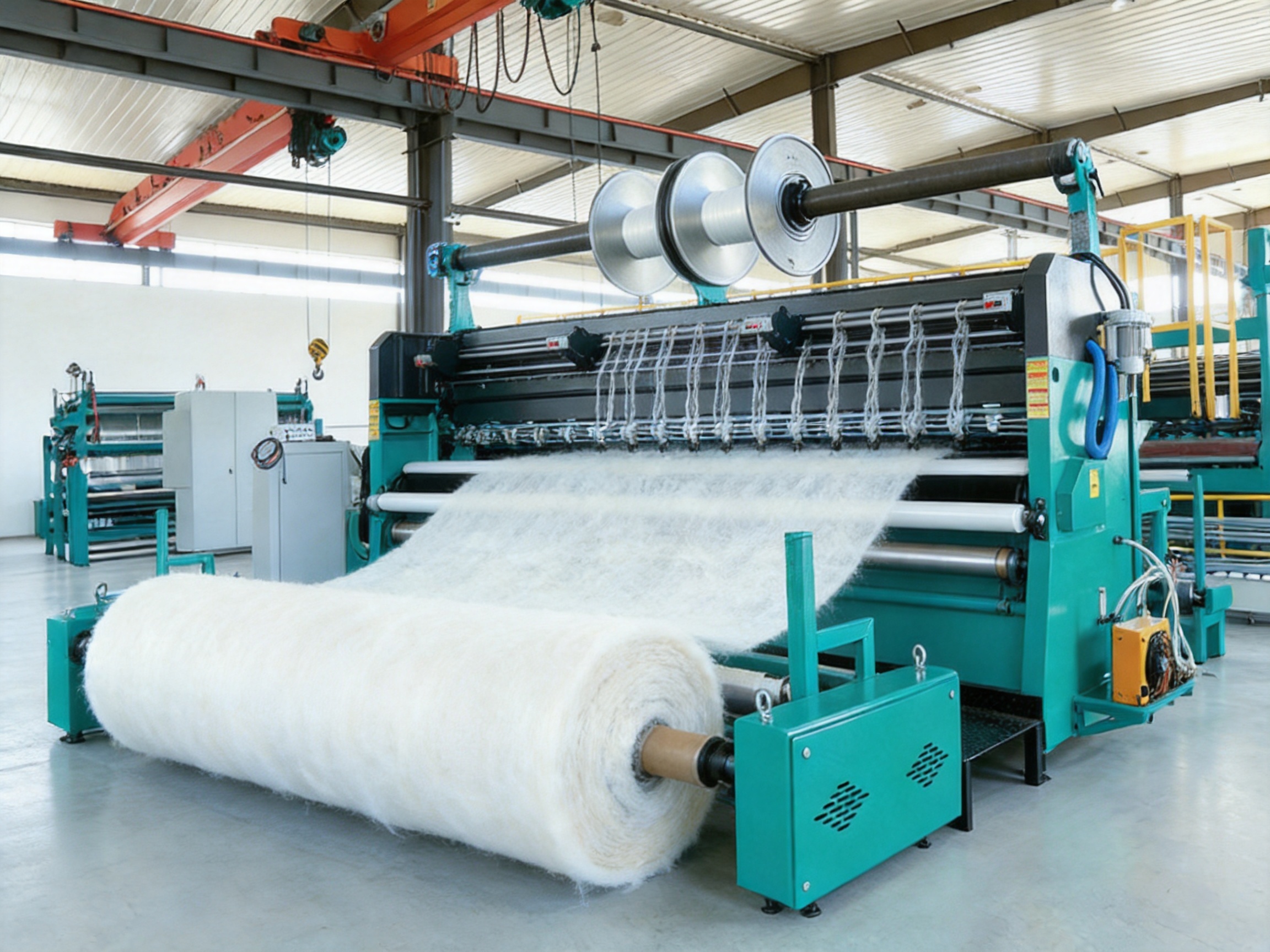
8. Configuration and Process Engineering
The FB machine is configured according to production requirements rather than supplied as a completely fixed catalogue unit. This approach is important because stitch-bonding performance depends on the relationship between the machine and the rest of the production line.
The first consideration is the upstream web-forming process. The web may arrive from carding, cross-lapping, air laying, or another system. The machine layout must accommodate the web width, delivery height, transport direction, tension behavior, and roll or sheet handling method.
The second consideration is the desired fabric construction. The customer should identify the target basis weight, thickness, tensile strength, elongation, tear strength, surface character, stitch pattern, and finished width. These requirements guide the choice of yarn path, guide bar arrangement, gauge, stitch density, and operating range.
The third consideration is the downstream process. The finished roll may go to winding, slitting, coating, laminating, printing, dyeing, cutting, or direct assembly. The machine layout and control interface should be designed so that roll handling, tension control, edge alignment, and production data can be managed effectively.
The fourth consideration is the production target. Daily output should be calculated from the actual construction, shift schedule, expected efficiency, setup time, maintenance requirements, and quality inspection procedure. A high nominal speed does not automatically produce the lowest cost per square meter if the machine is operating outside a stable quality range.
| Configuration Input | Required Information | Why It Matters |
|---|---|---|
| Fiber specification | Fiber type, denier, blend ratio, recycled content, and fiber length | Influences web formation, needle selection, and stitch stability |
| Web characteristics | Basis weight, width, thickness, uniformity, and delivery method | Determines machine working conditions and web handling requirements |
| Fabric construction | Stitch pattern, gauge, yarn type, strength, and elongation target | Defines the loop-forming arrangement and product performance |
| Production target | Daily output, shift pattern, product mix, and utilization rate | Supports realistic capacity and investment calculations |
| Line interface | Upstream carding or web laying and downstream winding or coating | Determines layout, material flow, and control integration |
| Factory conditions | Power supply, compressed air, floor space, lifting access, and environmental conditions | Confirms installation feasibility |
| Samples and drawings | Raw web samples, finished fabric samples, product drawings, or line layouts | Provides a practical basis for engineering confirmation |
9. Manufacturing Strengths and Production Control
The performance of a textile machine depends not only on its design but also on how accurately it is manufactured, assembled, tested, and supported. Changzhou Yuanyang Electromechanical Technology Co., Ltd. operates a production base in Jiangsu with an area of more than 12,000 square meters and an annual capacity of more than 200 sets.
The company integrates research and development, manufacturing, sales, installation, commissioning, and after-sales service. This integrated structure allows technical information to move between engineering and production teams during the machine-building process. It also enables customer feedback from installation and operation to influence later design improvements.
Manufacturing control begins with component procurement. Components must meet the technical requirements established for the machine design. Critical items associated with the drive system, loop-forming mechanism, yarn guidance, web transport, control system, and machine frame require appropriate inspection and verification before assembly.
During production, the machine structure is assembled and adjusted according to engineering drawings and process requirements. Alignment, mechanical clearances, transmission behavior, yarn-path geometry, and access for maintenance all influence the final performance of the equipment.
Assembly is followed by testing and debugging. The machine must be checked for operating stability, movement accuracy, control response, yarn handling, web transport, and the interaction of the principal working components. Where customer samples or target constructions are available, these can help guide the pre-delivery verification process.
The company maintains a dedicated inspection room and an intelligent warehouse with digital control of warehousing, storage, sorting, inventory checking, and delivery. These systems support orderly material management and help improve the traceability and consistency of machine production.
Every machine is tested before leaving the factory. Pre-delivery verification reduces the risk of discovering basic mechanical or control problems after installation at the customer’s site. It also gives engineers an opportunity to record the initial process settings and prepare the machine for commissioning.
10. Engineering and Customization Capabilities
Yuanyang specializes in warp-knitting equipment and related machinery, including stitch-bonding machines, biaxial warp-knitting machines, multiaxial warp-knitting machines, carbon fiber multiaxial warp-knitting machines, powder scattering machines, web-laying machines, and customized textile equipment.
This product background is valuable because the FB machine is normally part of a wider textile production system. Customers may need to coordinate web formation, stitching, powder application, coating, lamination, winding, or other processes. Experience across related equipment categories helps engineers consider the complete line rather than treating the stitch-bonding machine as an isolated unit.
Customization can include non-standard machine dimensions, special material handling, unusual fabric constructions, modified line layouts, special guarding, control interfaces, and integration with existing equipment. The company also provides customized solutions for high-precision warp-knitting accessories and special equipment.
Before manufacturing begins, the supplier can review technical information, prepare a machine configuration, confirm the proposed layout, and produce three-dimensional drawings for approval. This process allows potential interference, access, material-flow, and installation issues to be identified at an early stage.
Engineering attention is particularly important for difficult-to-process fibers, complex fabric designs, high recycled content, unusual web weights, and products that must operate continuously for long production campaigns. A configuration based only on a general catalogue specification may not provide sufficient process stability for such applications.
11. Installation, Commissioning, and Operator Training
Installation is an important part of machine performance. The FB machine must be positioned accurately, connected to the appropriate utilities, aligned with the upstream and downstream equipment, and adjusted according to the approved layout.
After the equipment reaches the customer’s factory, an assigned engineer can support installation and commissioning. The engineer works with the customer’s team to establish the operating conditions, check material flow, adjust the yarn path, confirm machine synchronization, and verify the quality of the stitch-bonded fabric.
Commissioning continues until the line reaches the agreed working point. This may involve adjustments to machine speed, web tension, yarn tension, stitch density, guide bar settings, winding conditions, and other process parameters. The exact procedure depends on the product and the customer’s line configuration.
Training covers machine operation, routine adjustment, inspection, cleaning, lubrication, troubleshooting, quality control, and production records. Maintenance personnel receive guidance on wear components, adjustment procedures, replacement methods, and preventive maintenance schedules.
Longer training programs of one to two months can be arranged at the company’s fabrication workshop. These programs may include knitter operation, maintenance practice, workshop management, quality control, production planning, and process parameter management.
The company can also assist customers in establishing and compiling quality system documentation. Clear documentation helps operators reproduce approved settings, trace production conditions, record maintenance activities, and respond to quality deviations.
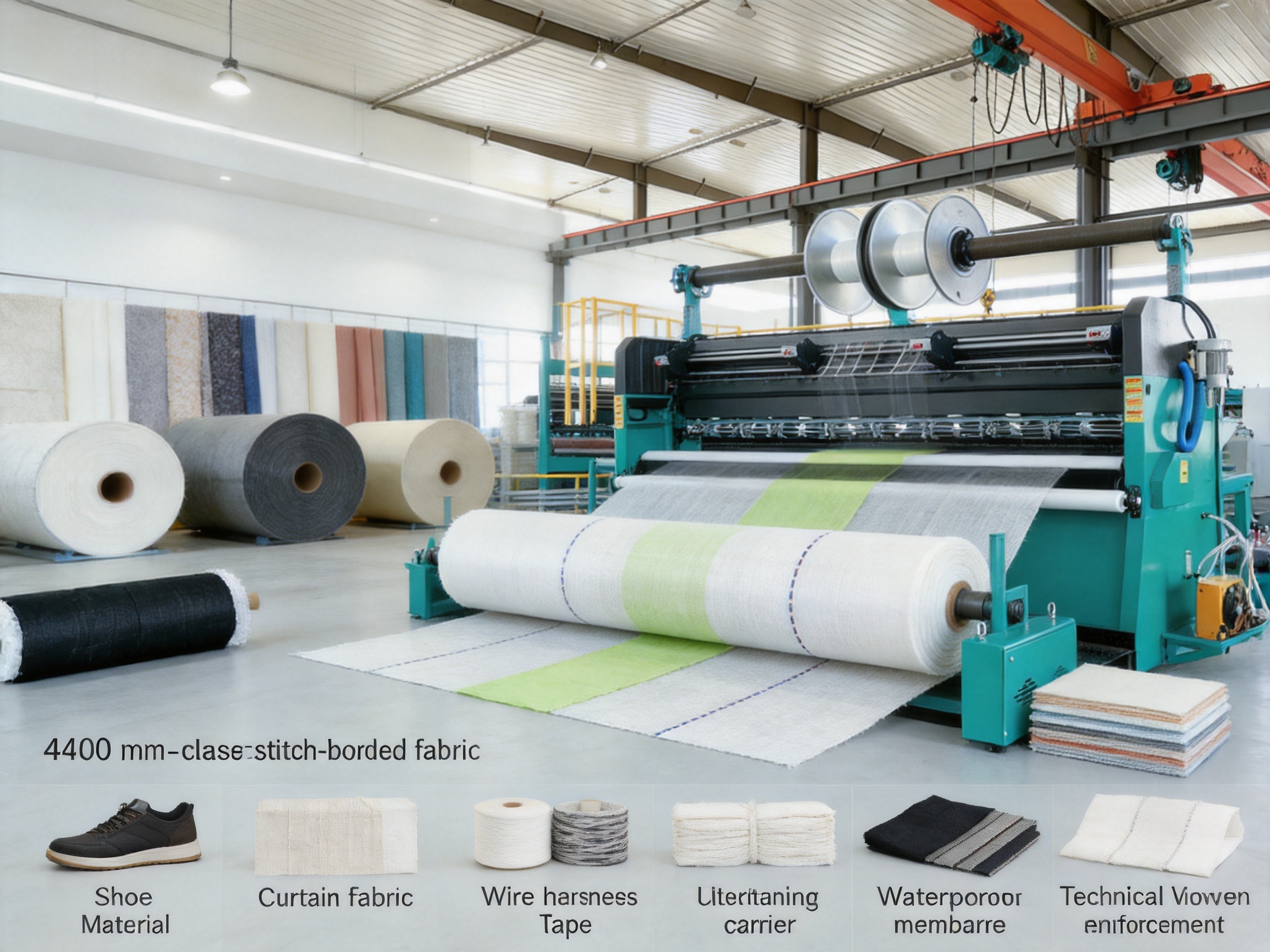
12. Maintenance and Serviceability
A stitch-bonding machine operates with repeated high-speed movement in the loop-forming and yarn-guidance systems. Regular maintenance is therefore essential for stable production, consistent fabric quality, and controlled operating costs.
Needles and loop-forming elements are among the primary wear components. The machine is designed so that access to these components can be planned without unnecessary dismantling of the web path. Efficient access helps reduce maintenance time and supports faster recovery when a worn or damaged element must be replaced.
Guide bars, yarn tensioners, and feed rollers should be checked during routine maintenance. Their settings established during commissioning should be recorded in a process sheet. Maintaining a record of approved settings makes it easier to restore the machine after maintenance, material changes, or an extended shutdown.
Lubrication points and drive components should follow a scheduled routine. The schedule should specify inspection frequency, lubricant type where applicable, cleaning requirements, and the person responsible for each task. Preventive maintenance is generally more effective than waiting for a component failure to interrupt production.
Operators should also monitor fabric quality. Changes in stitch appearance, edge alignment, width, tension, surface consistency, or roll hardness may indicate a problem in the web, yarn supply, guide system, loop-forming area, take-up, or winding section.
Spare parts and technical support are handled through the after-sales service system and regional service arrangements. Remote communication can help engineers understand operating symptoms, while on-site support may be required for more complex mechanical, electrical, or process issues.
13. Quality Management from Component to Finished Machine
Quality control should cover the full manufacturing route rather than only the final inspection. The company applies controlled procedures from component procurement through production, assembly, testing, and debugging.
Incoming components are reviewed according to their importance and technical requirements. During assembly, technicians check the fit and alignment of mechanical parts, the installation of transmission components, the routing of yarn-related systems, and the connection of control and electrical components.
Testing verifies that the machine responds correctly to operating commands and that the working mechanisms function as intended. Mechanical movement, drive operation, control response, safety functions, yarn guidance, web transport, and winding behavior all require attention.
Where a customer has supplied fabric samples, drawings, or defined production parameters, these materials provide a basis for comparing the machine’s operating behavior against the intended application. Although factory testing cannot reproduce every condition of the customer’s plant, it can reduce uncertainty before shipment.
The company’s inspection room and digital warehouse support the organization of production and delivery activities. Accurate warehousing and inventory records help ensure that the correct components, spare parts, accessories, and documentation are prepared for each machine.
14. Operating Performance and Production Economics
The economic value of the FB machine should be assessed by considering more than the purchase price. Important factors include usable output, fabric quality, energy consumption, labor requirements, material utilization, maintenance cost, changeover time, binder or chemical savings, and compatibility with existing production assets.
The mechanical bonding principle can reduce the need for binder-related equipment and process stages. Depending on the customer’s previous production method, this may simplify the factory layout and reduce some operating requirements. The actual economic benefit must be calculated using local energy prices, chemical costs, labor rates, product specifications, and production volumes.
Wide working width can contribute to efficient production when the customer has a market for wide rolls or multiple slit widths. It may reduce the number of machine passes needed for a given order and provide greater flexibility in downstream converting.
Flexible speed control can also support economic operation. Running at the highest possible speed is not always the best choice if it causes excessive defects, yarn breaks, unstable web handling, or accelerated wear. A stable operating point that produces acceptable quality may result in better practical output and lower cost per qualified square meter.
Production planning should include the time required for cleaning, inspection, yarn changes, web changes, setup, roll handling, and preventive maintenance. These factors influence the difference between theoretical capacity and sellable production.
15. Practical Comparison with Alternative Bonding Methods
| Evaluation Item | Stitch Bonding with the FB Machine | Binder-Based Web Bonding | Typical Consideration |
|---|---|---|---|
| Bonding principle | Warp-knitted yarn loops mechanically secure the web | Chemical binder adheres fibers together | The required fabric hand and chemical profile influence the choice |
| Drying or curing | Not required for the mechanical bonding stage | May require drying, heating, or curing | Line complexity and energy use may differ |
| Structure control | Controlled through yarns, stitch pattern, gauge, and density | Controlled through binder distribution and thermal conditions | Different methods provide different performance balances |
| Raw-material flexibility | Chemical fibers and blends, subject to process evaluation | Depends on fiber compatibility with the binder system | Fiber blend and final application must be reviewed |
| Fabric character | Can preserve bulk and a textile-like hand | May become firmer or stiffer after binder application | Final finishing and formulation remain important |
| Downstream compatibility | Suitable for winding, slitting, coating, and lamination | May require compatibility checks with residual binder chemistry | Composite construction should be considered as a whole |
This comparison is not intended to suggest that one bonding technology replaces every other technology. Different products require different processes. The advantage of the FB machine is that it gives chemical fiber textile manufacturers an efficient mechanical bonding option with broad structural flexibility and a reduced dependence on chemical bonding stages.
16. Recommended Project Development Process
A successful FB machine project should begin with a clear description of the intended product. The customer should define the application, finished width, basis weight, thickness, tensile targets, elongation, surface requirements, and expected annual production.
The next step is to provide information about the raw material. Fiber type, denier, blend ratio, recycled content, fiber length, and web-forming method help determine whether additional testing or special handling is required.
Fabric samples are highly valuable. A sample of the desired finished product allows the engineering team to understand the required construction, surface character, strength, flexibility, and downstream compatibility. If a finished sample is not available, a drawing or technical specification can be used as a starting point.
The line layout should then be reviewed. The positions of the carding machine, web layer, stitch-bonding machine, winding equipment, coating unit, lamination equipment, slitter, and storage areas must be considered together. Floor space, lifting access, operator walkways, maintenance clearance, and material flow are all relevant.
After the technical review, the supplier prepares the proposed configuration and quotation. Three-dimensional drawings or layout drawings can be developed for customer approval before manufacturing. This stage provides an opportunity to clarify interfaces and minimize later changes.
Once the machine is manufactured and tested, it is prepared for shipment with the appropriate documentation, spare parts, settings, and installation information. On-site commissioning and training then complete the project.
17. Frequently Asked Questions
What fibers can the FB Fiber Web Stitch Bonding Machine process?
The machine is designed for chemical fibers and chemical fiber blends. Typical materials include polyester, polypropylene, viscose, nylon, and combinations of these fibers. Recycled content may also be considered, but the fiber characteristics should be reviewed because they can affect web formation, needle selection, yarn behavior, and machine settings.
Does the machine use chemical binders?
No. The FB machine secures the loose fiber web through a warp-knitting loop mechanism. Stitching yarns pass through the web and form a stable loop structure. A chemical binder and a curing oven are not required for the mechanical bonding stage.
What is the standard working width?
The stated working width is 4400 mm, or approximately 173 inches. The final machine structure and line layout can be reviewed when the customer’s upstream and downstream equipment requires a special arrangement or a different working width.
What is the expected daily production?
The reference output is approximately 5000 m² per day for a 150 g shoe-material construction. Actual output depends on web weight, stitch density, fabric construction, operating speed, shift pattern, setup time, material changes, and quality requirements. A project-specific output calculation should be completed before ordering.
Can the machine produce different types of fabric?
Yes. The FB platform is intended for multiple stitch-bonded chemical fiber products. Different products require different yarn arrangements, stitch patterns, web weights, speeds, and finishing processes. The machine should be configured around the customer’s product range and planned production mix.
What applications are suitable for the machine?
Applications include Lixin fabric, interlinings, wire harness tape, curtain fabrics, home textile stitch-bonded nonwovens, waterproof membrane carriers, shoe materials, reinforcement substrates, and other technical fabrics made from chemical fibers.
How does the machine compare with binder-based bonding?
The FB machine uses mechanical stitching rather than chemical adhesion. It can eliminate the binder application and curing stage for the bonding process, preserve web bulk and hand, and provide structural control through yarn and stitch settings. The best choice depends on the required product performance and the complete manufacturing route.
Can the machine be integrated with an existing production line?
Yes. The machine layout and control interface can be reviewed in relation to upstream carding or web-laying equipment and downstream winding, coating, laminating, or slitting systems. Customers should provide line drawings, equipment dimensions, material-flow information, and utility details during the engineering stage.
What information is needed for a quotation?
Useful information includes the fiber type and blend, denier, recycled content, web weight, web width, target fabric construction, stitch pattern, finished width, production target, upstream and downstream equipment, factory utilities, available floor space, and samples or drawings.
What installation and training support is available?
An engineer can be assigned to support installation, commissioning, and training at the customer’s factory. Training covers operation, maintenance, process adjustment, quality control, and production management. One- to two-month training programs can also be arranged at the fabrication workshop.
Which components require the most maintenance?
Needles and loop-forming elements are important wear components. Guide bars, yarn tensioners, feed rollers, drive components, and lubrication points should also be inspected according to the maintenance schedule. Recording approved settings during commissioning helps operators restore stable conditions after maintenance.
Can the machine be customized?
Customization may include machine structure, working width, layout, stitch pattern, gauge, yarn path, guide bar arrangement, special fiber handling, drive and control interfaces, guarding, color, and functional module integration. The actual scope depends on the product and line requirements.
18. Conclusion
The FB Fiber Web Stitch Bonding Machine provides a flexible and efficient method for converting loose chemical fiber webs into stable, high-strength textile structures. Its warp-knitting loop mechanism avoids the need for chemical binders in the bonding stage and gives manufacturers control over stitch arrangement, fabric density, strength, bulk, and surface character.
With a speed range of 50–1200 r/min, a 4400 mm working width, and a reference output of approximately 5000 m² per day for a 150 g shoe-material construction, the machine can serve a broad range of production requirements. Its applications extend from shoe materials and wire harness tape to curtain fabrics, interlinings, waterproof membrane carriers, and technical nonwovens.
The principal advantage of the FB platform is its combination of mechanical bonding, broad raw-material compatibility, wide-format production, configurable construction, and practical line integration. These features allow textile manufacturers to develop several product families on one adaptable equipment platform rather than relying on a narrow, single-purpose machine.
Manufacturing quality and engineering support are equally important. In-house research and development, controlled component procurement, structured assembly, pre-delivery testing, digital warehouse management, installation assistance, commissioning, training, documentation, and after-sales service all contribute to the machine’s long-term value.
For customers evaluating a stitch-bonding investment, the most reliable approach is to begin with the complete production requirement. Fiber specifications, web characteristics, fabric construction, output target, line interface, factory conditions, and finished-product samples should be reviewed together. With this information, the FB machine can be configured as a practical, scalable, and application-oriented solution for modern chemical fiber textile production.
References
1. Changzhou Yuanyang Electromechanical Technology Co., Ltd., FB Fiber Web Stitch Bonding Machine Product Information.
2. Changzhou Yuanyang Electromechanical Technology Co., Ltd., Company Manufacturing and Service Information.
3. Technical documentation concerning warp-knitting loop formation and stitch-bonded textile structures.
4. General production principles for chemical fiber webs, nonwoven substrates, coating carriers, and textile reinforcement fabrics.
5. General maintenance and commissioning practices for warp-knitting and stitch-bonding machinery.
Product: FB Fiber Web Stitch Bonding Machine

News
-
Three quotations land on the same desk for the same polyester nonwoven line, and on paper they look interchangeable. Each is priced per metre of working width. Each quotes a similar top speed. Each c...
READ MORE -
Which Machine Category Matches Each Technical Fiber and Fabric Goal A warp knitting machine is the primary production platform for technical fiber textiles across fiberglass, chemical fiber, and carbo...
READ MORE -
Two quotations land on the same desk. Both offer a multiaxial warp knitting line, both list the same working width, both promise high output. One buyer signs and discovers six months later that the f...
READ MORE -
What a Stitch Bonding Machine Does A stitch bonding machine is a warp knitting type machine that uses knitting needles and a stitching yarn to hold a web of fibers, a layer of chopped strands, or a la...
READ MORE
-
Contact Info.
+86-198 5534 1617
+86-134 0158 3002yuanyang@yywarpknitting.com 699#, Shengzhi West Rd, Lvcheng Town, Danyang City, Zhenjiang City, Jiangsu Province, China

-
QR Code
-
Quick Links
Home About Products Manufacturing Customization News Contact -
Product List
Machine for Chemical Fiber Textile Machine for Fiberglass Textile Machine for Carbon Fiber Textile -
About Us
Company Profile Factory Gallery Value-added Service
Copyright © 2026 Changzhou Yuanyang Electromechanical Technology Co., Ltd. All Rights Reserved.
Custom Warp Knitting Machine Manufacturers
