

 English
 中文简体
 русский
 Français
 Español
 Deutsch

YRS3-M-B Raschel Banner Biaxial Warp Knitting Machine: Complete Guide to Production, Performance, and Industrial Applications
2026-10-03
Content
- 1 1. The Role of Biaxial Warp Knitting in Banner Fabric Production
- 2 2. Main Technical Specifications
- 3 3. Productivity Advantages of the YRS3-M-B
- 4 4. Fabric Quality and Mesh Regularity
- 5 5. Applications of the YRS3-M-B
- 6 6. Configuration Options for Different Production Requirements
- 7 7. Manufacturing Strengths Behind the Machine
- 8 8. Quality Control and Pre-Delivery Testing
- 9 9. Installation, Commissioning, and Training
- 10 10. Maintenance and Long-Term Service
- 11 11. Advantages Compared with Less Specialized Equipment
- 12 12. Recommended Purchasing and Configuration Process
- 13 13. Practical Production Recommendations
- 14 14. Environmental and Operational Considerations
- 15 15. Frequently Asked Questions
- 15.1 What products can the YRS3-M-B produce?
- 15.2 What is the confirmed working width?
- 15.3 What is the machine speed range?
- 15.4 What daily output can be expected?
- 15.5 Can the machine use coarse high-tenacity polyester yarn?
- 15.6 Is the fabric coated inside the machine?
- 15.7 Can the machine be customized?
- 15.8 What information is needed for a quotation?
- 15.9 How is installation performed?
- 15.10 Is training available away from the customer’s factory?
- 15.11 What quality checks are performed before shipment?
- 15.12 What support is available after delivery?
- 16 16. Conclusion
- 17 References
- 18 Product: YRS3-M-B Raschel Banner Biaxial Warp Knitting Machine
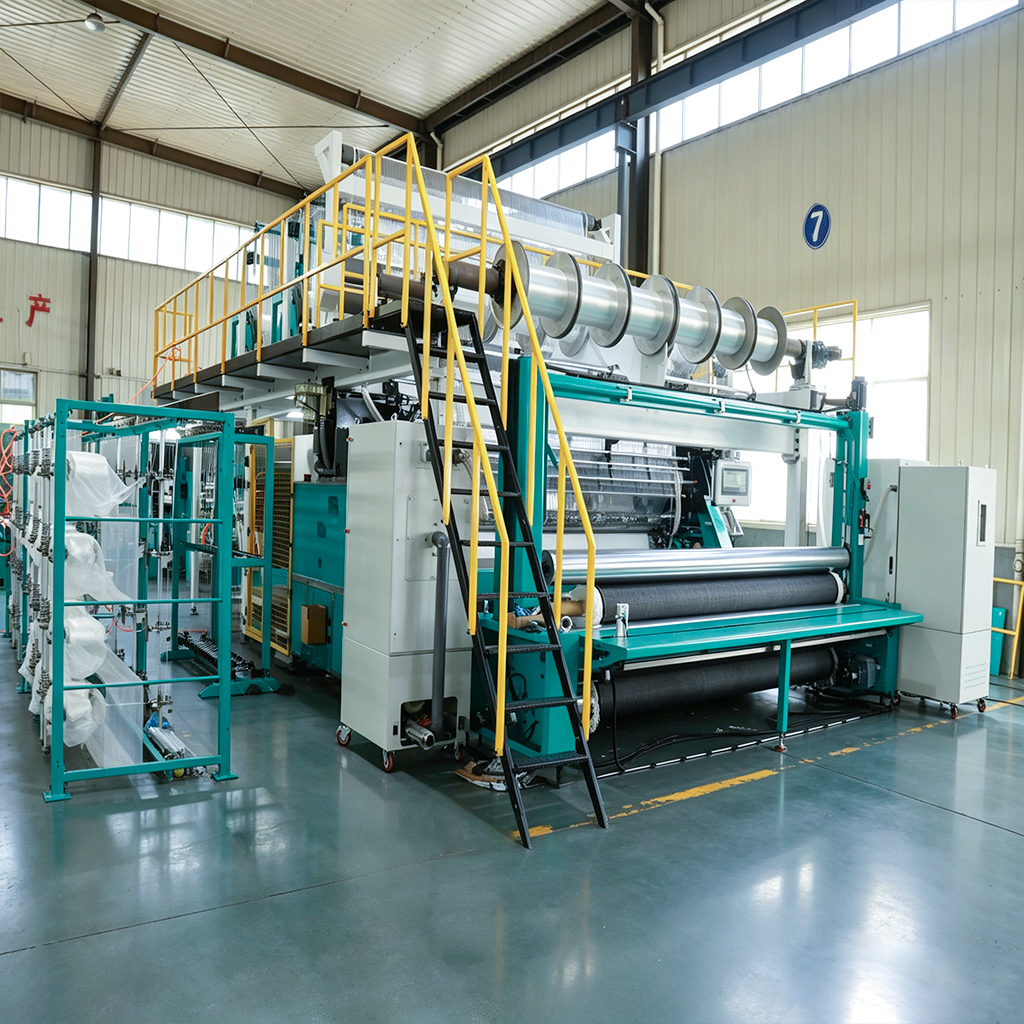
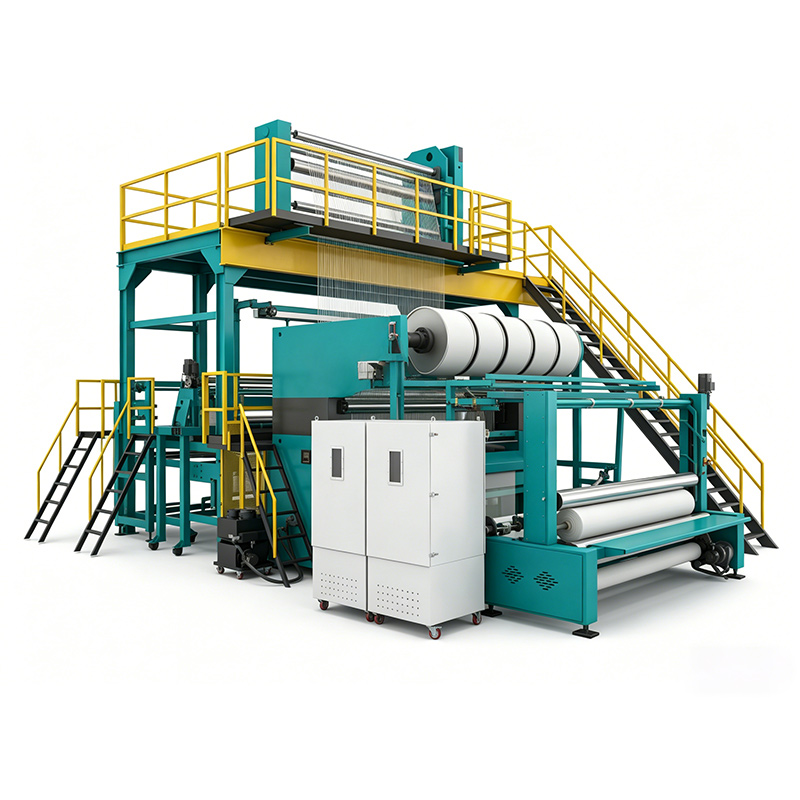
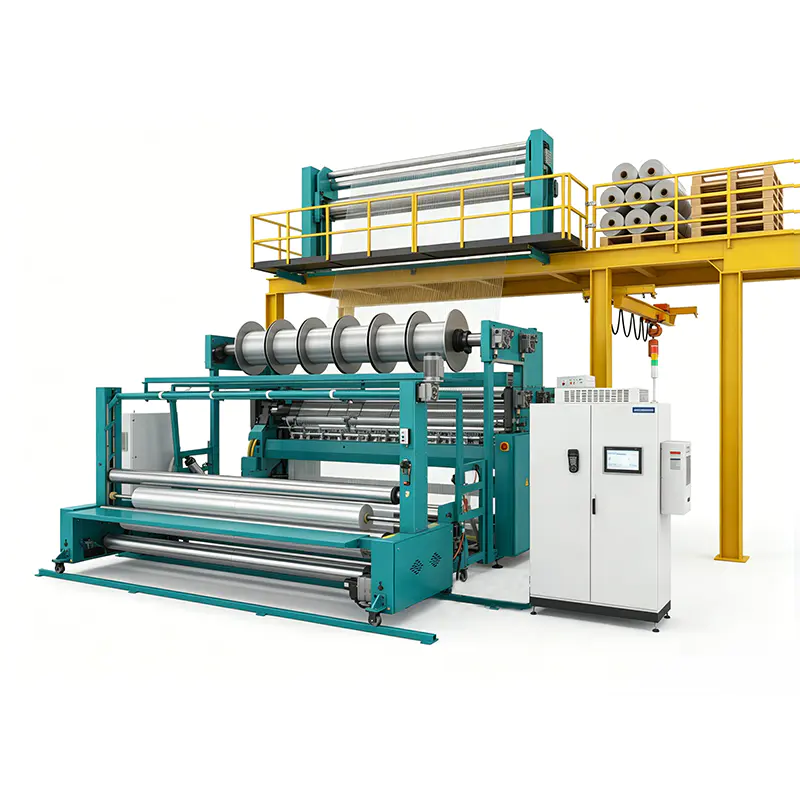
The YRS3-M-B Raschel Banner Biaxial Warp Knitting Machine is designed for manufacturers producing high-strength square-mesh fabrics for PVC-coated flex banners, lightbox advertising cloth, truck tarpaulins, side curtains, and related industrial textile products. It combines biaxial yarn reinforcement, high-speed Raschel knitting technology, broad working width, and production-oriented control systems in one specialized machine platform.
The machine uses high-tenacity polyester filaments as the primary reinforcing warp and weft yarns. These yarns are knitted together at right angles to create a stable square-mesh fabric. After knitting, the open scrim is coated with PVC or another suitable compound to create a durable finished material with improved dimensional stability, tear resistance, printability, and resistance to deformation during handling and outdoor use.
Unlike a basic mesh-forming machine that focuses only on yarn placement, the YRS3-M-B is engineered around the complete manufacturing process. Its design considers yarn tension, mesh regularity, machine speed, fabric take-off, coating compatibility, production continuity, and integration with downstream finishing equipment. This approach helps manufacturers achieve consistent fabric quality while maintaining high productivity.
Changzhou Yuanyang Electromechanical Technology Co., Ltd. manufactures the YRS3-M-B as part of its broader range of warp knitting and industrial textile machinery. The company combines equipment design, fabrication, assembly, testing, customization, installation, and after-sales support, allowing the machine to be configured around the customer’s fabric construction and production line instead of being supplied only as a fixed catalogue model.
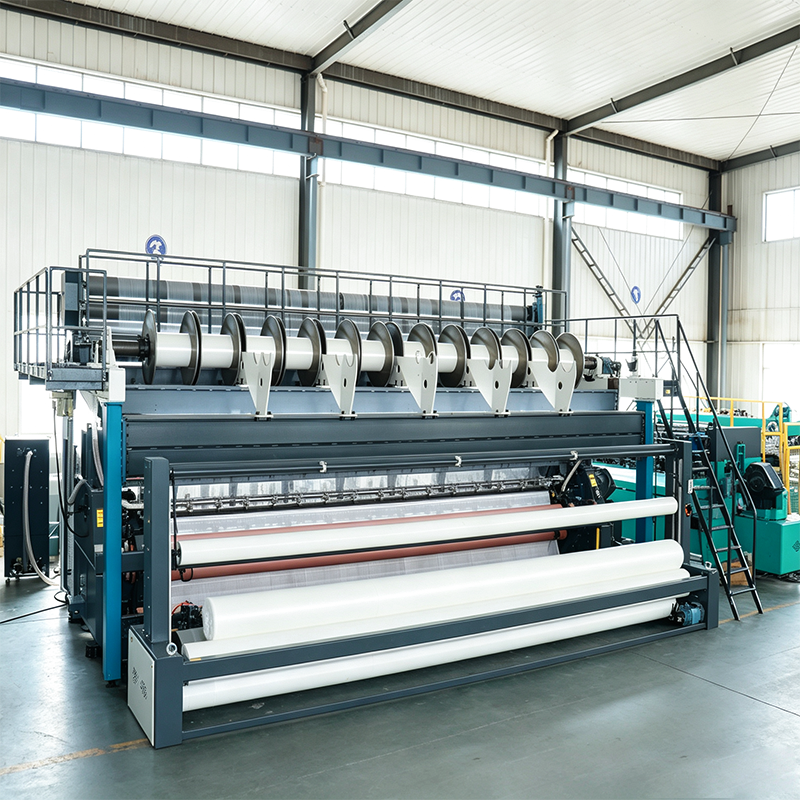
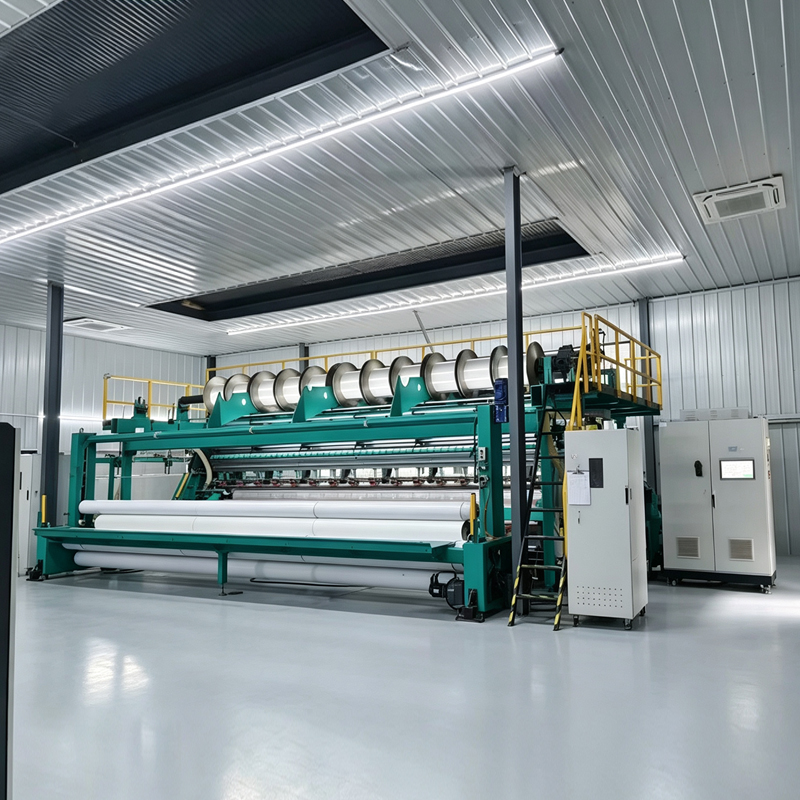
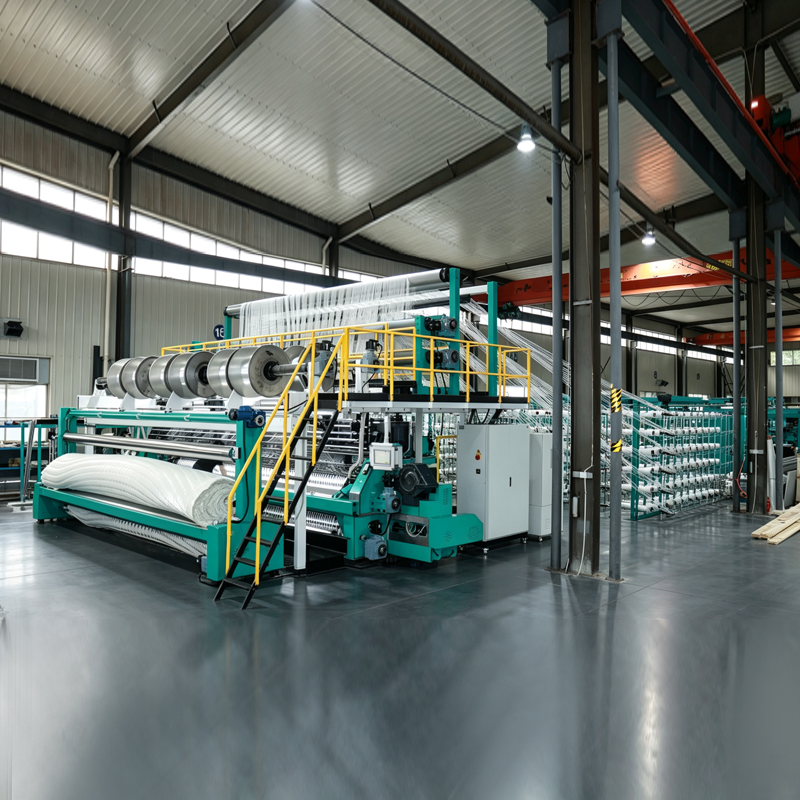
YRS3-M-B Raschel Banner Biaxial Warp Knitting Machine
1. The Role of Biaxial Warp Knitting in Banner Fabric Production
Flex banner and truck tarpaulin fabrics require a reinforcing structure that can withstand tension in both the machine direction and the cross-machine direction. A material reinforced only in one direction may stretch, skew, or lose its shape when exposed to wind, repeated rolling, installation tension, or the mechanical stress created during coating and finishing.
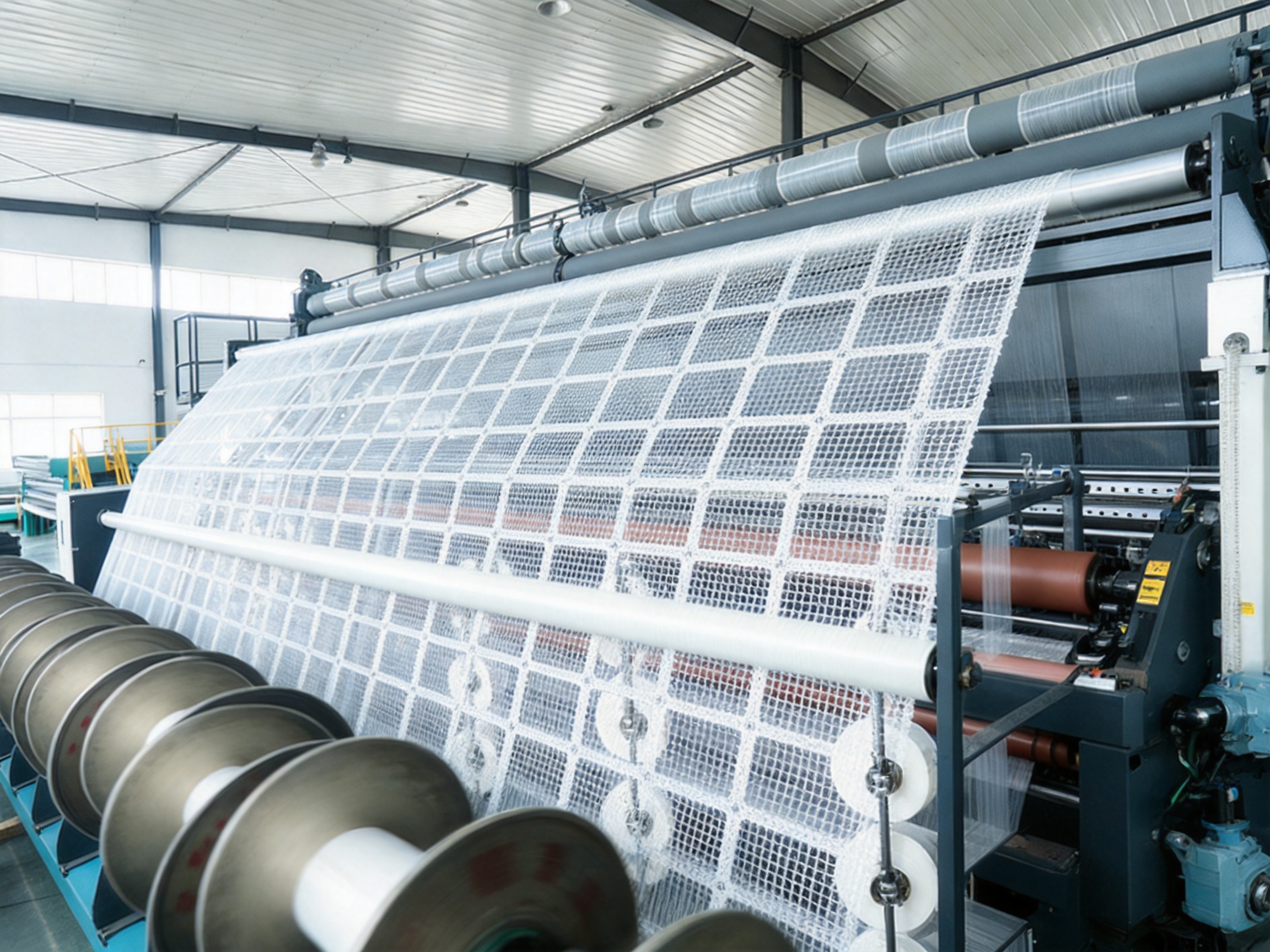
Biaxial warp knitting addresses this requirement by combining two yarn systems. The warp yarns run primarily along the length of the fabric, while the weft yarns are introduced across the width. These systems are knitted together so that the two directions remain structurally connected. The resulting square-mesh scrim provides a balanced reinforcement framework for the subsequent PVC coating.
The square mesh is important for more than appearance. Regular apertures create a predictable surface for coating penetration and bonding. If the mesh opening varies excessively, the coating may accumulate unevenly in some areas and fail to cover or anchor consistently in others. Such variations can affect opacity, surface smoothness, print quality, tensile behavior, and finished roll stability.
The YRS3-M-B is therefore intended for production environments where mesh geometry and fabric consistency are critical. It is suitable for manufacturers that need a reinforcing scrim with stable width, controlled aperture structure, and sufficient strength for large-format coated textile products.
1.1 Structure of the Finished Material
The material produced by the machine is generally an open square-mesh fabric before coating. High-tenacity polyester yarns form the load-bearing skeleton, and PVC is applied afterward to create the final banner or tarpaulin product. Depending on the coating formulation and finishing process, the final product may be printed, laminated, welded, folded, or converted into advertising panels, truck covers, and outdoor textile structures.
The knitted scrim must remain stable during coating, drying, tentering, calendering, and winding. A fabric that shifts or distorts before coating can create permanent defects in the finished product. The biaxial knitting construction helps limit independent movement between the warp and weft systems and supports more predictable behavior throughout the production line.
1.2 Why High-Tenacity Polyester Is Used
High-tenacity polyester is widely used in coated industrial textiles because it offers a practical balance of strength, dimensional stability, chemical resistance, processability, and cost. Coarse polyester yarns can provide the reinforcing performance required for banners and tarpaulins while remaining compatible with high-throughput textile production.
For the YRS3-M-B, yarn selection must be matched with guide settings, stitch construction, tension control, mesh opening, and coating requirements. The machine can be configured for high-tenacity polyester and standard polyester materials, while actual performance depends on the selected yarn linear density, yarn quality, fabric design, and process conditions.
2. Main Technical Specifications
The following specifications summarize the confirmed basic operating range of the YRS3-M-B. They should be used as a starting point for technical discussions rather than as a substitute for a fabric-specific configuration review.
| Parameter | Specification | Production Significance |
|---|---|---|
| Machine type | Raschel banner biaxial warp knitting machine | Produces knitted biaxial reinforcement scrim for coated industrial fabrics |
| Applicable fibers | High-tenacity polyester, coarse yarn, and polyester | Suitable for strong warp and weft reinforcement systems |
| Machine speed | 20–1300 r/min | Provides a broad operating range for different fabric constructions |
| Working width | 268 inches | Supports wide-format advertising and industrial fabric production |
| Reference daily output | 20,000 square meters per day | Actual output depends on construction, yarn, speed, and process conditions |
| Fabric structure | Square-mesh biaxial scrim | Creates a regular reinforcement base for PVC coating |
| Primary applications | Lightbox advertising fabric and truck tarpaulin fabrics | Suitable for large-format coated textile production |
The stated speed range of 20–1300 r/min gives manufacturers flexibility when setting up different fabric articles. A lightweight construction with a relatively open mesh may run at a different practical speed from a dense construction using coarse, high-tenacity yarn. The highest available rotational speed is not automatically the correct production speed for every article.
Actual production performance is influenced by yarn count, yarn tension, mesh density, fabric width, stitch construction, machine settings, operator experience, downstream coating speed, and the quality standards applied to the finished roll. For this reason, output should be confirmed through a fabric trial and process evaluation rather than calculated from machine speed alone.
3. Productivity Advantages of the YRS3-M-B
One of the principal advantages of the YRS3-M-B is its ability to maintain an optimized rotational speed and motion sequence during high-speed operation. In a biaxial knitting process, multiple mechanical movements must remain synchronized. Small timing errors can produce uneven mesh openings, yarn interference, broken filaments, or fabric defects.
High productivity is valuable only when the resulting fabric remains within specification. The machine is therefore designed to balance speed with motion stability. Its operating concept focuses on maintaining consistent relationships between yarn feeding, guide movement, knitting action, weft insertion, fabric formation, and take-off.
3.1 Stable Motion at High Speed
At high machine speeds, the dynamic behavior of the machine becomes increasingly important. Vibration, inertia, bearing loads, yarn acceleration, and the response of drive components can all affect fabric quality. A machine intended for continuous industrial production must be assembled with sufficient precision to keep these factors under control.
The YRS3-M-B uses a coordinated mechanical and control structure to support stable high-speed running. Proper drive settings help the machine reach the selected operating point smoothly, while synchronized motion sequencing reduces the risk of irregular knitting actions. This is especially important when the machine is producing wide fabric across a 268-inch working area.
3.2 Wide-Width Production
A working width of 268 inches allows the machine to produce broad reinforcement fabric suitable for large advertising cloth and industrial coated materials. Wide production can reduce the number of longitudinal joins required in the finished product and may improve the efficiency of downstream coating, printing, and cutting operations.
Wide-width machinery also places higher demands on beam arrangement, yarn path alignment, frame rigidity, operator access, and take-up control. The machine layout must be considered together with the customer’s building, coating line, material handling equipment, and roll storage areas. A wide machine cannot be evaluated only by its nominal width; the complete production environment must be prepared correctly.
3.3 Output Potential
The reference output for advertising cloth is 20,000 square meters per day. This figure is provided for guidance, since actual output varies according to fabric construction and process conditions. A producer running a dense or heavy construction may achieve a different output from a producer running a more open mesh with lighter yarn.
Output calculations should also account for start-up, article changes, yarn replacement, cleaning, inspection, maintenance, trial production, and unavoidable stoppages. A realistic production plan should distinguish between theoretical machine capacity and saleable finished fabric output.
4. Fabric Quality and Mesh Regularity
For PVC-coated banner fabric, the quality of the base scrim influences the quality of the final product. The mesh must provide consistent reinforcement while allowing the coating compound to occupy the open structure and bond around the yarn intersections.
Regular square openings support uniform coating coverage. They can also help maintain a consistent visual surface after coating and printing. If the warp and weft systems move out of alignment, the fabric may develop skewed or diamond-shaped openings. Such distortion can affect roll appearance, finished dimensions, print registration, and mechanical performance.
4.1 Yarn Tension Control
Yarn tension is one of the most important variables in biaxial fabric production. Excessive tension can cause yarn breakage, fabric contraction, or unwanted stress in the knitted structure. Insufficient tension can cause loose yarns, irregular mesh openings, and unstable fabric handling.
The correct tension range depends on yarn type, linear density, machine speed, guide configuration, and fabric construction. The machine configuration should therefore be established using the customer’s actual yarn data. Matching the guide and tension system to coarse high-tenacity polyester is particularly important because heavier yarns behave differently from fine textile filaments.
4.2 Aperture Geometry
The aperture size and shape must remain consistent across the full width and length of the roll. Regular geometry provides a more predictable basis for coating and helps the finished fabric maintain stable mechanical properties.
During commissioning, operators should inspect samples from the beginning, middle, and end of a production run. Width, mesh count, aperture shape, fabric weight, yarn placement, and visible defects should be compared with the agreed construction. This creates a practical quality-control routine that can be continued after the machine is accepted.
4.3 Dimensional Stability
Dimensional stability is essential for products that are printed, welded, tensioned, or installed over large frames. The biaxial structure distributes reinforcement in both primary directions and helps reduce excessive directional stretch. The subsequent PVC coating further consolidates the scrim and creates the finished weather-resistant material.
The final dimensional behavior still depends on coating temperature, drying conditions, tentering, cooling, winding tension, and storage. The knitting machine provides the stable base structure, while the coating and finishing line must preserve that structure through the remaining process stages.
5. Applications of the YRS3-M-B
5.1 Flex Banner and Advertising Cloth
Flex banner fabric is used for billboards, shop signs, event displays, lightbox advertising, and other large-format printed applications. These products require a smooth and stable coated surface, adequate tensile strength, controlled opacity, and resistance to handling during installation.
The square-mesh scrim produced by the YRS3-M-B provides reinforcement inside the PVC-coated structure. Its regular pattern supports even coating and contributes to a stable printing surface. The exact fabric design can be adjusted according to the required weight, strength, flexibility, and visual performance of the finished advertising material.
5.2 Lightbox Advertising Fabric
Lightbox advertising fabrics are often designed to transmit or diffuse light in a controlled way. The base scrim must be strong enough to support the coated sheet while maintaining an appearance suitable for illumination and printing.
The openness of the biaxial mesh allows the coating formulation to fill the structure and create a continuous surface. The final optical properties depend primarily on the PVC compound, pigment, coating thickness, and finishing process, but the uniformity of the scrim remains an important foundation for consistent production.
5.3 Truck Tarpaulin and Side Curtain Fabric
Truck tarpaulins and side curtains must withstand repeated folding, tensioning, abrasion, wind pressure, weather exposure, and loading operations. The fabric must also remain dimensionally stable when installed on a vehicle or trailer.
High-tenacity polyester reinforcement provides the tensile skeleton required for these applications. The knitted connection between warp and weft helps the fabric resist distortion when loads are applied in different directions. After PVC coating, the material can be converted into covers, curtains, panels, and other transport-related products.
5.4 Other Industrial Coated Textiles
Depending on the selected yarns, mesh construction, coating compound, and finishing process, the machine may also support other coated textile products requiring an open reinforcement scrim. Each application should be evaluated individually, especially where special chemical resistance, flame performance, low-temperature flexibility, or unusual mechanical properties are required.
6. Configuration Options for Different Production Requirements
The YRS3-M-B should be configured around the customer’s working point. A working point includes the fabric construction, yarn specification, production target, downstream process, building conditions, and quality requirements that define how the machine will be used.
6.1 Yarn and Gauge Configuration
The warp and weft yarn counts influence mesh strength, fabric weight, aperture size, and coating behavior. Coarse yarns may provide higher reinforcement but require suitable guides, tension settings, and clearance. The machine’s yarn path must be planned to reduce abrasion and prevent unnecessary filament damage.
Guide bar arrangements, stitch density, and knitting parameters are selected according to the required fabric structure. A producer changing between different articles may need documented recipes for each construction so that operators can repeat proven settings efficiently.
6.2 Width and Beam Handling
The 268-inch working width must be coordinated with the warp beam creel, yarn supply arrangement, machine access, and downstream line width. Beam positions should permit safe installation, threading, inspection, and replacement.
Material handling is an important part of wide-width production. Beam trolleys, lifting equipment, roll transport, and storage areas should be considered during the layout stage. Adequate access reduces installation time and helps maintenance teams work safely around the machine.
6.3 Drive and Control Parameters
Drive parameters should be established for stable acceleration, normal production, controlled stopping, and emergency response. Motion sequence settings must correspond with the selected fabric article. Where multiple products are manufactured, parameter storage can help operators repeat approved machine settings.
Control functions should be explained clearly during commissioning. Operators need to understand start-up procedures, alarm handling, speed changes, stop conditions, yarn break response, and safe restart practices. Clear documentation reduces errors and supports consistent shift-to-shift production.
6.4 Integration with Coating and Finishing Lines
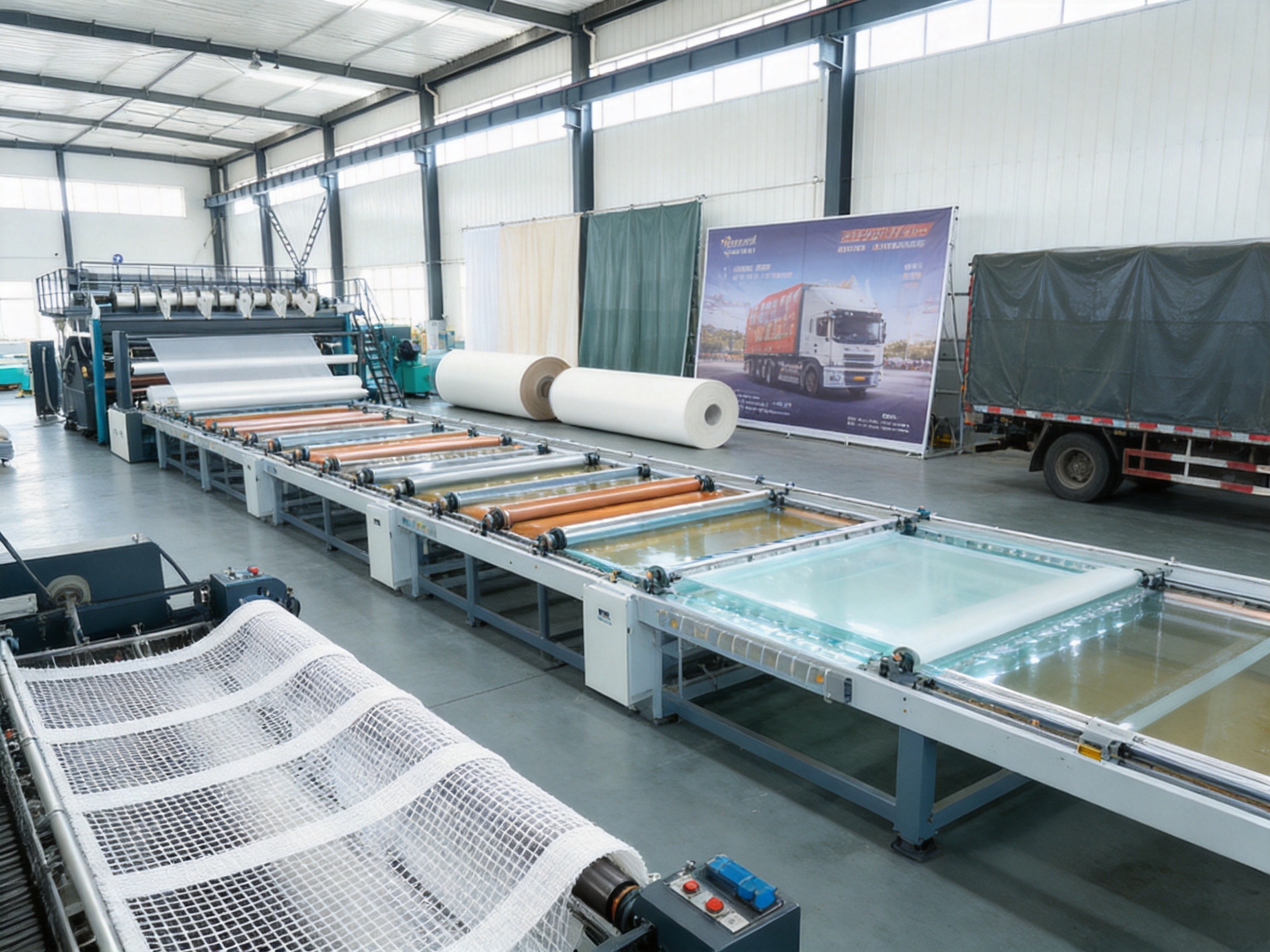
The knitting machine is normally the first major stage in a larger coated textile production system. Its take-off and batching arrangements should be compatible with the coating line’s input requirements. Roll diameter, fabric tension, storage method, and transfer procedures should be confirmed before installation.
Coordination is especially important when the knitted scrim is transferred directly to coating. Excessive storage tension, moisture, contamination, or edge damage can affect coating quality. A clear material-flow plan helps protect the fabric between knitting and coating.
7. Manufacturing Strengths Behind the Machine
The performance of a specialized textile machine depends not only on its design drawings but also on the manufacturing process used to build it. Precision machining, structural fabrication, component control, assembly accuracy, electrical integration, and factory testing all influence the reliability of the finished equipment.
Changzhou Yuanyang Electromechanical Technology Co., Ltd. operates a production base of more than 12,000 square meters with standardized workshops, customization areas, design trial workstations, and warehouse facilities. This manufacturing environment supports the development and production of warp knitting machines, stitch-bonding equipment, biaxial and multiaxial machines, carbon fiber textile machinery, powder scattering equipment, web laying machines, and related special equipment.
7.1 Research and Development Capability
The company’s engineering team includes experienced textile machinery professionals who work on structural design, machine performance, process adaptation, and special equipment development. This is important for applications where the customer’s fabric cannot be produced efficiently with a standard machine configuration.
Research and development work may involve machine structure redesign, functional module development, layout adaptation, special-material handling, and production-line integration. The objective is to create a machine that remains stable in the customer’s actual production environment rather than simply meeting a nominal specification on paper.
7.2 Standardized Production
Standardized workshops help organize component flow, assembly procedures, inspection points, and production records. A repeatable manufacturing process reduces variation between machines and makes it easier to trace problems when they occur.
At the same time, industrial textile machinery often requires non-standard engineering. The manufacturing system must therefore combine standardized quality control with flexible customization. This combination allows the company to preserve process discipline while adapting machine dimensions, modules, yarn paths, controls, and layouts to specific requirements.
7.3 Component and Material Control
Component quality affects machine longevity, running stability, vibration, noise, and maintenance requirements. Incoming materials and purchased components should be checked before they enter assembly. Critical parts require suitable dimensional and functional verification.
Controlling materials at the receiving stage prevents avoidable defects from being carried into the finished machine. It also supports more reliable spare-parts identification and service planning after delivery.
7.4 Assembly and Alignment
Frame assembly, drive installation, guide-bar positioning, beam alignment, yarn-path setup, and electrical connection must be completed with attention to precision. A wide-width machine amplifies the effects of small alignment errors, so assembly quality is essential for uniform fabric production.
After mechanical assembly, the machine is inspected and adjusted before loaded operation. Alignment checks, lubrication, safety inspection, control verification, and movement testing form part of the preparation for factory trials.
8. Quality Control and Pre-Delivery Testing
The equipment is tested before shipment to verify mechanical operation, drive performance, control functions, safety systems, and fabric-forming capability. Testing provides an opportunity to identify problems while the machine is still at the manufacturing base, where engineering resources and replacement components are readily available.
8.1 No-Load Testing
No-load running tests examine machine movement without production yarns or fabric. Engineers can observe vibration, noise, drive response, lubrication, temperature rise, control signals, and emergency-stop functions. Problems found during this stage can be corrected before fabric trials begin.
8.2 Loaded Running Tests
Loaded tests introduce yarns and operate the machine under conditions closer to production. The purpose is to confirm yarn paths, knitting action, weft insertion, motion sequence, fabric take-off, and basic mesh formation.
Where the customer provides yarn information or a target construction, the factory trial can be adapted to those conditions. A production-representative trial provides more useful information than a generic demonstration because it reflects the intended yarn, speed, mesh density, and fabric weight.
8.3 Inspection Records
Inspection records support the acceptance process and help establish a reference point for future maintenance. Records may cover component checks, assembly inspection, running tests, fabric samples, electrical verification, and final pre-shipment review.
Customer participation in pre-shipment inspection can provide additional confidence. It also gives the customer’s technical personnel an opportunity to understand the machine before it arrives at the installation site.
9. Installation, Commissioning, and Training
Installation begins before the machine reaches the customer’s factory. Site conditions should be reviewed in advance, including floor loading, foundation requirements, leveling, building height, machine orientation, electrical supply, service access, beam movement, and connection with the coating line.
9.1 Site Preparation
The installation area must provide sufficient clearance around the machine for operation, cleaning, inspection, and maintenance. The relationship between the machine, warp beam creel, take-off section, fabric storage, and downstream equipment should be established in the layout plan.
Electrical requirements, grounding, compressed air if required, lighting, ventilation, and material-handling routes should be confirmed before delivery. Good preparation reduces delays and prevents later compromises in service access or safety.
9.2 Mechanical Installation
Mechanical installation includes positioning, frame leveling, beam placement, component connection, drive alignment, yarn-path preparation, and inspection of moving parts. Correct leveling is particularly important for a wide machine because uneven support can affect alignment across the working width.
9.3 Electrical Commissioning
Electrical commissioning includes control-panel inspection, drive setup, sensor checks, safety interlock verification, emergency-stop testing, and operator-interface configuration. Parameters are adjusted according to the intended fabric article and operating environment.
9.4 Fabric Trials
Fabric trials are used to verify mesh geometry, width, running stability, yarn behavior, and production settings. Trial samples should be inspected and compared with the agreed construction. If the machine is connected to a coating line, the trial may also include transfer and coating evaluation.
9.5 Operator Training
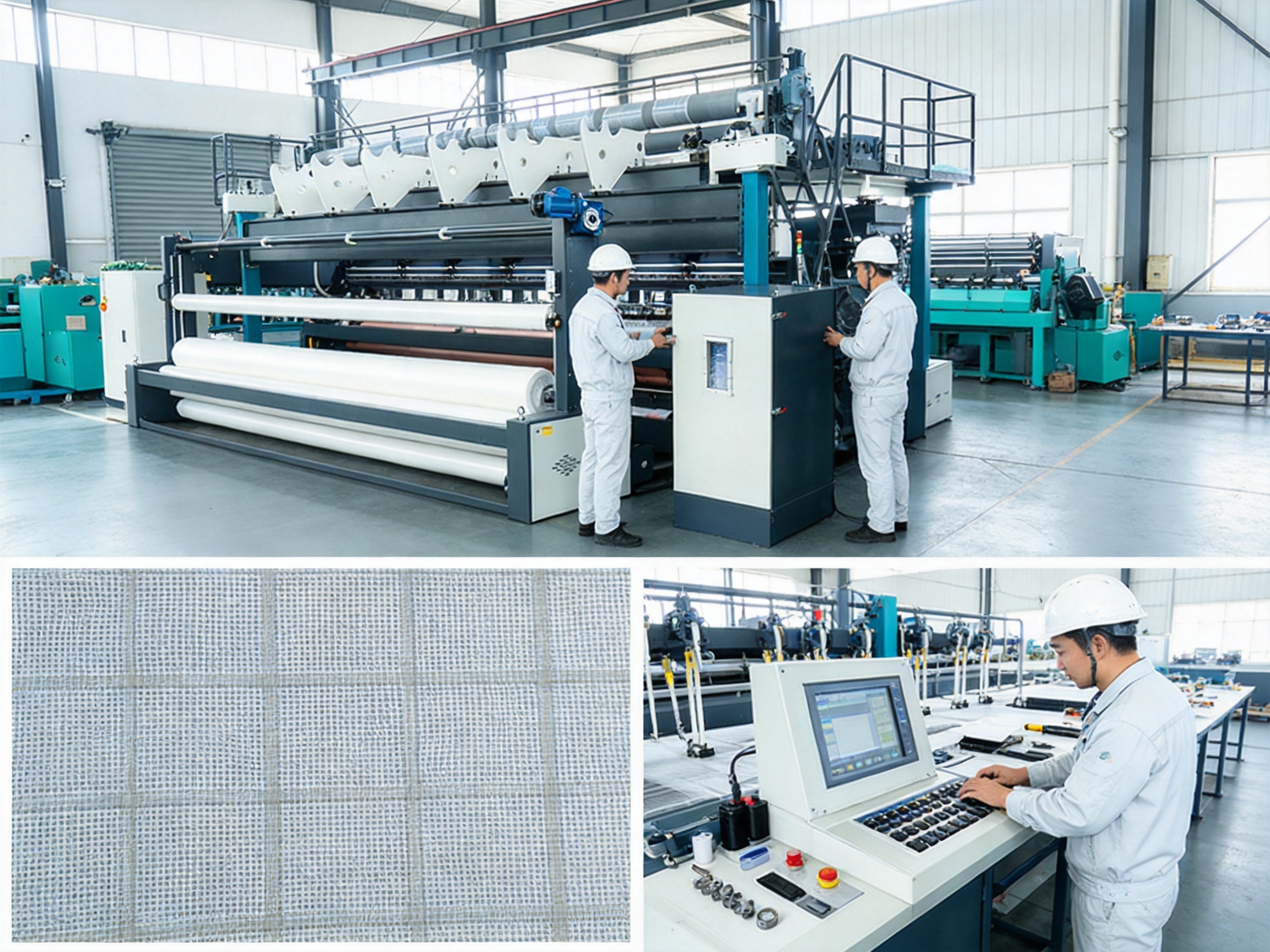
Engineers attend the customer’s factory for installation, commissioning, and training until the machine reaches the agreed operating condition. Training can cover machine start-up, normal operation, speed adjustment, yarn threading, fabric inspection, alarm response, cleaning, lubrication, routine maintenance, and safe shutdown.
Additional training is available at the fabrication workshop. Knitters, maintenance personnel, and workshop managers can work alongside the manufacturer’s production team for one to two months. This arrangement is useful for customers establishing a new production department or introducing a technically unfamiliar fabric process.
10. Maintenance and Long-Term Service
Banner and tarpaulin machines often operate for long shifts, making accessibility and preventive maintenance important factors in total operating cost. Regular cleaning, lubrication, inspection, and replacement of wear parts help protect machine performance and reduce unplanned downtime.
10.1 Routine Maintenance
Operators should follow a maintenance schedule based on running hours and production conditions. Daily checks may include yarn-path cleanliness, visible wear, abnormal noise, lubrication status, fabric quality, and safety devices. Longer-interval maintenance may include drive inspection, bearing checks, fastener verification, alignment review, and replacement of designated wear components.
Dust, fiber fragments, coating residues, and accumulated lint can interfere with moving parts and sensors. Keeping the machine clean supports reliable operation and makes early detection of mechanical problems easier.
10.2 Spare Parts Support
Spare-parts planning should focus on components that influence production continuity, including guides, needles or knitting elements where applicable, drive-related parts, sensors, belts, bearings, tension components, and other designated wear items. A recommended spare-parts list can be prepared according to the machine configuration and expected running hours.
10.3 Process Troubleshooting
Not every fabric problem originates from a mechanical failure. Mesh irregularity may be related to yarn quality, tension, guide contamination, incorrect settings, excessive speed, or downstream pulling forces. Effective troubleshooting considers the machine, yarn, fabric design, coating process, and operating conditions together.
Yuanyang provides after-sales engineering support, spare-parts guidance, production troubleshooting, and assistance with new fabric articles. When a customer expands its product range, the company can support the development of parameters for additional mesh constructions rather than treating the original setup as permanent.
11. Advantages Compared with Less Specialized Equipment
The YRS3-M-B has several advantages over less specialized or poorly matched equipment when the target product is a wide, high-strength, PVC-coated square-mesh fabric.
11.1 Purpose-Built Biaxial Reinforcement
A machine designed specifically for biaxial banner scrim provides a more appropriate yarn path and motion sequence than equipment intended only for single-direction reinforcement or lightweight mesh. The warp and weft systems are engineered to work together as a connected structure.
11.2 Better Compatibility with Coating Processes
The regular square mesh provides a predictable base for PVC coating. This can support more uniform coating penetration, surface formation, and finished roll appearance. The benefit is especially relevant to producers supplying printed or illuminated advertising materials where surface consistency is commercially important.
11.3 Broad Width and High Production Potential
The 268-inch working width and reference output of 20,000 square meters per day make the machine suitable for industrial-scale production. A producer may reduce joining operations and align the scrim supply more effectively with a wide coating line.
11.4 Customization for Actual Factory Conditions
Rather than limiting the customer to one standard configuration, the manufacturer can adapt the structure, layout, functional modules, yarn handling, and controls to suit the intended article and site. This is a significant advantage when the buyer has unusual yarns, a restricted workshop layout, an existing coating line, or multiple fabric requirements.
11.5 Complete Technical Support
Equipment performance depends on commissioning, operator competence, maintenance, and process development. Engineering support from installation through production trials gives the customer a more complete path to operation than a machine shipment without technical follow-up.
12. Recommended Purchasing and Configuration Process
A successful machine project begins with accurate technical information. The customer should provide the following data when requesting a proposal:
- Target fabric type and application
- Required mesh count and aperture size
- Finished fabric width and expected roll width
- Fabric weight and required tensile performance
- Warp and weft yarn type, linear density, and supplier
- Required daily or annual output
- Number of operating shifts
- PVC coating method and coating-line width
- Tentering, drying, printing, and finishing conditions
- Available floor area, building height, power supply, and material-handling equipment
- Fabric samples, construction drawings, or test requirements
A sample or drawing can shorten the configuration process because it gives the engineering team a direct reference for mesh structure, yarn placement, and expected appearance. Where the fabric is new, the customer should provide as much information as possible about the intended end use and required mechanical performance.
13. Practical Production Recommendations
Before starting continuous production, operators should confirm that the machine is level, the yarn supply is clean and correctly installed, and all guides and tension components are suitable for the selected yarn. The first fabric should be run at a controlled speed while the team checks mesh geometry and yarn behavior.
Speed should be increased gradually after stable fabric formation has been confirmed. If defects appear at higher speed, the cause should be investigated before simply reducing quality-control standards. Possible causes include excessive tension, insufficient tension, yarn variation, guide wear, incorrect drive parameters, vibration, or downstream fabric pulling.
Fabric samples should be collected according to a documented inspection plan. Measurements may include width, mesh count, aperture size, fabric weight, appearance, yarn break frequency, and dimensional change after coating. Consistent records allow the production team to identify gradual changes before they become large-scale roll defects.
Operators should also coordinate closely with the coating department. The knitted scrim should be transferred without unnecessary stretching, contamination, or edge damage. Changes in coating speed or tentering conditions should be communicated to the knitting department because the two processes influence the final fabric result.
14. Environmental and Operational Considerations
Efficient machine operation can reduce waste by lowering yarn breakage, minimizing trial material, and improving first-quality output. Stable motion and consistent mesh formation also reduce the amount of coated fabric that must be downgraded or discarded because of structural defects.
Energy consumption depends on machine speed, drive efficiency, yarn construction, operating hours, and the wider production line. Maintaining bearings, drives, lubrication systems, and control components in good condition supports efficient operation and reduces avoidable mechanical losses.
Worker safety must remain central to installation and production. Operators should be trained in safe access, moving-part hazards, emergency stops, beam handling, cleaning procedures, and lockout practices. Wide-width machinery requires particular attention to access routes and material movement around the frame.
15. Frequently Asked Questions
What products can the YRS3-M-B produce?
The machine produces biaxial square-mesh scrim from high-tenacity polyester and polyester yarns. The primary applications are PVC-coated flex banner, lightbox advertising fabric, truck tarpaulin, and related industrial coated textiles.
What is the confirmed working width?
The confirmed working width is 268 inches. The final usable width may depend on the selected configuration, edge treatment, fabric design, and downstream coating requirements.
What is the machine speed range?
The stated machine speed range is 20–1300 r/min. The practical operating speed depends on yarn count, mesh density, fabric construction, machine settings, and the required quality level.
What daily output can be expected?
The reference daily output for advertising cloth is 20,000 square meters. This is an indicative figure only. Actual output varies according to fabric construction, yarn type, machine speed, operating hours, article changes, and process conditions.
Can the machine use coarse high-tenacity polyester yarn?
Yes. High-tenacity polyester, including coarse reinforcing yarns, is one of the intended material categories. The guide arrangement, tension settings, yarn path, and fabric construction should be confirmed against the selected yarn specification.
Is the fabric coated inside the machine?
The machine forms the biaxial knitted square-mesh scrim. PVC coating is normally performed in a subsequent coating and finishing process. The knitted structure is designed to provide a stable and suitable base for that downstream coating operation.
Can the machine be customized?
Yes. Customization may include structural and layout redesign, functional module development, special-material adaptation, yarn handling changes, control adjustments, and integration with existing production lines. The configuration is developed from the customer’s fabric requirements and site conditions.
What information is needed for a quotation?
The manufacturer normally requires fabric width, mesh count, aperture size, fabric weight, yarn type and linear density, production target, coating-line information, site dimensions, power conditions, and a sample or drawing if available.
How is installation performed?
Installation includes site preparation review, mechanical positioning and alignment, beam and yarn-path setup, electrical commissioning, control adjustment, fabric trials, and operator training. Engineers attend the customer’s factory until the machine reaches the agreed operating condition.
Is training available away from the customer’s factory?
Yes. Training can also be provided at the manufacturer’s fabrication workshop. Operators, maintainers, and workshop managers may receive practical training for one to two months while working alongside the production and engineering teams.
What quality checks are performed before shipment?
Pre-shipment checks may include incoming component control, assembly inspection, no-load running, loaded running, drive and control verification, safety inspection, fabric trial evaluation, and final customer inspection where required.
What support is available after delivery?
Support includes installation assistance, commissioning, training, spare-parts supply, maintenance guidance, process troubleshooting, rapid-response service, and assistance with developing parameters for additional fabric constructions.
16. Conclusion
The YRS3-M-B Raschel Banner Biaxial Warp Knitting Machine is a specialized production solution for manufacturers of PVC-coated flex banner, lightbox advertising cloth, truck tarpaulin, and related industrial textiles. Its biaxial construction locks high-tenacity polyester warp and weft yarns into a regular square-mesh scrim, creating a stable reinforcement base for downstream coating.
Its principal advantages include a broad 20–1300 r/min speed range, 268-inch working width, high productivity potential, compatibility with coarse reinforcing yarns, stable high-speed motion, and suitability for integration with coating and finishing lines. The reference output of 20,000 square meters per day demonstrates its industrial production orientation, while the actual output must be confirmed according to the fabric article and process conditions.
The machine’s value is strengthened by the manufacturer’s engineering and manufacturing capabilities. Research and development, standardized workshops, customization areas, component control, assembly testing, site commissioning, operator training, spare-parts support, and process troubleshooting form a complete equipment service system.
For producers seeking consistent mesh geometry, wide-format output, and a reliable reinforcement platform for coated textile products, the YRS3-M-B offers a practical combination of performance, customization, manufacturing quality, and long-term technical support.
References
1. Changzhou Yuanyang Electromechanical Technology Co., Ltd. Product specifications and technical information for the YRS3-M-B Raschel Banner Biaxial Warp Knitting Machine.
2. Changzhou Yuanyang Electromechanical Technology Co., Ltd. Technical information on biaxial warp knitting machinery, stitch-bonding machines, multiaxial machines, and industrial textile equipment.
3. Textile Institute. Principles of Textile Manufacture: Textile Machinery and Processes.
4. Textile Institute. Technical guidance on warp knitting structures, yarn handling, fabric formation, and industrial textile production.
5. International Organization for Standardization. General principles for textile testing, fabric dimensional stability, tensile evaluation, and quality inspection.
6. Industrial textile engineering references concerning PVC-coated fabrics, reinforcement scrims, coating-line integration, and production quality control.
Product: YRS3-M-B Raschel Banner Biaxial Warp Knitting Machine

News
-
Two quotations land on the same desk. Both offer a multiaxial warp knitting line, both list the same working width, both promise high output. One buyer signs and discovers six months later that the f...
READ MORE -
Two buyers open the same catalogue and both ask for a warp knitting machine. One needs a 4.5 m wide glass-fibre geogrid with 0° and 90° yarns stitched together for a soil-reinforcement contract; the ...
READ MORE -
A fabric engineer compares two swatches on a cutting table. One is a lightweight mesh that holds its shape, resists runs, and stretches very little. The other is a soft jersey that curls at the edges...
READ MORE -
Three quotations land on the same desk for the same polyester nonwoven line, and on paper they look interchangeable. Each is priced per metre of working width. Each quotes a similar top speed. Each c...
READ MORE
-
Contact Info.
+86-198 5534 1617
+86-134 0158 3002yuanyang@yywarpknitting.com 699#, Shengzhi West Rd, Lvcheng Town, Danyang City, Zhenjiang City, Jiangsu Province, China

-
QR Code
-
Quick Links
Home About Products Manufacturing Customization News Contact -
Product List
Machine for Chemical Fiber Textile Machine for Fiberglass Textile Machine for Carbon Fiber Textile -
About Us
Company Profile Factory Gallery Value-added Service
Copyright © 2026 Changzhou Yuanyang Electromechanical Technology Co., Ltd. All Rights Reserved.
Custom Warp Knitting Machine Manufacturers
