

 English
 中文简体
 русский
 Français
 Español
 Deutsch

YRS3-M-F-II Raschel Chopped Fiber Biaxial Warp Knitting Machine for Advanced Composite Fabrics
2026-10-21
Content
- 1 Purpose and Operating Principle
- 2 Key Production Capabilities
- 3 Advantages of Directional Biaxial Reinforcement
- 4 Integrated Chopping Unit
- 5 Fabric Construction and Application Flexibility
- 6 Core Technical Specifications
- 7 Working Width and Full-Width Production
- 8 Comparison with Conventional Alternative Equipment
- 9 Processability and Resin Flow Considerations
- 10 Configuration Variables
- 11 Manufacturing Strengths of the Supplier
- 12 Advanced Manufacturing Process
- 13 Quality Control and Production Stability
- 14 Installation and Commissioning
- 15 Operator Training and Technical Documentation
- 16 Maintenance and Serviceability
- 17 Production Troubleshooting
- 18 Information Required for a Firm Configuration
- 19 Position Within the Fiberglass Textile Equipment Range
- 20 Why Choose an Integrated Equipment Partner
- 21 Economic and Operational Considerations
- 22 Frequently Asked Questions
- 22.1 What type of machine is the YRS3-M-F-II?
- 22.2 Which fibers can the machine process?
- 22.3 Can the 0°/90° ratio be customized?
- 22.4 What chopped-layer weights are available?
- 22.5 Can a nonwoven fabric be used instead of a chopped layer?
- 22.6 What is the typical finished fabric weight?
- 22.7 What is the machine speed?
- 22.8 What is the working width?
- 22.9 What daily output can be expected?
- 22.10 Is the machine suitable for wind-power fabrics?
- 22.11 How does the machine differ from a random chopped strand mat line?
- 22.12 How does it differ from a machine without an integrated chopping unit?
- 22.13 Does the supplier provide installation and commissioning?
- 22.14 Is operator training available?
- 22.15 Can the machine be customized for a non-standard plant layout?
- 22.16 Which parts require the most maintenance?
- 22.17 How is machine performance accepted?
- 23 Conclusion
- 24 References
- 25 Product: YRS3-M-F-II Raschel Chopped Fiber Biaxial Warp Knitting Machine(HS)
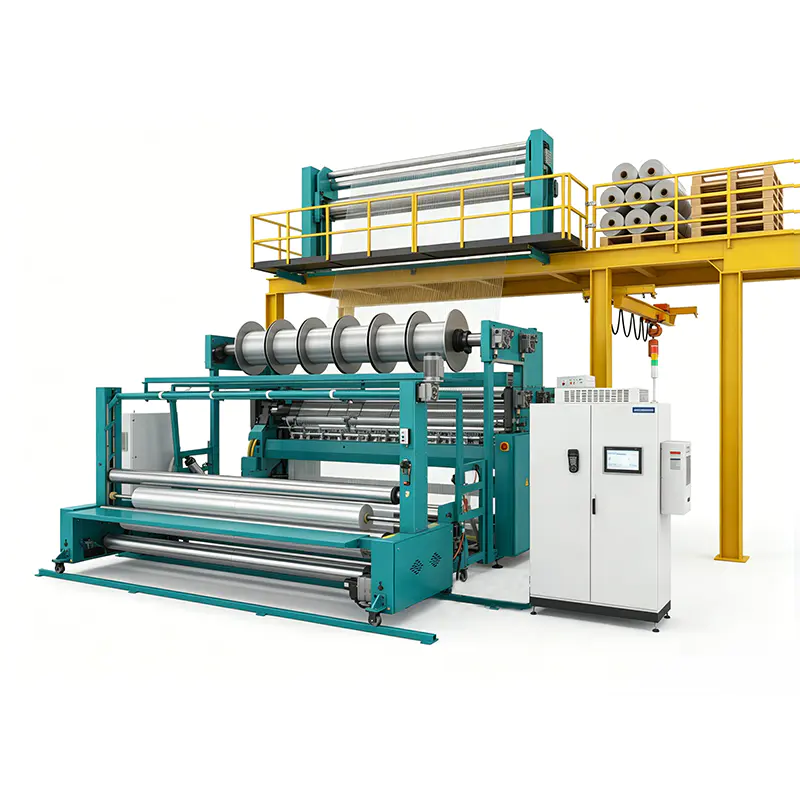
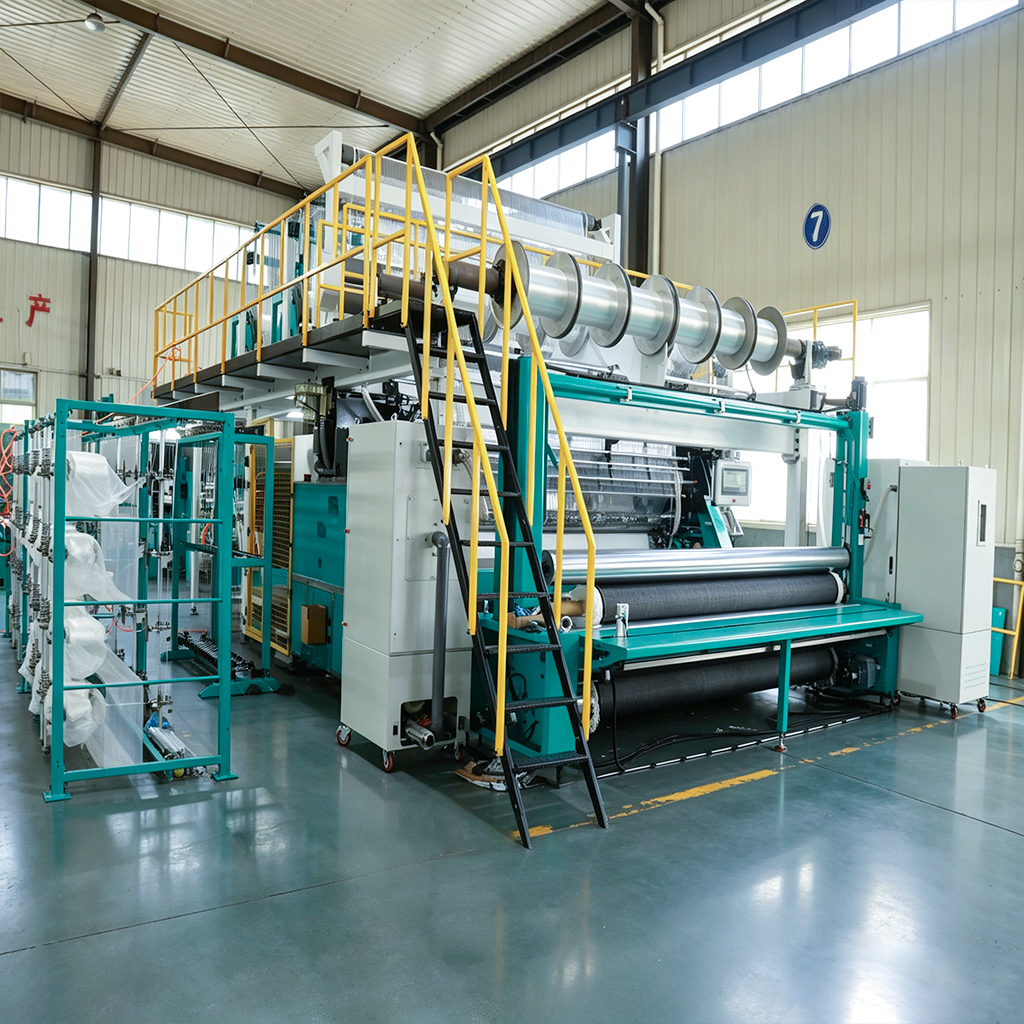
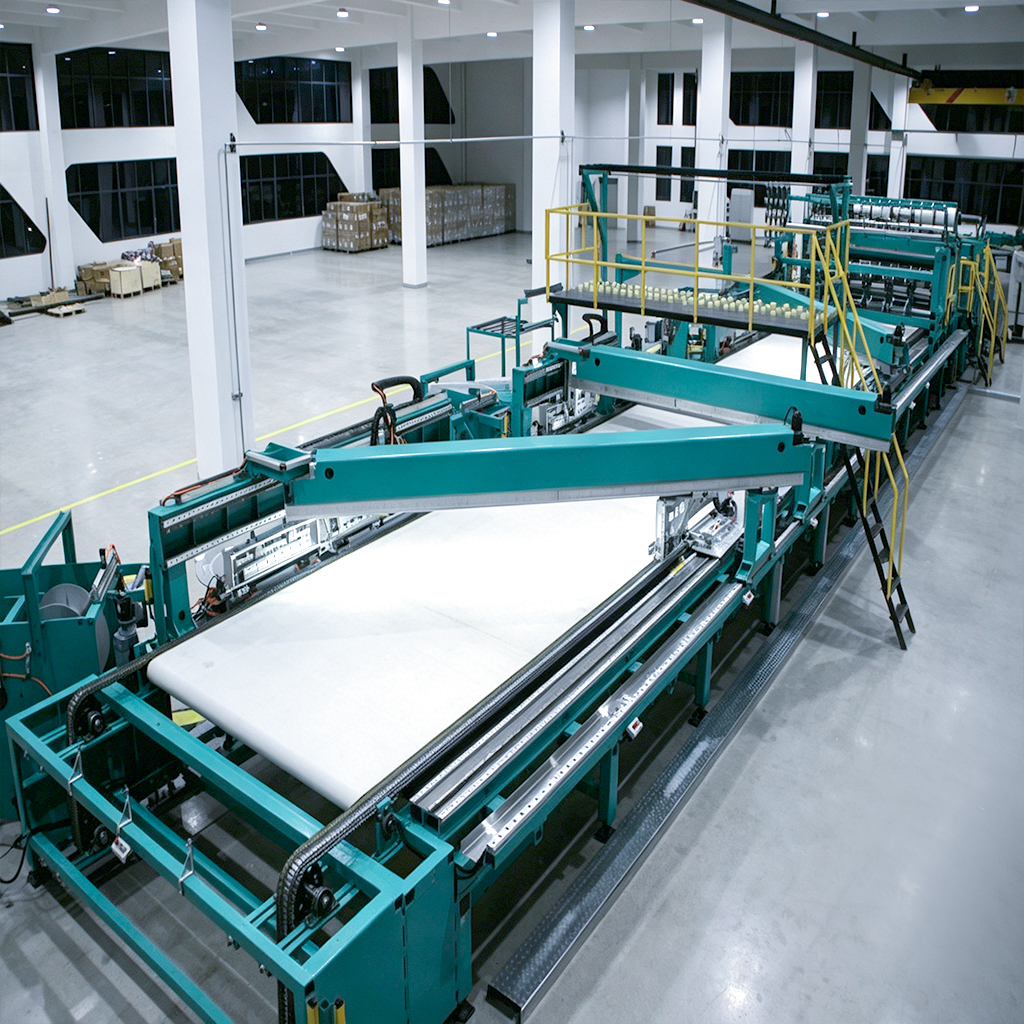
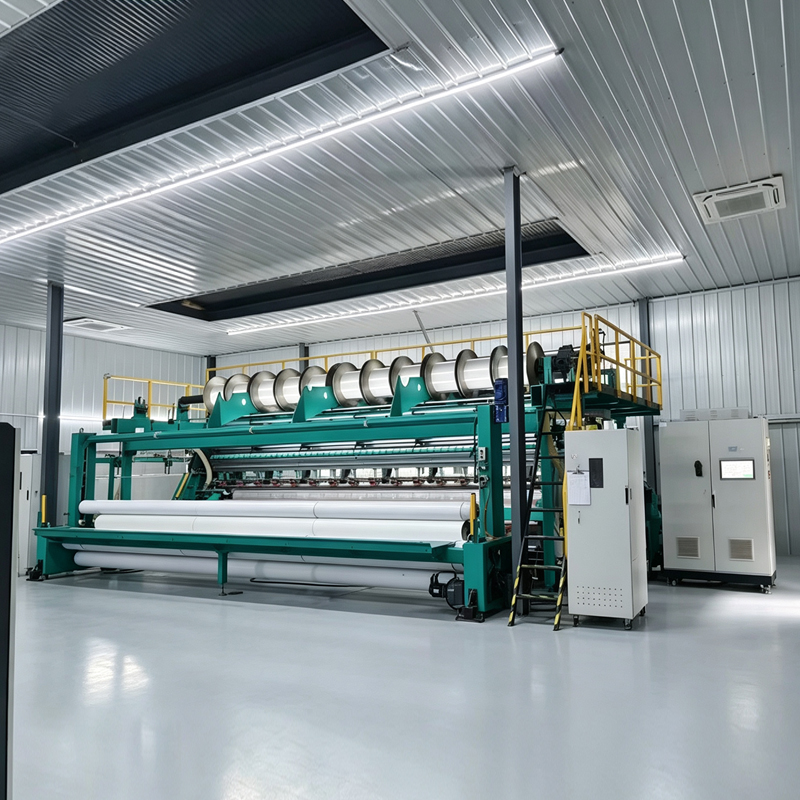
The YRS3-M-F-II Raschel Chopped Fiber Biaxial Warp Knitting Machine is designed for manufacturers that require stable, high-throughput production of glass-fiber and polyester reinforcement fabrics. By combining 0°/90° weft insertion, Raschel warp knitting, and an integrated chopping unit, the machine produces engineered composite textiles with controlled directionality, adjustable areal weight, and optional chopped or nonwoven layers.
This configuration is particularly suitable for wind-power components, nacelle covers, composite structures, and other applications where reinforcement fabrics must provide predictable handling, efficient resin flow, and repeatable mechanical performance. Unlike conventional randomly oriented chopped strand mats, the machine creates an orderly reinforcement structure in which the main yarn directions can be controlled according to the requirements of the final laminate.
Changzhou Yuanyang Electromechanical Technology Co., Ltd. manufactures this machine as part of its fiberglass textile equipment range. The company combines mechanical design, warp knitting technology, functional module integration, manufacturing, commissioning, and after-sales service to provide complete equipment solutions rather than a basic standalone machine.
For composite manufacturers, this approach is important. Fabric performance depends not only on the machine’s nominal speed or working width, but also on yarn tension, directional balance, chopping uniformity, stitching stability, layer integration, roll handling, and the machine’s ability to remain consistent over long production runs. The YRS3-M-F-II is developed around these production realities.
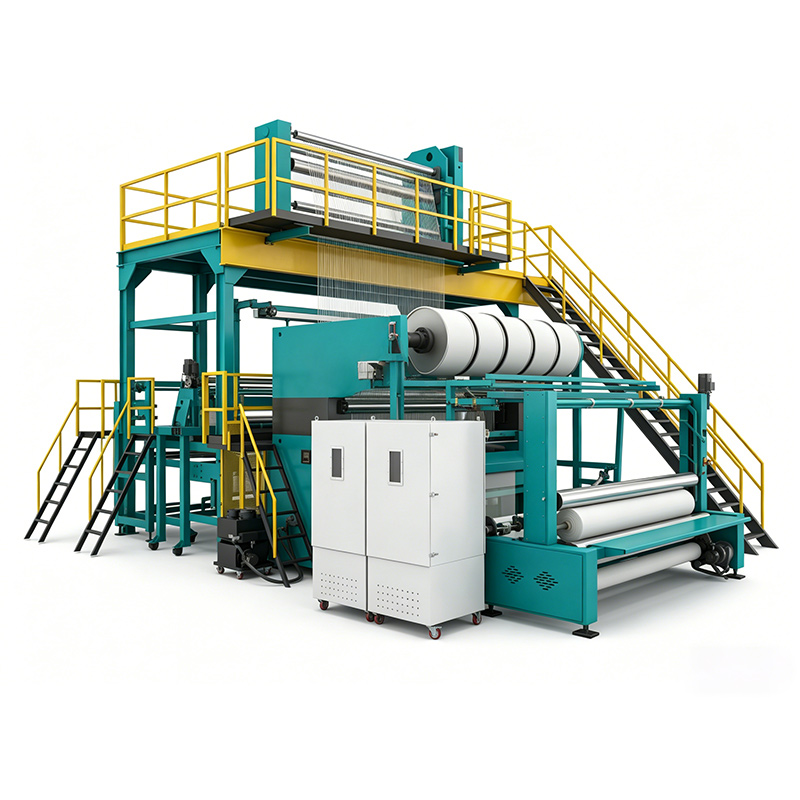
YRS3-M-F-II Raschel Chopped Fiber Biaxial Warp Knitting Machine(HS)
Purpose and Operating Principle
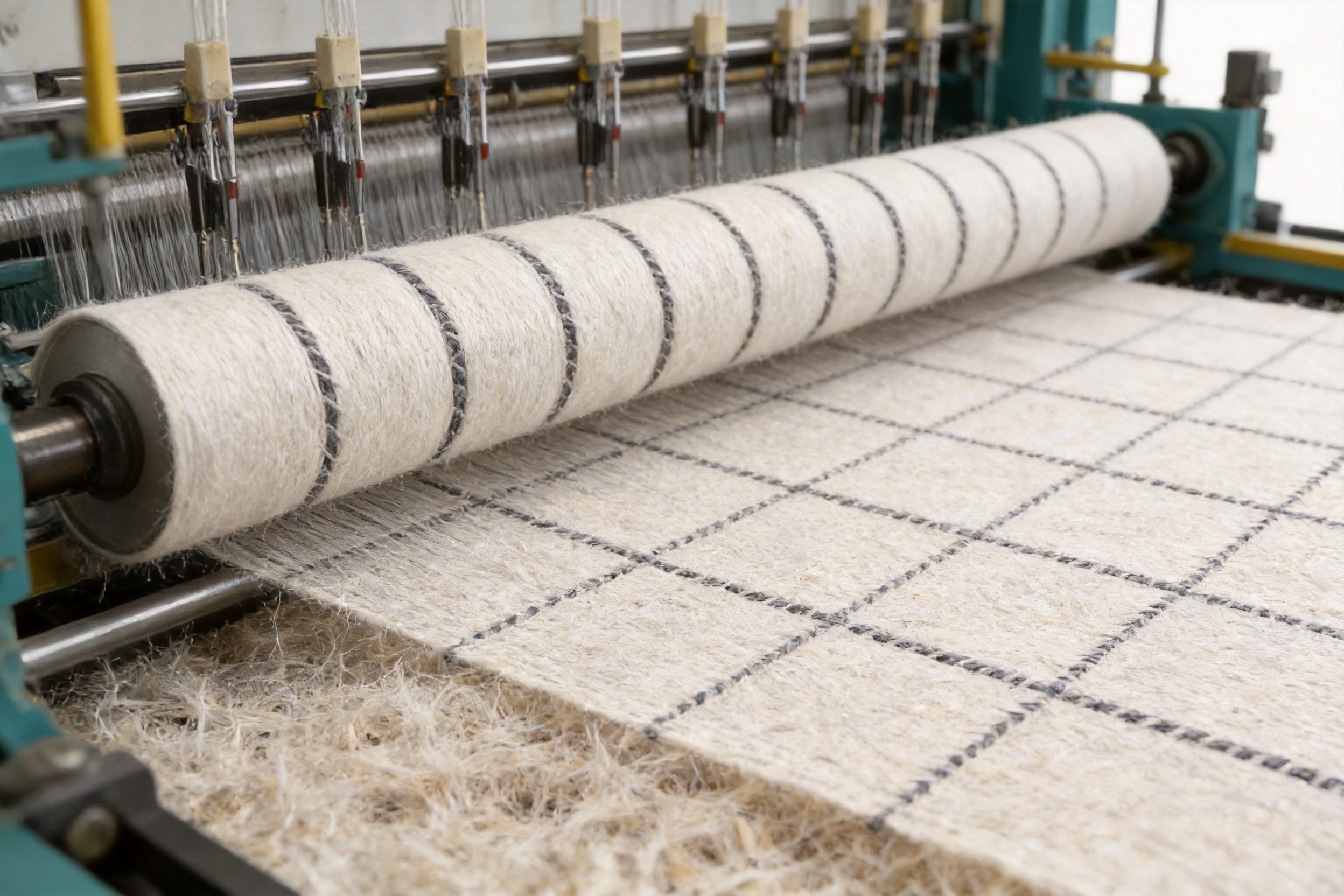
The YRS3-M-F-II is a biaxial warp knitting machine equipped with a chopping unit. It produces full-width fabrics containing yarns laid in the 0° and 90° directions, while an optional chopped fiber layer or nonwoven fabric can be introduced beneath the yarn structure.
In a typical production process, warp yarns are supplied in the machine direction and maintained under controlled tension. Weft yarns are inserted across the working width at the specified directional angles. The knitting mechanism then connects the laid yarns into an integrated textile structure. Where required, the chopping unit deposits chopped fibers into the lower layer, allowing the resulting fabric to combine directional reinforcement with additional bulk, resin absorption, or surface coverage.
The process produces a fabric that is different from a conventional woven textile. Woven fabrics generally rely on interlacing warp and weft yarns, while the YRS3-M-F-II uses warp knitting and weft insertion to create a reinforcement structure with a controlled 0°/90° balance. The arrangement can provide efficient load transfer and a construction that is well suited to composite molding.
The machine is also different from equipment that produces only random chopped strand mats. Random mats distribute fibers without a defined primary orientation. That construction may be useful for some applications, but it does not provide the same directional control as a biaxial reinforcement fabric. The YRS3-M-F-II allows manufacturers to define the relative contribution of the 0° and 90° yarn systems, making the fabric more adaptable to structural design requirements.
Key Production Capabilities
The machine is designed for glass fiber and polyester applications. The exact configuration can be adjusted according to yarn count, package format, target fabric weight, required directional ratio, chopped layer specification, and downstream processing conditions.
Production of full-width weft-inserted chopped mats.
Production of biaxial composite fabrics with orderly 0°/90° reinforcement.
Integration of an optional chopped fiber layer beneath the yarns.
Integration of a suitable nonwoven fabric beneath the yarns.
Customization of the 0°/90° weight ratio.
Production of greige fabrics typically weighing between 300 and 2000 g/m².
Processing of optional chopped layers from approximately 50 to 500 g/m².
Reference daily output of up to 3000 kg, depending on construction and process conditions.
These capabilities allow one machine platform to serve several fabric families. A manufacturer can use the equipment for relatively heavy reinforcement fabrics, composite fabrics with a chopped backing layer, or engineered textiles intended for large molded structures.
Advantages of Directional Biaxial Reinforcement
The most important advantage of the YRS3-M-F-II is the ability to control reinforcement in two principal directions. The 0° direction generally corresponds to the machine direction, while the 90° direction extends across the fabric width. The weight ratio between these directions can be adjusted to match the expected load pattern of the composite component.
For parts that experience different loads along length and width, a fixed fabric balance may not be sufficient. By adjusting the directional ratio, fabric manufacturers can supply reinforcement that more closely corresponds to the design of the finished structure. This can help reduce unnecessary material, improve laminate efficiency, and simplify the creation of tailored reinforcement packages.
Directional control also improves production consistency. When the yarn arrangement is defined and repeatable, downstream users can calculate laminate construction more reliably. This is especially valuable in wind-power components and nacelle covers, where large surface areas and repeated production cycles demand predictable textile behavior.
The directional structure may also support better handling during cutting, lay-up, and molding. A stable stitched construction can help keep yarns in position while the fabric is moved or placed over a mold. The exact handling performance depends on fiber type, stitch parameters, fabric weight, and resin system, but the machine provides a controlled platform for developing these characteristics.
Integrated Chopping Unit
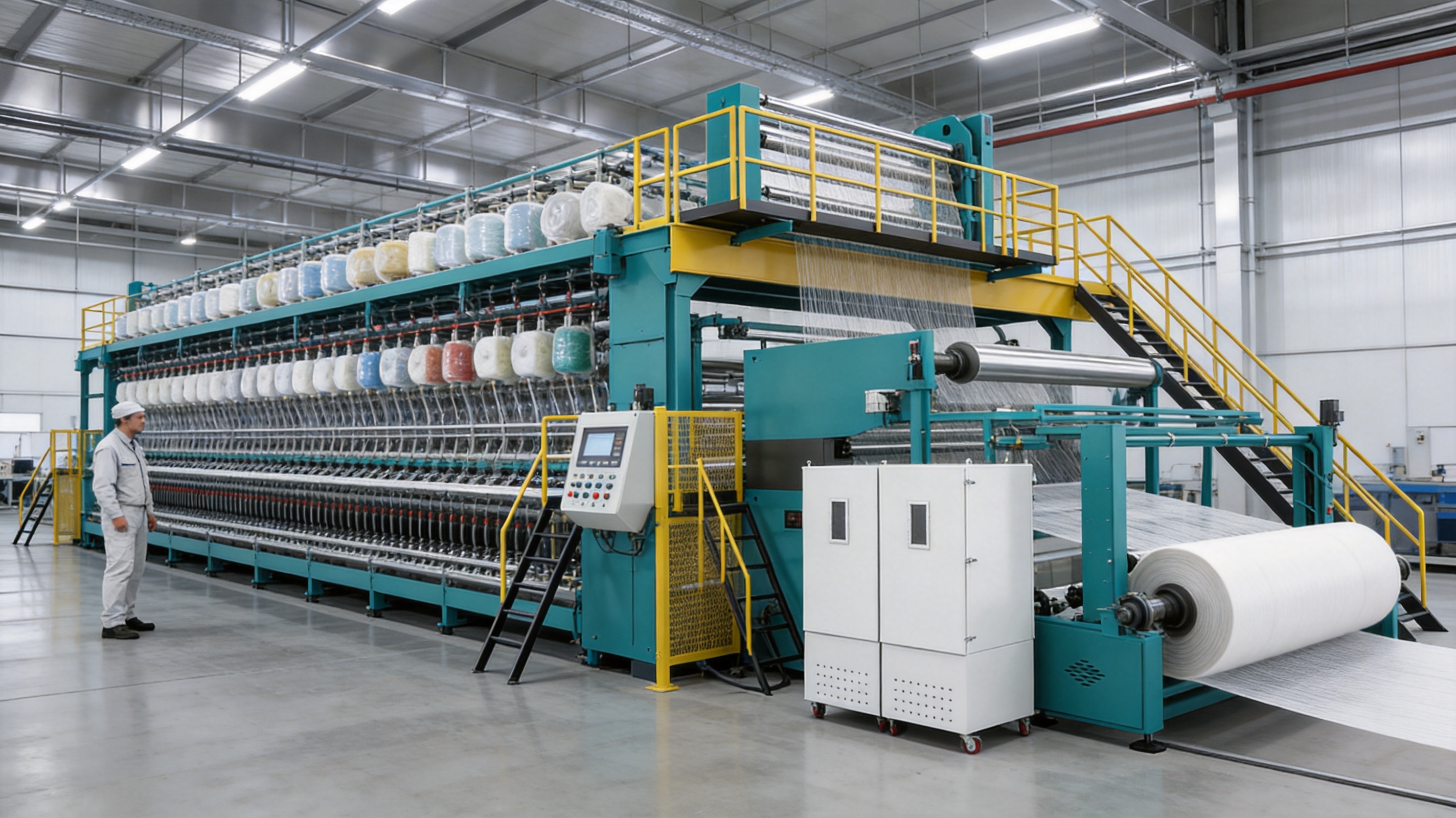
The integrated chopping unit is a central feature of this machine. It allows chopped fibers to be incorporated into the fabric line without requiring a separate mat-production process followed by an additional bonding or laminating operation.
When a chopped layer is needed, the fiber is cut and distributed beneath the directional yarns. The layer can be specified within a typical range of 50–500 g/m². This allows manufacturers to develop constructions with additional thickness, coverage, surface conformity, or resin-flow characteristics.
Integrating the chopping function into the warp knitting line can provide several practical advantages. It reduces the number of separate processing stages, limits intermediate material handling, and allows the chopped layer and directional yarn system to be produced as one coordinated textile. Fewer independent operations can also simplify production planning and reduce the risk of misalignment between separately manufactured layers.
The chopping unit must operate in coordination with yarn delivery, tension control, knitting speed, and fabric take-up. If the chopped fiber feed is inconsistent, the final fabric may show variations in mass or appearance. For this reason, the machine is configured with attention to the relationship between cutting, distribution, substrate support, and stitch formation.
Manufacturers can also choose a suitable nonwoven fabric instead of, or in combination with, a chopped layer. This option is useful where the required composite construction calls for a preformed support, additional surface coverage, or a different resin-handling behavior.
Fabric Construction and Application Flexibility
The YRS3-M-F-II can produce greige fabrics in a typical weight range of 300–2000 g/m². This broad range gives composite manufacturers room to develop lightweight, medium-weight, and heavy reinforcement products on one equipment platform.
A lighter construction may be selected where drape, mold conformity, or reduced laminate thickness is important. A heavier construction may be preferred for large structural components that require a high fiber content or substantial reinforcement per layer. The final fabric weight is determined by yarn type, yarn density, directional ratio, chopped layer, nonwoven selection, and machine settings.
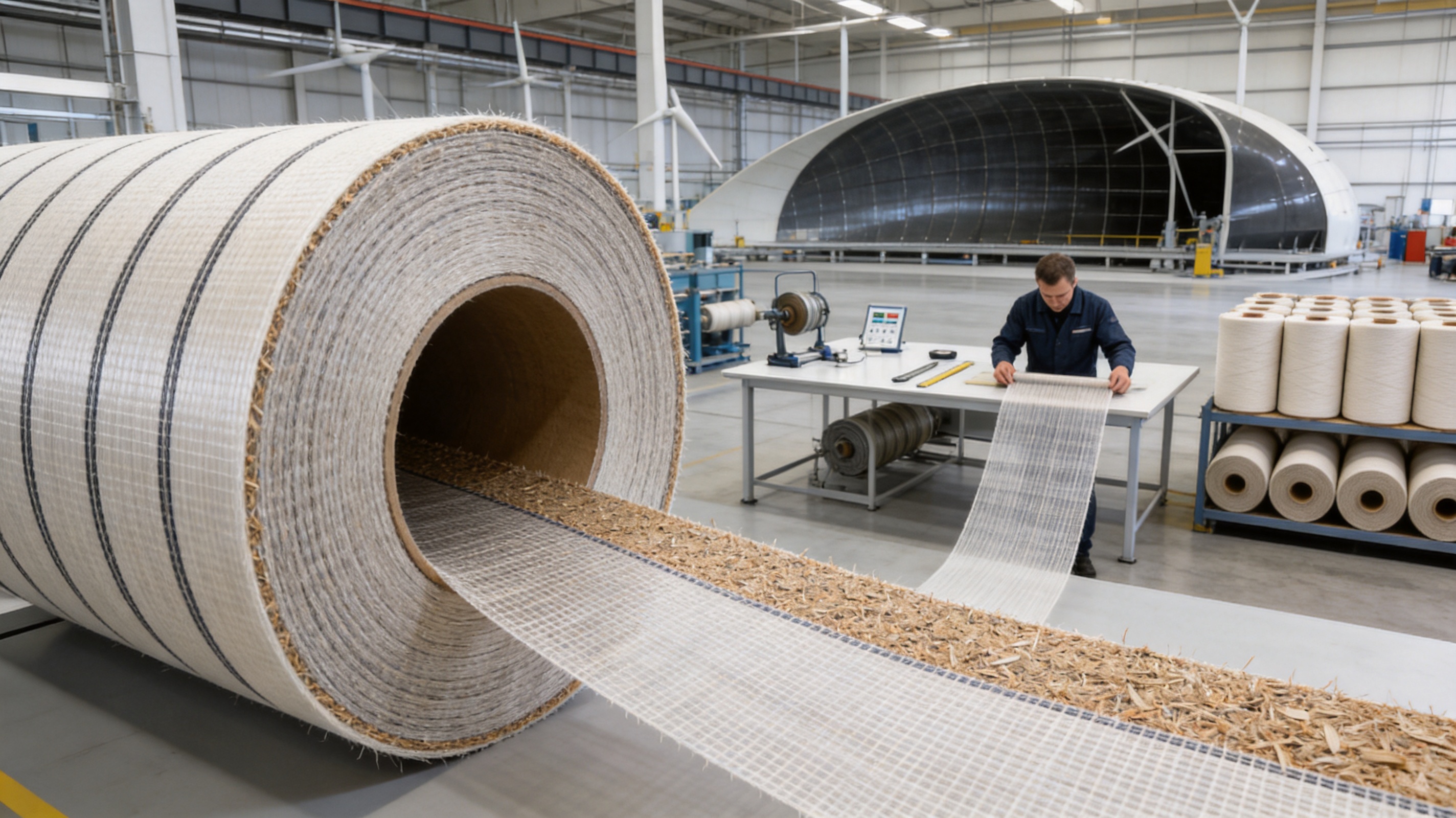
The equipment is applicable to wind-power products and nacelle covers, but its potential use is not limited to those areas. It can also be considered for composite panels, industrial covers, transportation structures, marine components, construction reinforcement, and other products that use glass-fiber or polyester-based textiles.
In wind-power manufacturing, reinforcement fabrics may need to cover large areas while maintaining consistent weight and orientation. A full-width machine with a nominal working width of 103 inches can help support the production of wide rolls and reduce the number of seams or overlaps required during lay-up. The appropriate trim width should be confirmed against the customer’s downstream cutting and molding process.
For nacelle covers and similar enclosure components, the fabric may need to combine surface coverage with controlled reinforcement. A chopped layer can help fill the structure and support the development of a suitable laminate thickness, while the 0°/90° yarn arrangement provides a defined reinforcement framework.
Core Technical Specifications
| Parameter | Specification | Production Consideration |
|---|---|---|
| Machine type | Raschel chopped fiber biaxial warp knitting machine | Combines warp knitting, biaxial weft insertion, and chopping |
| Applicable fibers | Glass fiber and polyester | Final yarn specification is confirmed during configuration |
| Machine speed | 50–1000 r/min | Actual operating speed depends on fabric construction |
| Nominal working width | 103 inches | Trim and usable width should be confirmed for the project |
| Lay direction | 0°/90° | Directional weight ratio can be customized |
| Optional chopped layer | 50–500 g/m² | Introduced beneath the directional yarns |
| Typical greige fabric weight | 300–2000 g/m² | Depends on yarn density and layer selection |
| Reference daily output | 3000 kg | Actual output varies with weight, speed, and construction |
These figures are reference values rather than universal production guarantees. Actual performance depends on fiber characteristics, yarn tex, package quality, fabric architecture, operator settings, speed limits, maintenance condition, and the level of process control used by the customer.
Working Width and Full-Width Production
The nominal working width of the YRS3-M-F-II is 103 inches in the 0°/90° configuration. A wide working width is particularly useful for composite textile producers supplying large components. It can increase roll productivity and reduce the need to join multiple narrow fabric sections.
Full-width production can also improve material utilization. When the fabric width corresponds closely to the mold or cutting plan, less edge waste may be generated. The actual economic benefit depends on component geometry, trim allowance, roll width, and the customer’s cutting method.
Working width must be considered together with yarn delivery, edge formation, fabric take-up, and downstream roll handling. During the technical review, the manufacturer confirms the nominal width, usable width, edge quality, and trim requirements. This prevents a mismatch between the machine’s theoretical width and the width needed by the customer’s production line.
Comparison with Conventional Alternative Equipment
Many reinforcement fabric lines are designed around one primary function. Some machines produce only directional biaxial fabrics, while others produce only chopped mats or feed a separate nonwoven layer. The YRS3-M-F-II is differentiated by combining these functions within one coordinated Raschel warp knitting platform.
| Production Approach | Typical Limitation | YRS3-M-F-II Benefit |
|---|---|---|
| Random chopped strand mat only | Limited control of primary reinforcement direction | Provides defined 0°/90° directional yarn placement with an optional chopped layer |
| Separate chopped mat and biaxial fabric lines | Requires additional handling, storage, and bonding or assembly steps | Integrates chopping and biaxial knitting in one production process |
| Fixed-ratio biaxial equipment | Less flexibility for products with different directional load requirements | Allows the 0°/90° weight ratio to be customized |
| Narrow-width equipment | May require more seams or parallel strips for large components | Offers a nominal 103-inch working width |
| Basic textile machinery without application support | Customer must independently solve commissioning and process development | Includes configuration, commissioning, training, and technical support |
The comparison does not mean that one machine is suitable for every fabric product. Woven, stitched, random-mat, multiaxial, and nonwoven technologies each have their own applications. The advantage of the YRS3-M-F-II is its suitability for manufacturers that specifically need orderly biaxial laying together with an optional chopped or nonwoven layer.
It can also reduce the need for separate equipment when a customer’s product range includes both directional composite fabrics and chopped-layer constructions. The value of this approach is greatest where production flexibility, reduced handling, and integrated process control are important.
Processability and Resin Flow Considerations
One stated advantage of the fabric produced by this machine is excellent forming processability and efficient flow guidance. These characteristics are relevant to composite manufacturing because textile reinforcement must conform to molds, maintain its intended position, and allow resin to travel through the laminate during impregnation.
The orderly yarn arrangement can create defined flow paths within the reinforcement structure. The chopped layer or nonwoven layer may influence surface coverage, thickness, permeability, and resin distribution. The final result depends on the fabric architecture and resin system, so production trials remain necessary before a customer selects a construction for a specific component.
Forming behavior is affected by stitch density, yarn type, directional ratio, fabric weight, and the amount of chopped material. A configuration that is ideal for a flat panel may not be ideal for a deeply curved mold. For this reason, Yuanyang reviews the customer’s target component and fabric requirements before finalizing the machine configuration.
The machine does not replace composite process development. Instead, it gives fabric manufacturers a controlled platform for developing fabrics with repeatable characteristics. Once the fabric construction is established, the customer can evaluate drape, permeability, tensile behavior, wet-out, thickness, and laminate performance through standard production trials.
Configuration Variables
Each YRS3-M-F-II project is treated as a configured machine rather than a completely fixed catalogue item. This is necessary because fabric construction, fiber supply, plant layout, and downstream processing differ from one customer to another.
Fiber Type and Yarn Specification
The applicable fibers include glass fiber and polyester. The customer should provide the fiber type, yarn count, tex, package format, sizing information, and any special handling requirements. These details affect the creel arrangement, tension system, yarn guides, chopping settings, and acceptable operating speed.
Target Areal Weight
The target fabric weight determines yarn density, layer selection, speed range, and output expectations. A high-weight greige fabric may require lower operating speed or different delivery settings than a lighter construction. The customer should provide the required weight tolerance as well as the nominal target.
Directional Weight Ratio
The 0°/90° ratio is selected according to the mechanical requirements of the finished composite. Some products may need a balanced construction, while others may require a greater proportion of reinforcement in one direction. The ratio should be established before final machine drawings and process parameters are approved.
Chopped or Nonwoven Layer
The customer must specify whether a chopped fiber layer is required, whether a nonwoven fabric will be used, and what weight range is expected. The optional chopped layer is typically between 50 and 500 g/m². If the project uses a nonwoven material, its width, basis weight, roll format, thickness, and handling behavior should be provided.
Line Interface and Roll Handling
The machine may need to communicate with upstream and downstream equipment. Speed signals, tension feedback, roll change procedures, fabric inspection, winding, and packaging should be reviewed during layout design. Clear interface requirements help avoid later modifications after installation.
Manufacturing Strengths of the Supplier
Changzhou Yuanyang Electromechanical Technology Co., Ltd. is located in Jiangsu Province, a major center for China’s textile machinery industry. The company integrates research and development, manufacturing, sales, installation, commissioning, and service.
Its product portfolio includes stitch-bonding machines, biaxial warp knitting machines, multiaxial warp knitting machines, carbon-fiber multiaxial warp knitting machines, powder scattering machines, web laying machines, and specialized textile equipment. This broader technical background supports the development of machines for reinforcement fabrics and other difficult-to-process materials.
The company operates a production base of more than 12,000 square meters, including standardized workshops, an intelligent warehouse, and dedicated inspection areas. Such facilities are important for large textile machines because quality depends on more than final assembly. Frame accuracy, machined parts, guide alignment, drive coordination, electrical integration, tension components, and safety systems must all be controlled throughout manufacturing.
Advanced Manufacturing Process
Engineering and Structural Design
The manufacturing process begins with technical review and machine design. Engineers assess the customer’s fabric construction, fiber type, working width, production target, optional layer, and workshop conditions. The mechanical structure and functional modules are then designed around the required process window.
For non-standard projects, the design may include structural redesign, module integration, process optimization, or adjustment of the machine layout. This capability is useful when customers work with unusual yarns, demanding fabric weights, restricted workshop dimensions, or specialized downstream systems.
Component Procurement and Inspection
Critical components must be selected according to their role in the machine. Chopping elements, yarn guides, weft insertion parts, drive components, tension systems, bearings, sensors, and electrical equipment all influence running stability. Incoming parts are checked before assembly to ensure that specifications and quality requirements are met.
Controlled procurement also supports serviceability. When standard components and documented specifications are used where appropriate, replacement and maintenance can be managed more efficiently throughout the machine’s operating life.
Precision Machining and Assembly
Machined parts are produced and inspected according to engineering drawings. Assembly requires attention to alignment, clearances, drive synchronization, yarn path geometry, and access for maintenance. On a warp knitting machine, small alignment errors can become visible as tension variation, stitch instability, edge defects, or uneven fabric formation.
The assembly team therefore checks mechanical relationships step by step rather than treating the machine as a collection of independent components. The chopping unit, weft insertion system, knitting elements, take-up mechanism, and control system must work together as one process line.
Electrical and Control Integration
The electrical control system is integrated with the mechanical functions of the machine. Operating speed, tension settings, safety functions, production signals, and line interfaces are reviewed during commissioning. Control parameters can be adjusted to match the fabric construction and the customer’s process requirements.
A suitable control strategy helps operators manage speed changes, start-up conditions, material transitions, and production monitoring. The objective is not simply to achieve a high maximum speed, but to maintain stable production within the speed range suitable for the selected fabric.
Factory Testing
Every machine is tested before dispatch. Testing may include mechanical operation, electrical functions, speed control, yarn-path checks, chopping performance, weft insertion, fabric take-up, and safety systems. Where project conditions permit, sample fabric production is used to verify that the machine can produce the agreed construction.
Factory testing provides an opportunity to identify issues before shipment. It also gives the installation team a reference for commissioning at the customer’s plant. Test records and configuration details can support later troubleshooting and operator training.
Quality Control and Production Stability
Quality control is applied throughout the manufacturing process rather than only at final inspection. The company describes a staged approach covering component procurement, machining, assembly, testing, and debugging.
For a chopped fiber biaxial machine, important quality points include:
Accuracy of the working width and edge-forming system.
Consistency of yarn delivery and tension control.
Alignment of the weft insertion components.
Synchronization between the chopping unit and fabric formation system.
Stability of stitch formation at the agreed speed.
Uniformity of the chopped layer.
Reliable communication between machine controls and line equipment.
Accessibility of wear parts and maintenance points.
Stable production is especially important for heavy greige fabrics. Higher material throughput places greater demands on yarn supply, take-up, drive systems, and structural rigidity. The machine must remain mechanically stable while processing the selected yarns and layer weights.
Installation and Commissioning
Installation is a major part of the equipment supply process. A large warp knitting machine must be positioned correctly, connected to utilities, aligned, and integrated with the customer’s material handling and production systems.
Yuanyang’s engineers support installation and commissioning at the customer’s factory. They check machine positioning, electrical connections, operating conditions, yarn paths, tension settings, chopping-unit parameters, and initial fabric production. The objective is to bring the line to the agreed fabric specification rather than merely completing mechanical assembly.
Commissioning normally proceeds through several stages. The machine is first checked without production material, followed by low-speed operation with yarns. Operators then review stitch formation, insertion, chopping, fabric take-up, and roll handling. Speed and production weight are increased after the basic process is stable.
Acceptance can be based on agreed fabric characteristics, including areal weight, directional ratio, chopped-layer uniformity, fabric appearance, and running stability at the specified working speed. Clear acceptance criteria protect both the equipment supplier and the customer by defining how performance will be evaluated.
Operator Training and Technical Documentation
Training is provided for knitters, maintainers, and workshop management personnel. Operators learn how to thread the machine, set yarn tension, adjust production parameters, identify common defects, and perform routine cleaning and inspection.
Maintenance personnel receive instruction on wear points, lubrication, drive inspection, sensor checks, spare-part replacement, and safe access procedures. Management and quality personnel can be trained to understand production records, acceptance criteria, process deviations, and corrective actions.
The company can also assist with quality-system documentation. This may include equipment records, process-setting sheets, inspection forms, maintenance schedules, start-up procedures, and production control documents. Proper documentation helps the customer create a repeatable process instead of relying only on individual operator experience.
For complex projects, training may be conducted on site or at the manufacturer’s workshop over a period of one to two months. The appropriate training period depends on machine configuration, product complexity, operator experience, and the customer’s commissioning plan.
Maintenance and Serviceability
The chopping unit and weft insertion elements are among the primary wear areas of the machine. These parts should be checked regularly because wear can affect cutting quality, yarn placement, fabric appearance, and operating stability.
At each shift handover, operators should review the yarn path, tension condition, stitch formation, fabric edges, chopped-layer uniformity, and unusual noise or vibration. Early detection of deviations can prevent a small issue from becoming a production stoppage.
A practical maintenance program should include:
Routine cleaning around yarn guides, knitting elements, and the chopping unit.
Inspection of cutting elements and replacement when wear reaches the permitted limit.
Checking yarn tension and package unwinding conditions.
Inspection of weft insertion components and guide alignment.
Verification of drive, sensor, and safety-system operation.
Lubrication and preventive maintenance according to the machine schedule.
Recording of defects, adjustments, replacement parts, and production interruptions.
Yuanyang supports spare parts and consumables through its after-sales network. Long-term technical assistance is also available for production problems after handover. This service is valuable when the customer changes fabric construction, introduces a new yarn, or needs to optimize the process for a different composite application.
Production Troubleshooting
Uneven Chopped Layer
Uneven chopped-fiber distribution may result from inconsistent fiber feed, cutting-element wear, incorrect operating speed, material variation, or unsuitable settings between the chopping unit and substrate. The first checks should include fiber supply, cutter condition, feed tension, machine synchronization, and layer weight measurement across the fabric width.
Directional Weight Variation
Variation between the 0° and 90° systems can be caused by yarn supply differences, incorrect delivery settings, tension instability, or a change in machine speed. Operators should compare yarn package conditions, confirm the selected ratio, and measure fabric weight separately in the two principal directions where possible.
Edge Defects
Edge quality may be affected by working-width settings, trim alignment, yarn tension, guide condition, and take-up control. Since wide fabrics are often cut directly for large composite components, stable edges can reduce material waste and improve downstream handling.
Stitch or Surface Irregularities
Irregular stitch formation may be associated with yarn damage, incorrect threading, contamination, worn guides, unsuitable tension, or operating conditions outside the recommended process window. A systematic inspection of the yarn path and knitting elements is usually more effective than making multiple adjustments at the same time.
Information Required for a Firm Configuration
Customers seeking a firm machine configuration and quotation should provide as much project information as possible. The following inputs help engineers select the appropriate modules and define realistic performance expectations.
| Required Input | Reason for Review |
|---|---|
| Target fabric construction | Defines yarn arrangement, layer selection, and process requirements |
| Target areal weight and tolerance | Supports speed, density, and output calculations |
| Fiber type, tex, and package format | Determines creel, tension, guide, and chopping requirements |
| Required 0°/90° ratio | Establishes directional yarn delivery and fabric balance |
| Chopped layer specification | Confirms whether the chopping unit is needed and defines its range |
| Nonwoven requirement | Determines the need for an additional feed or support system |
| Required working width and trim | Confirms whether the nominal 103-inch platform matches production needs |
| Daily output target | Helps calculate line balance and realistic operating speed |
| Workshop dimensions and utilities | Supports layout, installation, power, and maintenance access planning |
| Downstream process | Defines roll handling, winding, inspection, cutting, and interface requirements |
If some values are not yet fixed, the engineering team can propose a starting configuration for discussion. Final settings should be confirmed during drawing review, sample development, and acceptance planning.
Position Within the Fiberglass Textile Equipment Range
The YRS3-M-F-II occupies a specialized position within a broader fiberglass textile equipment portfolio. It is intended for applications that need both directional biaxial reinforcement and an optional chopped or nonwoven layer.
| Model or Equipment Type | Main Function | Typical Positioning |
|---|---|---|
| YRS3-M-F-I Raschel Chopped Fiber Biaxial Warp Knitting Machine | Chopped fiber biaxial fabric production | HX configuration for chopped mats and composite fabrics |
| YRS3-M-F-II Raschel Chopped Fiber Biaxial Warp Knitting Machine | Chopped fiber biaxial fabric production | HS configuration for wind power, nacelle covers, and related structures |
| YRS3-M-H High Strength Biaxial Warp Knitting Machine | Biaxial reinforcement without integrated chopping | Structural reinforcement fabrics requiring high-strength directional construction |
| YRS3-M-V Biaxial Warp Knitting Machine with Nonwoven Fabric | Biaxial fabric with nonwoven feed | Composite fabrics requiring an integrated nonwoven layer |
The correct model depends on the customer’s fabric construction rather than on a simple preference for one machine name. Yuanyang reviews the material, output, layer structure, and application before recommending the configuration.
Why Choose an Integrated Equipment Partner
Buying a machine for composite textile production involves more than comparing speed and width. The customer also needs confidence that the supplier understands the relationship between mechanical design and fabric performance.
An integrated equipment partner can help coordinate the following areas:
Machine structure and fabric width.
Fiber package handling and tension control.
Chopping-unit design and layer uniformity.
0°/90° ratio and fabric areal weight.
Electrical control and line communication.
Installation and plant layout.
Operator and maintenance training.
Spare parts and after-sales support.
Yuanyang’s experience with biaxial, multiaxial, stitch-bonding, carbon-fiber, powder-scattering, and web-laying equipment gives it a broader understanding of reinforcement-textile production. This background supports customization for demanding fabrics and difficult materials.
Economic and Operational Considerations
The economic value of the YRS3-M-F-II should be evaluated across the complete production process. A machine with integrated chopping can reduce the need for separate mat production and intermediate handling. Full-width production may improve material utilization for large components. Adjustable directional ratios can allow one platform to serve multiple product specifications.
However, output should always be calculated from the actual fabric construction. The reference figure of 3000 kg per day does not apply identically to every product. Heavy fabrics, high chopped-layer weights, difficult yarns, frequent product changes, and conservative operating speeds can all reduce production volume.
A realistic calculation should consider machine speed, fabric weight, usable width, operating efficiency, shift schedule, changeover time, maintenance, raw-material availability, inspection, and roll handling. Customers should use trial data and agreed process assumptions when preparing a production forecast.
Frequently Asked Questions
What type of machine is the YRS3-M-F-II?
It is a Raschel chopped fiber biaxial warp knitting machine with an integrated chopping unit. It produces 0°/90° weft-inserted reinforcement fabrics and can add a chopped or nonwoven layer beneath the yarns.
Which fibers can the machine process?
The stated applicable fibers are glass fiber and polyester. Final compatibility depends on yarn construction, tex, package format, sizing, tension behavior, and the required fabric architecture.
Can the 0°/90° ratio be customized?
Yes. The weight ratio between the 0° and 90° directions can be customized according to the load requirements and laminate design of the customer’s product.
What chopped-layer weights are available?
The optional chopped layer is typically specified from 50 to 500 g/m². The final range should be confirmed against the fiber type, construction, and machine configuration.
Can a nonwoven fabric be used instead of a chopped layer?
Yes. A suitable nonwoven fabric can be added beneath the yarns where the product requires a different support, surface, thickness, or resin-handling characteristic.
What is the typical finished fabric weight?
The greige fabric weight typically ranges from 300 to 2000 g/m². Actual weight depends on yarn density, directional ratio, chopped-layer selection, nonwoven material, and process settings.
What is the machine speed?
The reference machine speed is 50–1000 r/min. The appropriate operating speed depends on the fiber, yarn, fabric structure, layer weight, and required quality level.
What is the working width?
The nominal working width is 103 inches for the 0°/90° configuration. Usable width and trim should be confirmed according to the customer’s product and downstream cutting requirements.
What daily output can be expected?
The reference daily output is 3000 kg. Actual output may be higher or lower depending on fabric construction, areal weight, operating speed, utilization, material supply, product changes, and process stability.
Is the machine suitable for wind-power fabrics?
Yes. The machine is positioned for wind-power applications and nacelle covers because it can produce wide, directional reinforcement fabrics with adjustable 0°/90° balance and an optional chopped layer.
How does the machine differ from a random chopped strand mat line?
A random chopped strand mat line produces fibers with predominantly random orientation. The YRS3-M-F-II combines a chopped layer with orderly 0°/90° yarn insertion, providing greater control over the main reinforcement directions.
How does it differ from a machine without an integrated chopping unit?
A machine without integrated chopping may produce directional fabric only, requiring a separate process for the chopped layer. The YRS3-M-F-II combines the directional yarn structure and chopping function in one coordinated line.
Does the supplier provide installation and commissioning?
Yes. Engineers support installation, commissioning, and process start-up at the customer’s factory. Acceptance can be based on agreed fabric characteristics and operating conditions.
Is operator training available?
Yes. Training can cover machine operation, yarn threading, tension adjustment, chopping-unit operation, routine inspection, maintenance, troubleshooting, and quality documentation.
Can the machine be customized for a non-standard plant layout?
Customization may include structural adjustment, functional module integration, layout redesign, and process-oriented optimization. The customer should provide workshop dimensions, utility information, material flow, and downstream equipment details.
Which parts require the most maintenance?
The chopping unit and weft insertion elements are primary wear points. Yarn guides, tension components, stitch-forming parts, drive systems, sensors, and take-up components should also be inspected according to the maintenance schedule.
How is machine performance accepted?
Acceptance may evaluate areal weight, 0°/90° direction ratio, chopped-layer uniformity, fabric appearance, operating speed, running stability, and other criteria agreed during the technical review.
Conclusion
The YRS3-M-F-II Raschel Chopped Fiber Biaxial Warp Knitting Machine is designed for manufacturers that need more than a conventional chopped mat or a fixed-ratio biaxial fabric line. Its integrated chopping unit, 0°/90° weft insertion, customizable directional balance, wide working width, and optional nonwoven feed provide a flexible foundation for advanced fiberglass textile production.
Its principal advantages are process integration, directional control, broad fabric-weight capability, and suitability for large composite applications. By combining chopped fiber and biaxial reinforcement in one coordinated production platform, the machine can help reduce intermediate handling and support the development of fabrics with efficient forming and resin-flow characteristics.
The value of the equipment is strengthened by Yuanyang’s manufacturing and engineering capabilities. Standardized workshops, staged quality control, dedicated inspection, in-house research and development, factory testing, installation support, operator training, and after-sales service allow the supplier to address the complete life cycle of the machine.
For a successful project, customers should define the fabric architecture, fiber and yarn specification, directional ratio, chopped or nonwoven layer, target areal weight, working width, daily output, plant layout, and downstream process. With these inputs, the machine can be configured around a realistic production objective rather than a generic catalogue specification.
As composite manufacturers seek lighter, stronger, wider, and more process-efficient reinforcement textiles, an integrated biaxial warp knitting platform can provide a practical route to product diversification and stable industrial production. The YRS3-M-F-II is positioned to meet that requirement in wind power, nacelle covers, and other fiberglass composite applications.
References
1. Changzhou Yuanyang Electromechanical Technology Co., Ltd. Product information for the YRS3-M-F-II Raschel Chopped Fiber Biaxial Warp Knitting Machine.
2. Changzhou Yuanyang Electromechanical Technology Co., Ltd. Technical information on biaxial warp knitting machinery, fiberglass textile equipment, and composite fabric production.
3. General principles of warp knitting, weft insertion, stitch-bonded reinforcement fabrics, and multiaxial textile construction.
4. General composite-material production practice concerning reinforcement areal weight, fiber orientation, resin flow, laminate forming, and fabric handling.
5. General industrial guidelines for textile machinery commissioning, preventive maintenance, operator training, and production acceptance.
Product: YRS3-M-F-II Raschel Chopped Fiber Biaxial Warp Knitting Machine(HS)

News
-
Three quotations land on the same desk for the same polyester nonwoven line, and on paper they look interchangeable. Each is priced per metre of working width. Each quotes a similar top speed. Each c...
READ MORE -
Two quotations land on the same desk. Both offer a multiaxial warp knitting line, both list the same working width, both promise high output. One buyer signs and discovers six months later that the f...
READ MORE -
Match the machine type to the fabric: choose a tricot Warp Knitting Machine for fine, smooth fabrics such as lining and sportswear, a raschel machine for open, patterned, and technical fabrics, a doub...
READ MORE -
Two buyers open the same catalogue and both ask for a warp knitting machine. One needs a 4.5 m wide glass-fibre geogrid with 0° and 90° yarns stitched together for a soil-reinforcement contract; the ...
READ MORE
-
Contact Info.
+86-198 5534 1617
+86-134 0158 3002yuanyang@yywarpknitting.com 699#, Shengzhi West Rd, Lvcheng Town, Danyang City, Zhenjiang City, Jiangsu Province, China

-
QR Code
-
Quick Links
Home About Products Manufacturing Customization News Contact -
Product List
Machine for Chemical Fiber Textile Machine for Fiberglass Textile Machine for Carbon Fiber Textile -
About Us
Company Profile Factory Gallery Value-added Service
Copyright © 2026 Changzhou Yuanyang Electromechanical Technology Co., Ltd. All Rights Reserved.
Custom Warp Knitting Machine Manufacturers
