

 English
 中文简体
 русский
 Français
 Español
 Deutsch

YRS3-M-F-II Raschel Chopped Fiber Biaxial Warp Knitting Machine (HS): Integrated Production for High-Performance Fiberglass Reinforcement Fabrics
2026-10-09
Content
- 1 1. The Role of Controlled Reinforcement Fabrics in Composite Manufacturing
- 2 2. What the YRS3-M-F-II Machine Produces
- 3 3. Main Advantages Compared with Conventional Production Methods
- 4 4. Applications in Wind Power and Composite Structures
- 5 5. Technical Specifications
- 6 6. Production Process and Machine Configuration
- 7 7. Configuration Choices Confirmed Before Production
- 8 8. Manufacturing Strengths of Changzhou Yuanyang Electromechanical Technology Co., Ltd.
- 9 9. Installation, Commissioning, and Acceptance
- 10 10. Maintenance and Serviceability
- 11 11. Comparison with Related Machine Platforms
- 12 12. Process and Commercial Benefits for Manufacturers
- 13 13. Recommended Project Evaluation Procedure
- 14 14. Frequently Asked Questions
- 14.1 What type of fabric does the YRS3-M-F-II produce?
- 14.2 Is the chopped fiber randomly distributed?
- 14.3 Can the 0°/90° ratio be changed?
- 14.4 What fibers can be processed?
- 14.5 What is the available chopped layer weight?
- 14.6 Can a nonwoven fabric be used instead of chopped fibers?
- 14.7 What is the normal greige fabric weight range?
- 14.8 What is the maximum machine speed?
- 14.9 What is the reference daily output?
- 14.10 What industries can use the fabrics?
- 14.11 How is the machine accepted after installation?
- 14.12 Does the supplier provide installation and training?
- 14.13 How does the HS model differ from the HX model?
- 14.14 Can the machine be customized?
- 15 15. Conclusion
- 16 References
- 17 Product: YRS3-M-F-II Raschel Chopped Fiber Biaxial Warp Knitting Machine(HS)
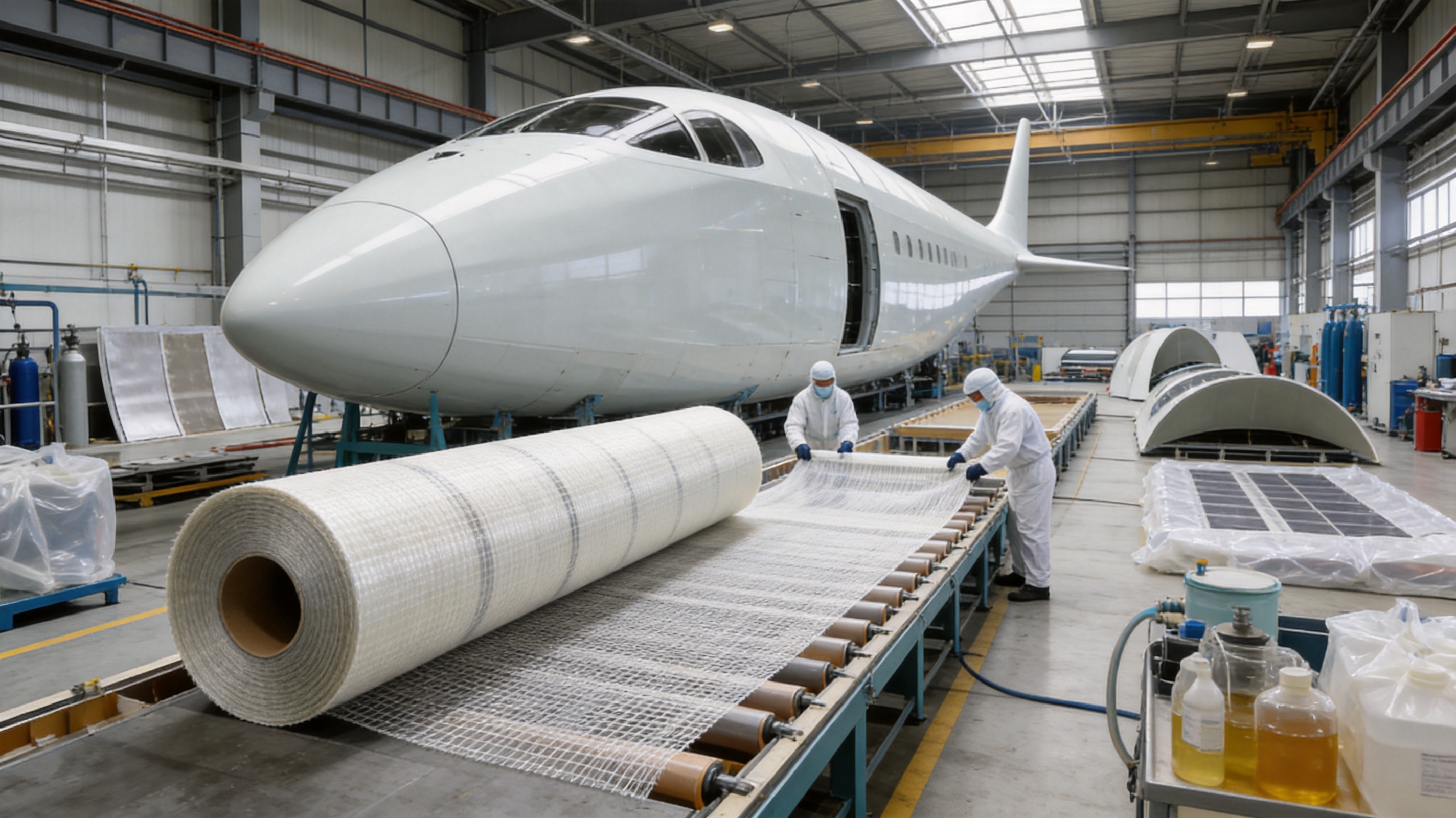
Advanced composite manufacturing increasingly depends on reinforcement fabrics that combine controlled fiber orientation, stable areal weight, efficient resin flow, and dependable production output. For manufacturers serving wind power, nacelle covers, transportation, construction, marine, and other composite applications, the reinforcement textile is not simply an intermediate material. It directly influences laminate strength, forming behavior, resin consumption, production efficiency, and final product consistency.
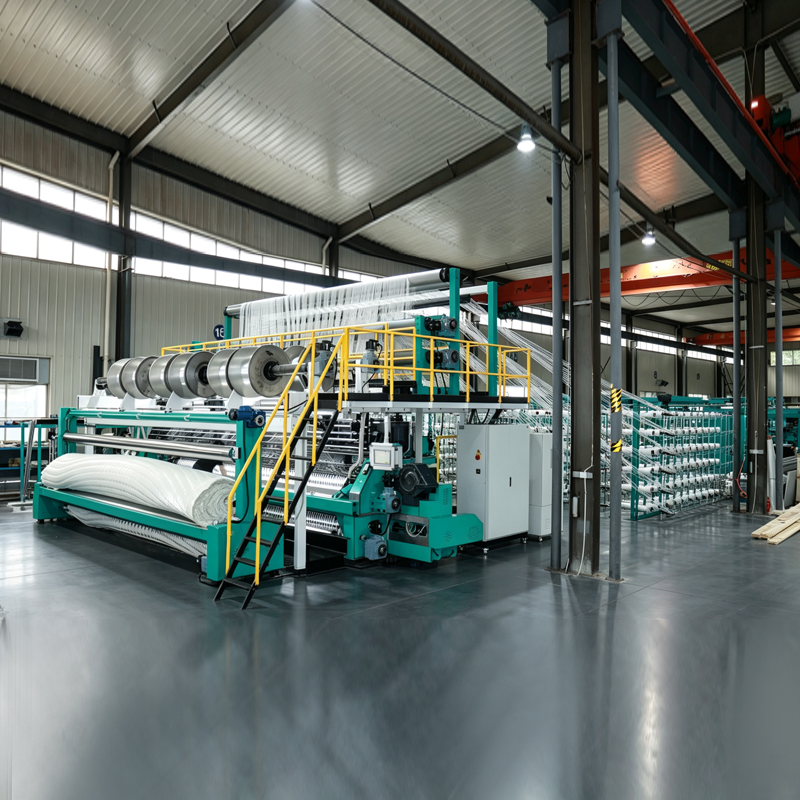
The YRS3-M-F-II Raschel Chopped Fiber Biaxial Warp Knitting Machine (HS) is designed for this demanding production environment. Developed by Changzhou Yuanyang Electromechanical Technology Co., Ltd., the machine combines biaxial warp knitting, full-width 0°/90° weft insertion, and an integrated chopping unit on one production platform. It produces ordered reinforcement fabrics in which the weft yarns are laid in parallel directions rather than being randomly distributed as in conventional chopped strand mats.
This integrated construction gives composite manufacturers greater control over fabric architecture. The 0° and 90° weight ratio can be adjusted according to the target laminate, while a chopped fiber layer or a suitable nonwoven fabric can be introduced beneath the yarns. Typical greige fabric weights range from 300 to 2000 g/m², and the optional chopped layer can be configured within a range of 50 to 500 g/m².
With an indicative machine speed of 50–1000 r/min, a nominal working width of 103 inches, and a reference daily output of approximately 3000 kg, the YRS3-M-F-II is intended for industrial-scale production. Actual output depends on fabric construction, yarn specifications, areal weight, operating speed, and process settings. The machine is therefore configured around the customer’s target fabric rather than treated as a fixed, one-size-fits-all catalogue unit.
1. The Role of Controlled Reinforcement Fabrics in Composite Manufacturing
Composite structures are engineered by combining a reinforcing material with a polymer matrix. Glass fiber, polyester, carbon fiber, and other reinforcements provide load-bearing capability, while the matrix transfers stress and protects the fibers. The performance of the finished composite depends not only on the basic fiber type but also on how the fibers are distributed, oriented, stitched, and combined with other layers.
In many applications, the principal loads do not occur randomly. Wind turbine components, nacelle covers, marine panels, vehicle parts, construction profiles, and industrial housings are normally designed around known load directions. A reinforcement fabric with controlled orientation can therefore provide more efficient structural performance than a material in which the fibers are distributed without directional control.
Traditional chopped strand mats are valuable for many applications because they conform well to complex shapes and offer relatively uniform multidirectional reinforcement. However, a randomly oriented mat may not provide the directional efficiency required for high-load composite structures. It may also require additional reinforcement layers to achieve the desired strength along specific axes.
A biaxial fabric introduces reinforcing yarns in two controlled directions, commonly referred to as 0° and 90°. This arrangement allows the fabric designer to specify the amount of reinforcement carried in each direction. When a chopped layer is integrated beneath the oriented yarns, the resulting textile can combine directional strength, conformability, interlaminar support, and useful resin-flow characteristics.
The YRS3-M-F-II is designed around this combination. It does not merely produce a random chopped material. Instead, it forms a composite reinforcement textile with orderly parallel weft placement and an optional chopped or nonwoven substrate. This makes the machine particularly relevant to manufacturers seeking a more engineered alternative to separate chopped mat and biaxial fabric production.
2. What the YRS3-M-F-II Machine Produces
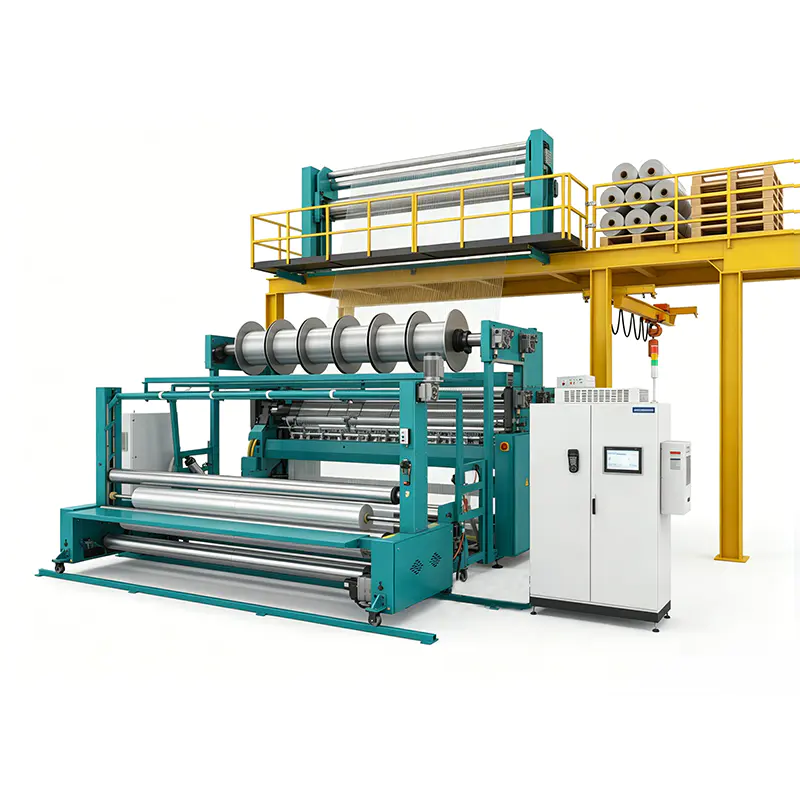
The YRS3-M-F-II is a Raschel chopped fiber biaxial warp knitting machine. Its production system brings together several coordinated functions:
- Warp yarn feeding in the machine direction.
- Full-width insertion of weft yarns across the working width.
- Controlled formation of 0°/90° reinforcement architecture.
- Optional chopping and deposition of chopped fibers.
- Optional feeding of a suitable nonwoven layer beneath the yarns.
- Warp knitting and stitching to stabilize the assembled layers.
- Take-up and roll formation for downstream handling.
During operation, the warp knitting system stabilizes the fabric structure while the weft insertion system places yarns in the required transverse direction. The chopping unit introduces chopped fibers when the construction calls for an integrated chopped layer. The machine can therefore produce full-width weft-inserted chopped mats and composite fabrics with a more clearly defined internal architecture than conventional random mats.
The directional ratio between the 0° and 90° layers is customizable. This is important because different composite products require different balances of longitudinal and transverse reinforcement. A panel subjected primarily to one directional load may require a different ratio from a cover or shell that experiences more balanced loading in two axes.
The machine can also be configured to produce a chopped layer between 50 and 500 g/m². In applications where a nonwoven substrate is preferred, a suitable nonwoven fabric can be fed beneath the yarns. These options allow the same basic platform to serve multiple product families and to adapt to evolving customer requirements.
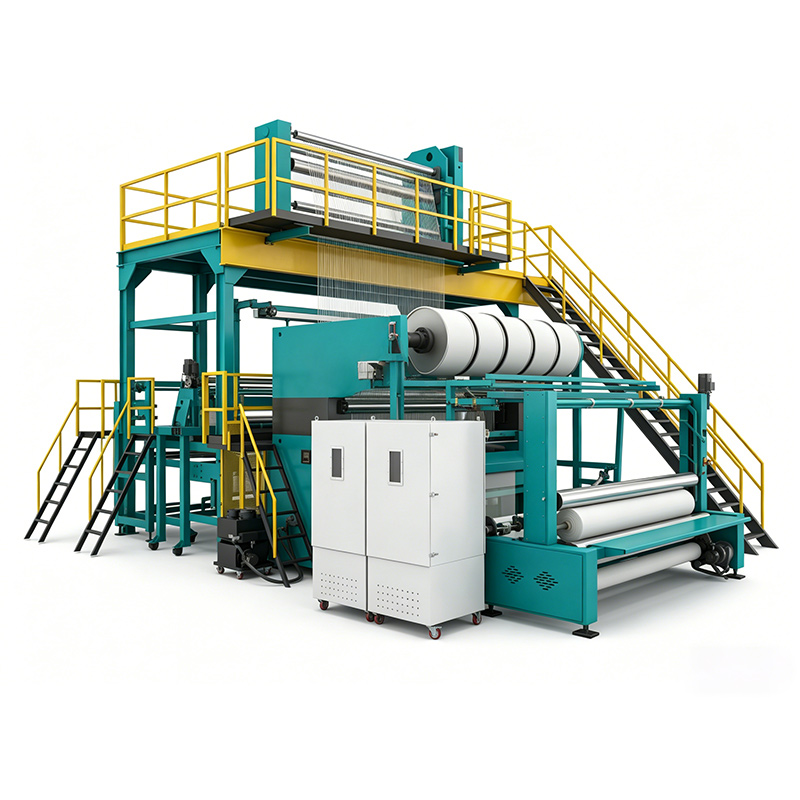
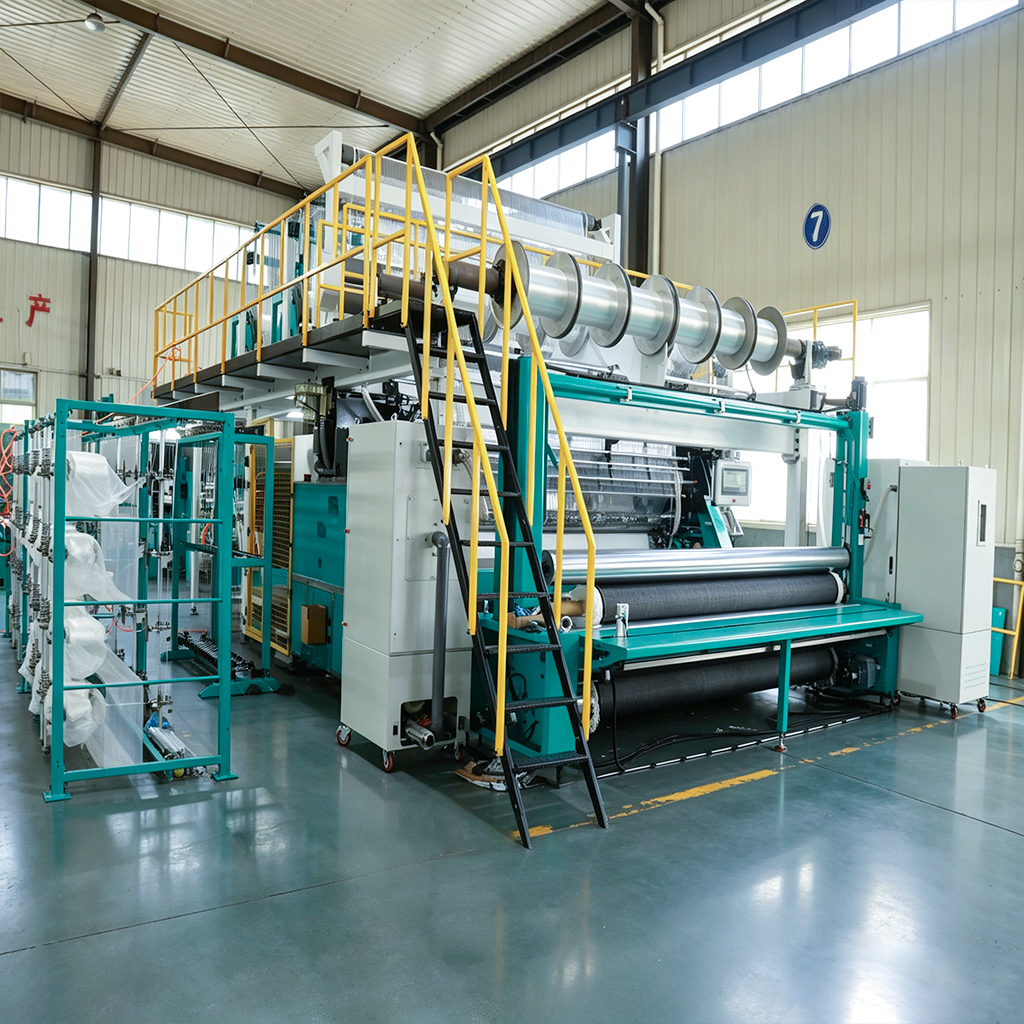
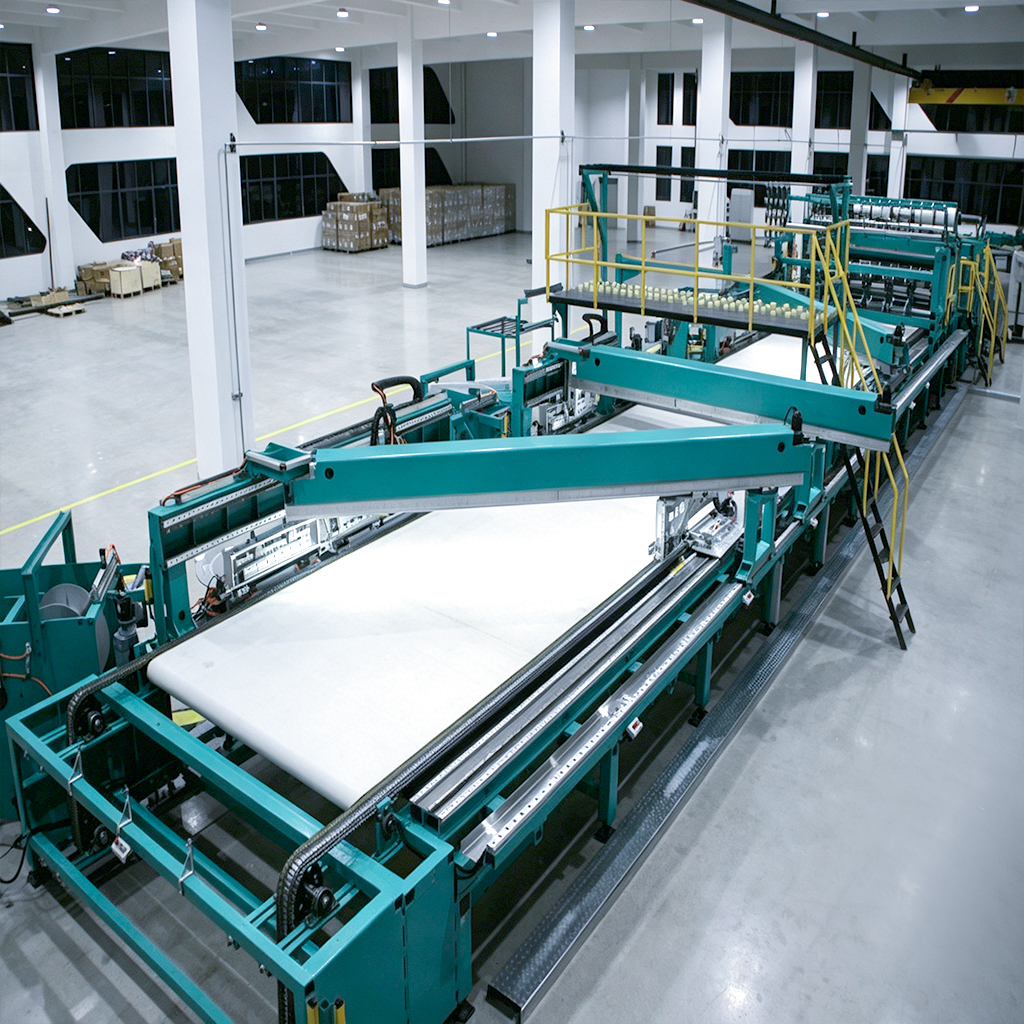
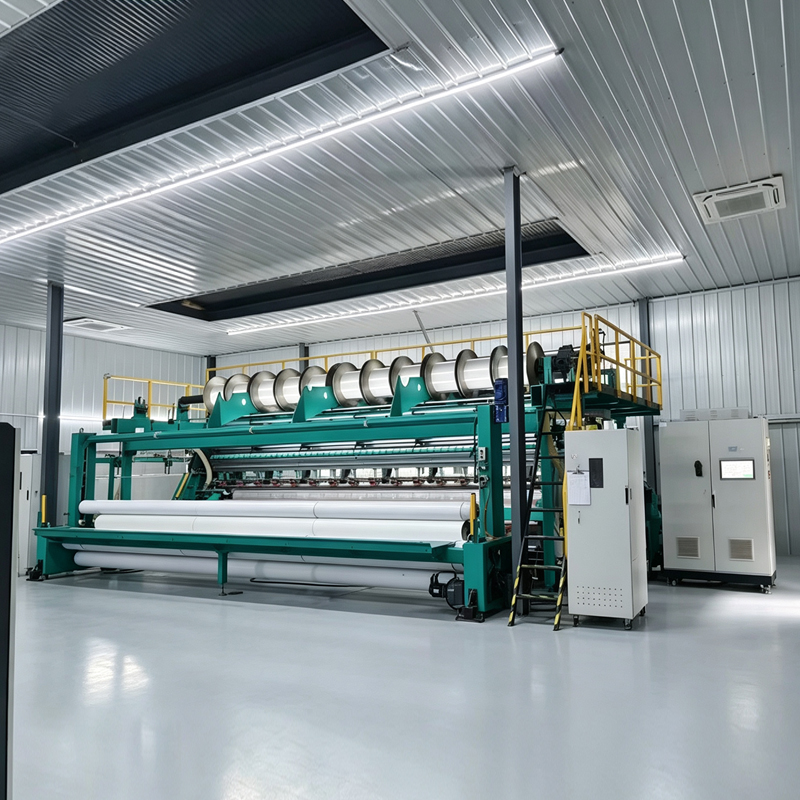
YRS3-M-F-II Raschel Chopped Fiber Biaxial Warp Knitting Machine(HS)
3. Main Advantages Compared with Conventional Production Methods
3.1 Integrated Biaxial and Chopped Fiber Production
One of the principal advantages of the YRS3-M-F-II is the integration of biaxial yarn insertion and chopped fiber processing within one machine system. In a more fragmented production arrangement, a manufacturer may need to produce a biaxial textile on one line, prepare a chopped mat on another line, and then combine the materials in a separate laminating, bonding, or handling operation.
Separate processing can increase floor-space requirements, material handling, labor demand, alignment risk, and production lead time. Each additional transfer creates another opportunity for contamination, wrinkling, edge damage, or variation in layer position. By integrating the operations, the YRS3-M-F-II can reduce the number of intermediate handling stages and provide a more consistent relationship between the directional yarns and the chopped layer.
This does not mean that every application must use the chopping function. The machine can be configured according to the target product. When the customer requires a biaxial construction with a chopped or nonwoven supporting layer, the integrated design is particularly valuable because the layers are assembled and stabilized during the same production sequence.
3.2 Controlled 0°/90° Weight Distribution
Conventional randomly oriented reinforcement mats do not normally provide the same level of directional weight control as a biaxial fabric. In the YRS3-M-F-II, the ratio between the 0° and 90° directions can be customized. This gives the fabric designer a practical way to align the reinforcement structure with the expected load path of the finished composite.
Directional control can help manufacturers optimize laminate design. Instead of adding excessive material in one direction to compensate for a weak axis, the reinforcement fabric can be specified with a more suitable distribution. This may support reductions in unnecessary material, improve handling, and simplify the design of multilayer stacks.
The selected ratio must be established from the product’s actual mechanical requirements, resin system, forming process, and downstream lamination method. The machine supplier therefore confirms the ratio during configuration rather than assuming a universal setting.
3.3 More Orderly Fiber Architecture
The machine produces fabrics characterized by orderly, directionally parallel weft laying. This structure differs from a conventional random chopped strand mat, in which the fibers are distributed in multiple orientations without a defined 0°/90° yarn framework.
An orderly architecture can provide more predictable handling and more consistent reinforcement placement. For composite manufacturers, predictability is important during cutting, draping, preforming, resin infusion, and quality inspection. The fabric can be evaluated according to its intended directional construction rather than treated only as a general-purpose random mat.
The resulting material is suitable for applications where the reinforcement must retain a defined orientation while still benefiting from a chopped layer or nonwoven support. This combination is especially relevant to large composite structures that need both directional reinforcement and forming adaptability.
3.4 Optional Chopped Layer or Nonwoven Layer
Different composite processes place different demands on the reinforcement textile. Some require additional fine fibers to improve surface coverage or multidirectional support. Others require a nonwoven layer to modify handling, resin distribution, surface behavior, or interlaminar structure.
The YRS3-M-F-II can be configured with an optional chopped layer beneath the oriented yarns. The specified chopped layer range of 50–500 g/m² gives manufacturers room to develop lighter or heavier constructions according to the application. A suitable nonwoven fabric may also be added or substituted where the project requires a different substrate.
This flexibility is a key advantage over equipment dedicated to only one fabric architecture. A manufacturer can use the platform to develop several related products, provided that the fiber, yarn, width, layer, and process requirements remain within the engineered configuration.
3.5 Broad Greige Fabric Weight Range
The typical greige fabric weight range of 300–2000 g/m² covers a broad section of industrial reinforcement applications. Lower weights may be selected for lighter composite skins, secondary reinforcement, or products requiring more flexibility. Higher weights may be appropriate for large structural components, thick laminate systems, wind power parts, and heavy-duty industrial products.
A broad operating range allows a plant to address more than one market without investing immediately in separate machines for every fabric weight. Nevertheless, the actual operating window must be confirmed through yarn specifications, stitch parameters, insertion density, chopping settings, and production trials.
3.6 Industrial Working Width and Output Potential
The nominal working width is 103 inches in the 0°/90° configuration. This width supports the production of broad reinforcement rolls and can reduce the number of seams or adjacent strips required in large composite parts.
The reference daily output is 3000 kg. This figure is provided for guidance only. Actual output is influenced by areal weight, machine speed, fabric design, yarn package quality, chopped fiber settings, stoppage frequency, operator skill, and the required quality standard. A responsible production plan should therefore use a project-specific output calculation rather than treating the reference figure as a guaranteed result.
4. Applications in Wind Power and Composite Structures
4.1 Wind Power Components
Wind power equipment requires large, lightweight, and mechanically reliable composite components. Nacelle covers and related housings must combine dimensional stability, impact resistance, manageable weight, environmental durability, and efficient manufacturing. Reinforcement fabrics used in these components must cover broad areas and remain suitable for forming over curved molds.
The YRS3-M-F-II is positioned for wind power and nacelle cover applications because it can produce broad biaxial fabrics with an optional chopped layer. The 0°/90° ratio can be adjusted to reflect the structural requirements of the part, while the chopped layer can support coverage and forming behavior.
Large wind power components also place importance on production consistency. A variation in areal weight, directional balance, or layer position can affect resin consumption and final laminate performance. The machine’s configuration and acceptance process are therefore centered on the actual fabric specification rather than only on machine running speed.
4.2 Nacelle Covers and Housings
Nacelle covers are generally shaped components that must satisfy both structural and surface requirements. The reinforcement textile must be capable of following the mold profile without excessive wrinkling or distortion. It must also provide enough directional strength for the cover to resist vibration, handling loads, wind pressure, and service conditions.
A biaxial construction with a controlled chopped or nonwoven layer can help manufacturers balance these requirements. Directional yarns supply the main reinforcement framework, while the additional layer can assist with coverage and handling. The exact result depends on the resin system, mold geometry, preforming method, and laminate schedule.
4.3 Composite Panels and Industrial Housings
Composite panels used in transportation, machinery, construction, and industrial enclosures often require a balance between stiffness, weight, cost, and ease of processing. The YRS3-M-F-II can support the production of fabrics for panels in which reinforcement is needed in two primary directions.
The ability to vary the 0°/90° ratio makes it possible to develop different products from the same machine platform. A more balanced structure may be used for a panel with multidirectional loading, while a biased structure may be selected for a part in which one axis carries a greater share of the load.
4.4 Flow-Guiding and Resin-Processing Applications
The product description emphasizes excellent forming processability and efficient flow guidance. These characteristics are valuable during composite processing because the reinforcement must conform to the mold while allowing resin to move through the laminate with suitable consistency.
Efficient flow behavior depends on many variables, including fiber architecture, stitch pattern, permeability, resin viscosity, temperature, vacuum level, and laminate compaction. The machine does not eliminate the need for process development, but it provides a controlled textile structure from which the manufacturer can establish a repeatable resin-infusion or wet-layup process.
5. Technical Specifications
| Parameter | Specification | Production Relevance |
|---|---|---|
| Machine type | Raschel chopped fiber biaxial warp knitting machine | Combines biaxial reinforcement formation with optional chopped fiber integration |
| Applicable fibers | Glass fiber and polyester | Suitable for common fiberglass reinforcement and related textile structures |
| Machine speed | 50–1000 r/min | Set according to fabric construction, yarn behavior, and process stability |
| Nominal working width | 103 inches | Supports broad-width reinforcement production |
| Lay direction | 0°/90° | Provides controlled biaxial reinforcement |
| Directional weight ratio | Customizable | Allows alignment with target laminate properties |
| Optional chopped layer | 50–500 g/m² | Supports combined directional and chopped reinforcement structures |
| Typical greige fabric weight | 300–2000 g/m² | Allows development of light, medium, and heavy reinforcement fabrics |
| Reference daily output | Approximately 3000 kg | Actual output varies with fabric design and process conditions |
These figures provide a basis for preliminary equipment selection. Final technical parameters should be confirmed after reviewing the target fabric construction, fiber tex, package format, directional ratio, chopped layer, nonwoven requirement, trim width, and downstream production process.
6. Production Process and Machine Configuration
6.1 Fiber and Yarn Preparation
Stable production begins with suitable raw materials. Glass fiber or polyester yarn must be supplied in a package format compatible with the creel, tension system, and yarn path. Yarn tex, filament structure, sizing, package build, and moisture condition can affect running stability and fabric quality.
Before production, the customer and equipment supplier confirm the fiber type, yarn count, package dimensions, target fabric weight, and required production speed. These details influence the number of packages, tension settings, feed arrangement, and the capacity of the chopping unit.
6.2 Warp and Weft Feeding
Warp yarns are fed in the machine direction and participate in the knitted stabilization structure. Weft yarns are inserted across the width to form the 0°/90° architecture. The machine must maintain consistent yarn tension and accurate insertion timing so that the directional ratio remains within the agreed tolerance.
At high production speeds, small variations in tension can accumulate into visible changes in fabric weight or alignment. For this reason, the yarn path, guide elements, insertion components, and stitch formation system require regular inspection and adjustment.
6.3 Chopping Unit
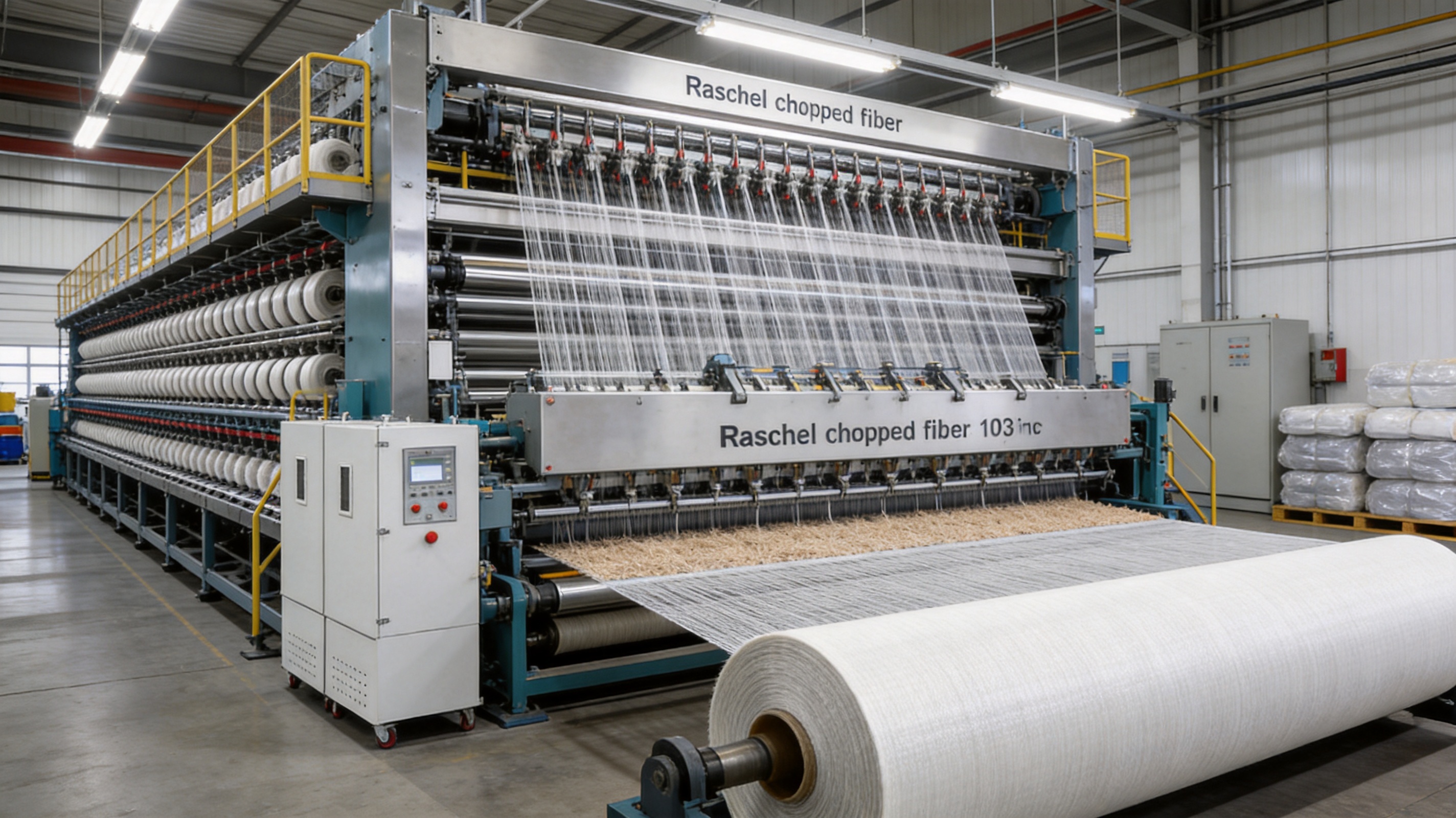
The integrated chopping unit is used when the fabric specification calls for a chopped fiber layer. Its function is to prepare and distribute chopped fibers at the required rate and position. The layer weight is established from the target construction, with the standard project range stated as 50–500 g/m².
Chopping performance depends on fiber type, filament characteristics, cutting condition, feed stability, blade condition, and the required fiber length. The chopping unit is therefore one of the primary wear and maintenance areas. Regular inspection helps prevent uneven deposition, excessive fiber accumulation, and variation across the width.
6.4 Optional Nonwoven Feeding
Where the application requires a nonwoven layer rather than, or in addition to, chopped fibers, a suitable nonwoven material can be introduced beneath the yarn structure. The nonwoven must be selected according to width, weight, tensile behavior, surface condition, and compatibility with the downstream resin or bonding process.
Nonwoven feeding changes the mechanical and handling behavior of the complete textile. The feed tension, alignment, and edge control must be established during machine configuration and commissioning. This is one reason why nonwoven capability is treated as a project-specific option rather than an automatic feature for every installation.
6.5 Stitching and Take-Up
After the directional yarns and optional underlying layer are assembled, the Raschel warp knitting system stabilizes the textile. Stitch formation must be consistent enough to hold the layers together during roll handling, cutting, placement, and molding, while avoiding unnecessary interference with the reinforcement function.
The take-up system then forms the finished material into rolls suitable for storage and downstream processing. Roll hardness, edge alignment, winding tension, and roll length should be agreed during commissioning because they affect warehouse handling and customer production efficiency.
7. Configuration Choices Confirmed Before Production
The YRS3-M-F-II is best understood as a configurable production platform. The machine’s structural layout and functional modules must be matched to the intended fabric. Before manufacturing begins, the following project inputs are normally reviewed:
- Target fabric construction and final use.
- Fiber type, yarn tex, filament arrangement, and package format.
- Target greige fabric weight.
- Required 0°/90° directional weight ratio.
- Chopped layer requirement and target chopped layer weight.
- Nonwoven layer requirement, if applicable.
- Required working width and edge trim.
- Expected machine speed and daily output.
- Workshop layout, material flow, utilities, and service access.
- Upstream yarn preparation and downstream roll-handling equipment.
- Quality criteria for weight, orientation, layer uniformity, and stability.
This approach offers an advantage over selecting a machine based only on nominal speed or width. Two fabrics with the same finished weight may require different yarn arrangements, stitch settings, chopped fiber rates, or tension controls. Project-based configuration helps prevent a mismatch between the equipment and the customer’s actual manufacturing objective.
8. Manufacturing Strengths of Changzhou Yuanyang Electromechanical Technology Co., Ltd.
Changzhou Yuanyang Electromechanical Technology Co., Ltd. is a high-tech enterprise based in Jiangsu Province, China, a major center for textile machinery development and production. The company integrates research and development, manufacturing, sales, and technical service, with a particular focus on warp knitting equipment and specialty textile machinery.
Its product portfolio includes stitch-bonding machines, biaxial warp knitting machines, multiaxial warp knitting machines, carbon fiber multiaxial warp knitting machines, powder scattering machines, web laying machines, and customized warp knitting accessories. This range gives the company experience across several reinforcement textile processes rather than limiting its expertise to a single machine type.
8.1 Dedicated Manufacturing Infrastructure
The company operates a production base of more than 12,000 square meters, including standardized workshops, an intelligent warehouse, and dedicated inspection rooms. A dedicated manufacturing environment supports the separation of machining, assembly, electrical work, testing, and final debugging activities.
For a complex machine such as the YRS3-M-F-II, manufacturing discipline is essential. The chopping unit, weft insertion components, warp knitting elements, tension systems, take-up equipment, control system, and safety functions must operate together. A structured production base helps the manufacturer manage these interfaces throughout the build.
8.2 Stage-by-Stage Quality Control
Yuanyang controls component procurement, machining, assembly, testing, and debugging in stages. This process is important because final machine performance depends on the accuracy and compatibility of many individual parts. Inspection before assembly can prevent defects from being carried into later production stages, while functional testing helps identify problems before shipment.
Each machine is tested before dispatch. Testing may include mechanical running, fabric formation, control response, tension adjustment, material feeding, chopping operation, roll take-up, and safety verification according to the agreed machine configuration. The exact acceptance program is normally linked to the customer’s fabric requirements.
8.3 Research and Development Capability
The company’s research and development team includes senior industry engineers experienced in structural redesign, functional module integration, difficult materials, and non-standard equipment configurations. This capability is particularly relevant to composite textile machinery because customers often require fabrics that fall outside standard constructions.
For the YRS3-M-F-II, R&D support may be required when the customer requests a special directional ratio, unusual yarn specification, additional nonwoven feeding, modified roll handling, integration with another production line, or a workshop layout that requires a customized equipment arrangement.
8.4 Focus on Difficult Materials and Special Fabrics
Glass fiber and other reinforcement materials can be challenging to process because they may be abrasive, sensitive to tension, and prone to generating lint or fragments. Stable production requires suitable yarn paths, compatible guides, reliable tension control, and maintenance procedures that address the material’s behavior.
Yuanyang’s focus on complex fabric designs and difficult-to-process materials supports the development of equipment for composite reinforcement applications. The manufacturer’s experience with biaxial and multiaxial textile systems also provides a broader technical foundation for adapting the machine to customer-specific requirements.
9. Installation, Commissioning, and Acceptance
Equipment performance depends on more than the machine delivered to the customer’s factory. Installation quality, workshop arrangement, utility preparation, operator training, and raw-material selection all affect the start-up process. Yuanyang provides installation, commissioning, and training support at the customer’s plant.
During installation, the machine is positioned according to the approved layout. Service access, yarn package placement, material flow, electrical connections, compressed air or other utility requirements, and roll removal routes are checked. A practical layout reduces unnecessary movement and allows operators to inspect the machine safely.
Commissioning then proceeds through material preparation, yarn threading, initial low-speed running, tension adjustment, stitch formation verification, weft insertion setup, chopping unit adjustment, and take-up calibration. The speed is increased only after the fabric is stable at the preliminary operating condition.
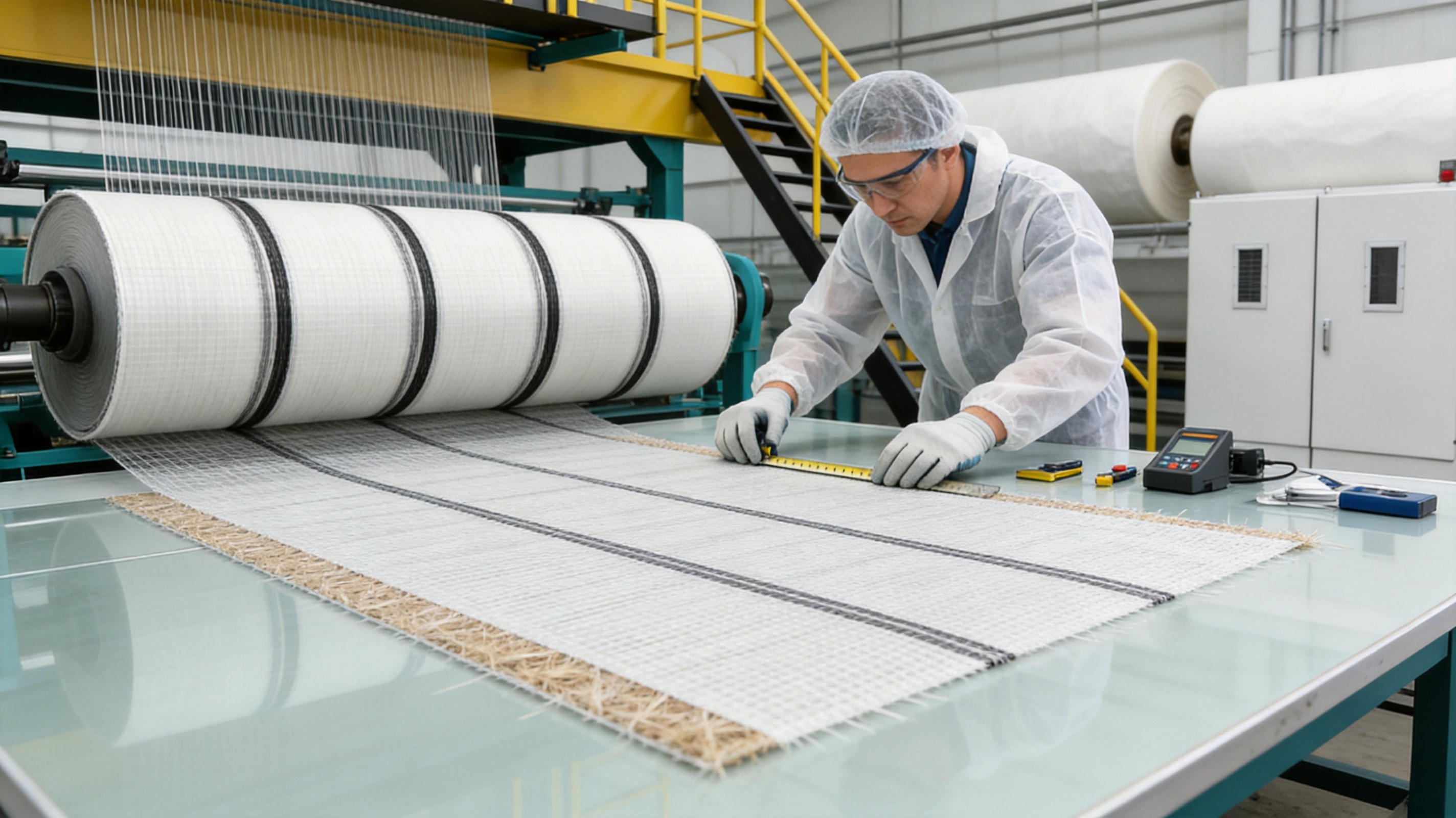
Acceptance should be based on the agreed fabric specification rather than machine speed alone. Typical acceptance factors include:
- Greige fabric areal weight.
- 0°/90° directional weight ratio.
- Chopped layer weight and uniformity.
- Nonwoven positioning, where applicable.
- Fabric width and edge quality.
- Stitch stability and layer retention.
- Running stability at the agreed working speed.
- Roll formation and handling performance.
Yuanyang can also provide training for knitters, maintenance personnel, and workshop management staff. Training may be conducted at the customer’s facility or at the company’s manufacturing workshop over a longer program when the project requires more extensive instruction.
10. Maintenance and Serviceability
Regular maintenance is necessary to preserve fabric quality and machine availability. The chopping unit and weft insertion elements are primary wear points because they are directly involved in material preparation and directional placement. Their condition should be checked according to operating hours, material type, production speed, and observed fabric quality.
Operators should inspect the yarn path, tension devices, guide elements, stitch formation area, and take-up system at each shift handover. Early detection of abnormal vibration, uneven tension, fiber accumulation, damaged guides, or inconsistent cutting can prevent larger production problems.
A practical maintenance program should include:
- Cleaning of fiber deposits and lint from working areas.
- Inspection of chopping blades and cutting surfaces.
- Verification of yarn guide condition.
- Checking of tension settings and sensor response.
- Inspection of insertion elements and stitch-forming components.
- Lubrication according to the machine maintenance schedule.
- Verification of electrical connections and control functions.
- Inspection of take-up alignment and winding tension.
- Replacement of worn consumables before they affect fabric quality.
Yuanyang supports spare parts and consumables through its after-sales network. Long-term technical assistance is also available for production problems after handover. This is important because real production conditions may reveal optimization opportunities that are not visible during initial commissioning.
11. Comparison with Related Machine Platforms
The YRS3-M-F-II belongs to a broader family of fiberglass textile equipment. Selecting the correct model depends on whether the customer needs chopped fiber integration, a high-strength biaxial structure, or nonwoven fabric feeding.
| Machine Platform | Main Configuration | Typical Positioning |
|---|---|---|
| YRS3-M-F-I (HX) | Raschel chopped fiber biaxial warp knitting | Chopped mats and composite fabrics in the HX configuration |
| YRS3-M-F-II (HS) | Raschel chopped fiber biaxial warp knitting with optional chopped or nonwoven layer | Wind power, nacelle covers, and composite reinforcement fabrics |
| YRS3-M-H | High-strength biaxial warp knitting without chopping | Structural reinforcement fabrics requiring high-strength biaxial construction |
| YRS3-M-V | Biaxial warp knitting with nonwoven fabric | Nonwoven-reinforced composite materials |
The HS model is appropriate when a customer needs the combination of 0°/90° directional yarns and an integrated chopped or supporting layer. The high-strength biaxial model may be more suitable when chopped fiber is not required and the main objective is a high-strength directional fabric. The nonwoven-feed model may be preferable when the production specification is centered on a nonwoven substrate.
These distinctions help avoid over-specification and under-specification. The best machine is not necessarily the one with the highest nominal speed. It is the one whose feeding, insertion, chopping, stitching, width, and control functions correspond to the intended fabric.
12. Process and Commercial Benefits for Manufacturers
12.1 Reduced Intermediate Handling
By combining multiple fabric-forming operations, the YRS3-M-F-II can reduce the need to move partially finished reinforcement layers between separate lines. Fewer transfers can improve material cleanliness, reduce handling labor, and simplify production scheduling.
12.2 More Efficient Product Development
Adjustable directional ratios and optional layer configurations allow a manufacturer to develop several fabric constructions on one platform. This can shorten the transition from laboratory or pilot requirements to industrial production, especially when the product family shares similar raw materials and width requirements.
12.3 Better Alignment Between Fabric and Laminate Design
When the fabric is designed around the expected load directions, the laminate engineer has greater control over the reinforcement schedule. This may support more efficient use of glass fiber and reduce the need for excessive corrective layers.
12.4 Consistent Production Documentation
A configured machine provides a defined basis for documenting machine speed, yarn setup, layer weights, directional ratio, inspection points, and acceptance criteria. Such documentation supports quality systems and makes production troubleshooting more systematic.
12.5 Support for Long-Term Product Expansion
A company producing only one reinforcement structure may face difficulty when customers request a new fabric weight, a different directional ratio, or a chopped support layer. The YRS3-M-F-II offers a broader platform for product expansion, subject to engineering confirmation and process trials.
13. Recommended Project Evaluation Procedure
Before purchasing or configuring the machine, the customer should prepare a clear technical brief. This brief should identify the finished composite application, expected loading conditions, resin system, forming process, target fabric weight, desired width, and annual production demand.
The next step is to define the fabric construction. The customer should specify the fiber type, yarn tex, 0°/90° ratio, chopped layer weight, nonwoven requirement, stitch characteristics, roll dimensions, and quality tolerances. If any parameter is not yet fixed, the equipment supplier can propose a starting configuration for evaluation.
Sample production or trial fabric is valuable when the application is new. Trials can assess forming behavior, resin flow, surface appearance, layer stability, cutting performance, and laminate mechanical properties. The results can then be used to refine machine settings before final production release.
Workshop planning should be completed at the same time. The customer must reserve space for the main machine, creel, yarn packages, raw-material storage, finished rolls, inspection, maintenance, and operator movement. Utilities and environmental conditions should also be reviewed because glass fiber processing can generate dust and requires suitable housekeeping procedures.
Finally, the acceptance protocol should be agreed before shipment. Clear acceptance criteria protect both parties by establishing how fabric weight, directional ratio, chopped layer uniformity, output, and running stability will be evaluated.
14. Frequently Asked Questions
What type of fabric does the YRS3-M-F-II produce?
The machine produces full-width weft-inserted chopped mats and composite reinforcement fabrics with a controlled 0°/90° biaxial structure. It can also be configured with an optional chopped layer or a suitable nonwoven fabric beneath the yarns.
Is the chopped fiber randomly distributed?
The machine includes a chopping unit for forming a chopped fiber layer, but the complete fabric is not equivalent to a purely random chopped strand mat. Its principal reinforcement structure includes orderly, directionally parallel weft laying in the 0°/90° configuration.
Can the 0°/90° ratio be changed?
Yes. The weight ratio between the 0° and 90° directions is customizable. The correct ratio is established from the target laminate properties, load requirements, fabric weight, and downstream composite process.
What fibers can be processed?
The stated applicable fibers are glass fiber and polyester. Other materials may be reviewed for a specific project, but suitability must be confirmed through engineering evaluation and process testing.
What is the available chopped layer weight?
The optional chopped layer is specified within a range of 50–500 g/m². The actual setting depends on the intended fabric construction and the requirements of the composite application.
Can a nonwoven fabric be used instead of chopped fibers?
A suitable nonwoven fabric can be added or substituted beneath the yarns when the application requires a nonwoven layer. The material’s width, weight, tension behavior, and compatibility with the process must be confirmed during configuration.
What is the normal greige fabric weight range?
The typical greige fabric weight range is 300–2000 g/m². The practical operating range depends on yarn specifications, directional ratio, stitch parameters, chopped layer, machine speed, and quality requirements.
What is the maximum machine speed?
The stated machine speed range is 50–1000 r/min. The correct operating speed is not necessarily the maximum speed. It must be selected according to fabric construction, yarn behavior, chopping stability, quality requirements, and production conditions.
What is the reference daily output?
The reference daily output is approximately 3000 kg. Actual output varies with fabric weight, construction, operating speed, raw-material performance, stoppage frequency, and process stability.
What industries can use the fabrics?
The machine is particularly suited to fiberglass textile applications for wind power, nacelle covers, composite structures, industrial housings, panels, and other products requiring controlled biaxial reinforcement with an optional chopped or nonwoven layer.
How is the machine accepted after installation?
Acceptance is based on the agreed fabric specification and operating condition. Typical criteria include areal weight, 0°/90° ratio, chopped layer uniformity, fabric width, layer stability, roll quality, and stable operation at the agreed working speed.
Does the supplier provide installation and training?
Yes. Changzhou Yuanyang Electromechanical Technology Co., Ltd. provides installation, commissioning, operator training, maintenance guidance, and technical support. Training can cover knitters, maintainers, and workshop management personnel.
How does the HS model differ from the HX model?
Both are chopped fiber biaxial warp knitting platforms. The HS configuration is positioned for applications such as wind power and nacelle cover fabrics, while the HX configuration serves the same general chopped mat and composite fabric family in a different machine configuration. The final selection should be based on the customer’s specific fabric and process requirements.
Can the machine be customized?
Yes. Customization may involve machine layout, functional module integration, feeding arrangements, roll handling, control interfaces, and adaptation to difficult materials or special fabric designs. The customer should provide the target fabric, workshop layout, and production objectives for technical review.
15. Conclusion
The YRS3-M-F-II Raschel Chopped Fiber Biaxial Warp Knitting Machine (HS) is designed for manufacturers that need more than a conventional random chopped mat. By combining 0°/90° weft insertion, warp knitting stabilization, an integrated chopping unit, and optional nonwoven feeding, it provides a flexible route to engineered reinforcement fabrics.
Its main advantages include customizable directional weight distribution, broad fabric weight capability, optional chopped or nonwoven layers, full-width production, and suitability for wind power and composite applications. The integrated process can reduce intermediate handling and help manufacturers maintain a more consistent relationship between directional yarns and supporting layers.
The equipment is supported by Changzhou Yuanyang Electromechanical Technology Co., Ltd.’s manufacturing infrastructure, research and development capability, staged quality control, installation service, and after-sales support. With a production base exceeding 12,000 square meters and experience in biaxial, multiaxial, carbon fiber, stitch-bonding, and specialty textile machinery, the company is positioned to develop equipment around demanding reinforcement textile requirements.
For the best result, the machine should be selected through a complete project review covering fiber type, yarn specifications, directional ratio, chopped layer, nonwoven material, width, fabric weight, output, workshop layout, and downstream composite process. When these variables are correctly matched, the YRS3-M-F-II can serve as a productive and adaptable platform for the manufacture of controlled fiberglass reinforcement fabrics.
References
1. Changzhou Yuanyang Electromechanical Technology Co., Ltd., YRS3-M-F-II Raschel Chopped Fiber Biaxial Warp Knitting Machine (HS) technical product information.
2. Changzhou Yuanyang Electromechanical Technology Co., Ltd., Fiberglass Textile Machinery Product Range and Equipment Configuration Materials.
3. General principles of warp knitting, weft insertion, stitch-bonded reinforcement textiles, and composite fabric construction.
4. General engineering guidance for glass fiber reinforcement fabrics used in resin infusion, wet lay-up, and structural composite manufacturing.
5. General manufacturing practices for textile machinery inspection, commissioning, operator training, and production acceptance.
Product: YRS3-M-F-II Raschel Chopped Fiber Biaxial Warp Knitting Machine(HS)

News
-
Three quotations land on the same desk for the same polyester nonwoven line, and on paper they look interchangeable. Each is priced per metre of working width. Each quotes a similar top speed. Each c...
READ MORE -
Two quotations land on the same desk. Both offer a multiaxial warp knitting line, both list the same working width, both promise high output. One buyer signs and discovers six months later that the f...
READ MORE -
Match the machine type to the fabric: choose a tricot Warp Knitting Machine for fine, smooth fabrics such as lining and sportswear, a raschel machine for open, patterned, and technical fabrics, a doub...
READ MORE -
Which Machine Category Matches Each Technical Fiber and Fabric Goal A warp knitting machine is the primary production platform for technical fiber textiles across fiberglass, chemical fiber, and carbo...
READ MORE
-
Contact Info.
+86-198 5534 1617
+86-134 0158 3002yuanyang@yywarpknitting.com 699#, Shengzhi West Rd, Lvcheng Town, Danyang City, Zhenjiang City, Jiangsu Province, China

-
QR Code
-
Quick Links
Home About Products Manufacturing Customization News Contact -
Product List
Machine for Chemical Fiber Textile Machine for Fiberglass Textile Machine for Carbon Fiber Textile -
About Us
Company Profile Factory Gallery Value-added Service
Copyright © 2026 Changzhou Yuanyang Electromechanical Technology Co., Ltd. All Rights Reserved.
Custom Warp Knitting Machine Manufacturers
