

 English
 中文简体
 русский
 Français
 Español
 Deutsch

How Rotary Laid Scrim Technology Improves Lightweight Reinforced Textile Production
2026-10-07
Content
- 1 Understanding the Role of Laid Scrim in Industrial Materials
- 2 Operating Principle of the LS Rotary Type Laid Scrim Machine
- 3 Key Product Advantages
- 4 Applications of Rotary Laid Scrim
- 5 Core Specifications and Engineering Meaning
- 6 Comparison with Alternative Scrim Production Approaches
- 7 Manufacturing Strengths Behind the Equipment
- 8 Quality Control from Components to Finished Rolls
- 9 Automation and Line Integration
- 10 Installation, Commissioning and Training
- 11 Maintenance and Long-Term Reliability
- 12 Information Required for Configuration and Quotation
- 13 Why Choose a Specialized Technical Textile Machinery Manufacturer?
- 14 Recommended Project Development Process
- 14.1 Step one: Define the target scrim
- 14.2 Step two: Review the downstream process
- 14.3 Step three: Confirm the layout
- 14.4 Step four: Conduct trials or sample evaluation
- 14.5 Step five: Manufacture and test the machine
- 14.6 Step six: Install and train at the customer’s factory
- 14.7 Step seven: Support continuous improvement
- 15 Frequently Asked Questions
- 15.1 What materials can the LS rotary type laid scrim machine process?
- 15.2 What type of fabric does the machine produce?
- 15.3 What is the standard working width?
- 15.4 What is the expected daily output?
- 15.5 How does the rotary type differ from a weft insertion type?
- 15.6 Can the machine be customized?
- 15.7 Can the machine be integrated with a coating or laminating line?
- 15.8 What quality checks are performed before shipment?
- 15.9 Does the manufacturer provide installation and training?
- 15.10 Which machine areas require the most maintenance?
- 15.11 What information is needed to request a quotation?
- 15.12 Is the machine suitable for new scrim products?
- 16 Conclusion
- 17 References
- 18 Product: LS Rotary Type Laid Scrim Machine
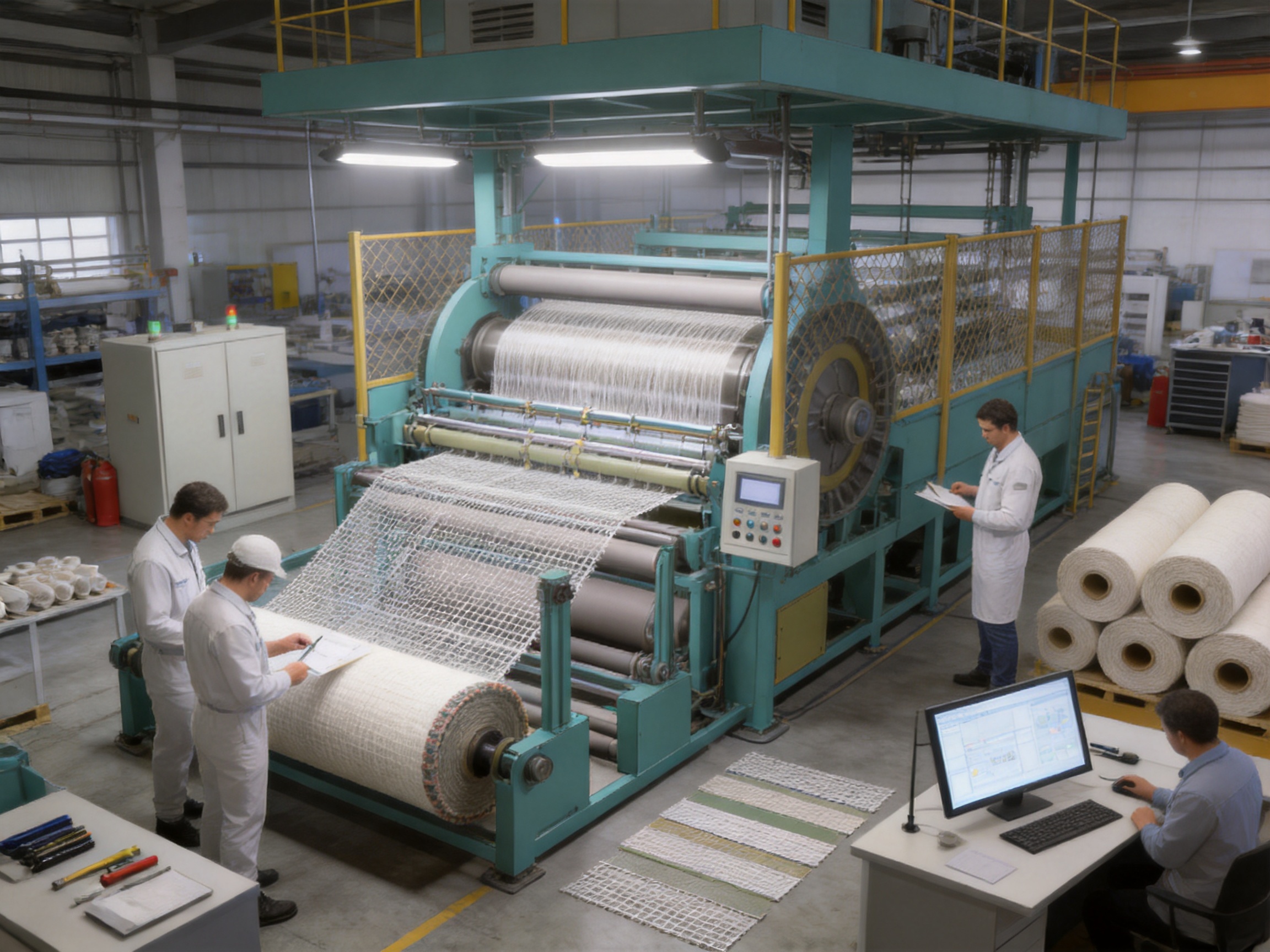
Lightweight scrim is used in a wide range of industrial products, including insulation facings, packaging materials, release papers, reinforced aluminum foil, marble backing, mosaic backing, fireproof boards, kraft paper laminates and other composite structures. Although the finished material may appear simple, producing a stable open grid with accurate yarn spacing, reliable bonding and consistent roll quality requires carefully coordinated machinery.
The LS rotary type laid scrim machine is designed for this production challenge. It combines web forming, chemical bonding and setting in one coordinated process to produce lightweight, directionally oriented grid fabrics. The machine is suitable for glass fiber and polyester yarns and is configured for manufacturers that need a stable, efficient and adaptable scrim-forming system.
Unlike conventional textile machines that rely on a more complex sequence of separate forming and laminating operations, the LS machine creates the grid structure through a rotary laying motion and fixes the yarn intersections through chemical bonding. This integrated approach can reduce process complexity, support consistent mesh formation and provide a practical foundation for downstream coating, laminating and paper-converting operations.
Understanding the Role of Laid Scrim in Industrial Materials
Laid scrim is an open-grid reinforcement material generally made from straight yarns arranged in selected directions. The yarns are positioned rather than woven in the conventional sense. This allows manufacturers to create fabrics with low weight, controlled orientation and useful reinforcement performance without adding unnecessary material to the final product.
In many applications, the scrim is not used as a finished consumer textile. Instead, it becomes an internal reinforcement layer or carrier within another product. It may be laminated to foil, paper, polymer film, insulation facing or a coated composite. The scrim improves dimensional stability, tear resistance, handling strength and resistance to deformation while maintaining a relatively low overall basis weight.
The performance of the finished scrim depends on several production variables. These include yarn type, yarn count, mesh pitch, orientation, working width, chemical binder, bonding temperature or dwell time, line speed, winding tension and the compatibility of the scrim with the downstream process. A machine that controls only the yarn-laying step is therefore not enough. The forming, bonding, setting and winding sections must work as one production system.
The LS rotary type laid scrim machine addresses this need by combining the principal operations in a coordinated line. The rotary laying mechanism positions the yarns into an open grid, while the chemical bonding and setting process fixes the intersections. The resulting structure can then be wound into rolls and transferred to coating, laminating or converting equipment.
Operating Principle of the LS Rotary Type Laid Scrim Machine
The machine begins with yarn packages arranged in a creel or yarn supply section. Depending on the planned product, the yarn may be glass fiber or polyester. The package format, yarn count and supply arrangement are selected according to the required mesh design and production conditions.
Yarns are guided through the machine along controlled paths before entering the rotary web-laying section. The rotary laying head places the yarns in a defined orientation and spacing. This motion allows the machine to form a lightweight open grid with directional reinforcement characteristics. The exact geometry of the grid is determined by the laying-head arrangement, yarn supply and selected operating parameters.
After the grid is formed, the crossing points are treated with a suitable chemical binder. The binder creates cohesion at the intersections and allows the grid to retain its shape during subsequent handling. The setting section then stabilizes the bonding condition so that the scrim can be wound, transported and processed in a downstream production line.
The one-time forming principle is an important feature of the system. The grid is created and stabilized as part of one coordinated production route instead of requiring a separate weaving or laminating stage merely to hold the yarns together. This can simplify plant layout and reduce the number of independent process interfaces that operators must control.
The machine speed is specified at approximately 50 to 300 revolutions per minute. Actual production speed depends on yarn properties, mesh density, binder behavior, drying or setting requirements, roll format and the required quality level. The reference working width is 2,000 millimeters, or approximately 79 inches, and the reference daily output is around 15,000 square meters. These figures are starting points for project planning rather than guaranteed production values for every fabric construction.
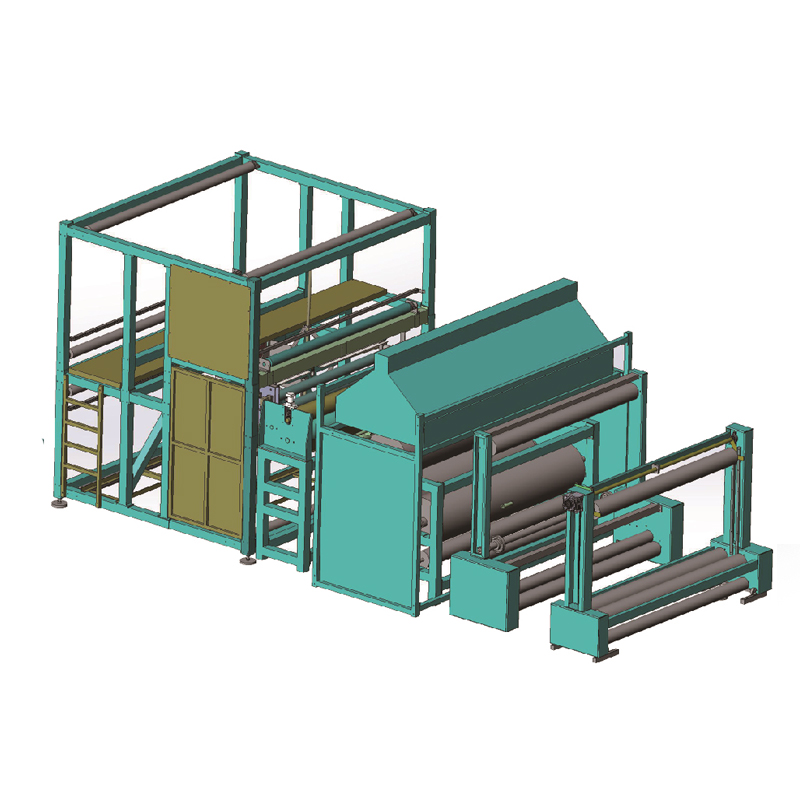
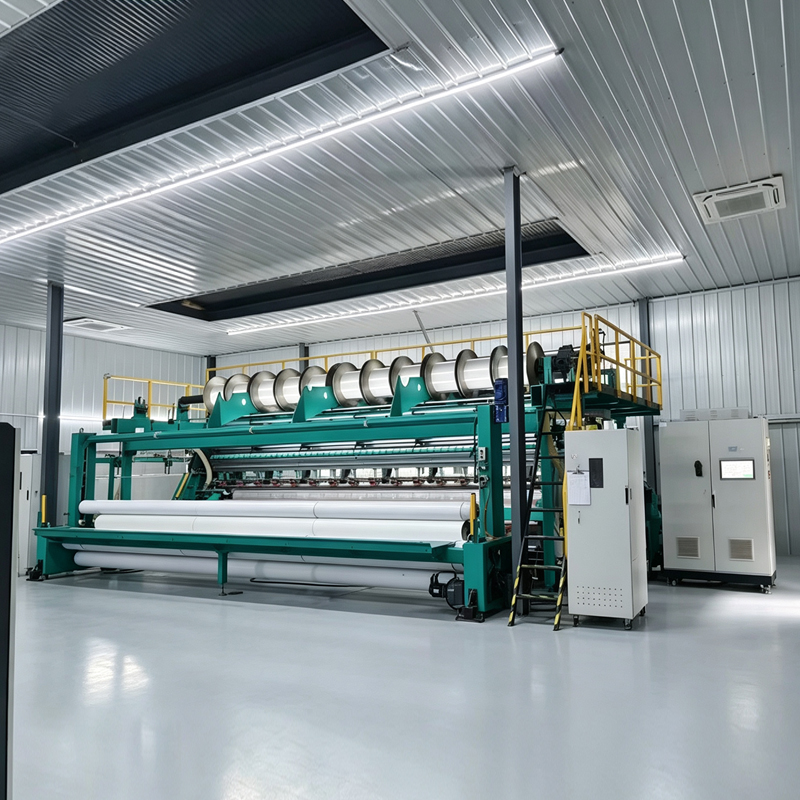
LS Rotary Type Laid Scrim Machine
Key Product Advantages
Integrated forming and bonding
A major advantage of the LS machine is the coordination of grid formation, chemical bonding and setting. In a separated production arrangement, each process may require independent alignment, transport and tension management. Every transfer introduces the possibility of yarn movement, edge distortion or mismatch between the forming and bonding stages.
By integrating these functions, the LS system provides a more direct production path. The yarns are laid, bonded and stabilized before the scrim is wound. This can help maintain grid regularity and reduce the handling required between process stages. It also gives engineers a clearer basis for coordinating machine speed, binder application and take-off tension.
Suitable for lightweight directional structures
The rotary laying principle is intended for low-weight scrim where the yarns must remain straight, evenly spaced and directionally organized. This is useful when the reinforcement objective is based on controlled orientation rather than a dense woven structure.
Lightweight scrim can help manufacturers reduce material consumption while retaining the reinforcement required by the finished product. For insulation facings, foil laminates and paper products, the open structure can also support good resin, adhesive or coating penetration. The final performance depends on the complete composite design, but the machine provides the foundation for a low-gsm reinforcement layer.
Glass fiber and polyester compatibility
The LS machine is designed for glass fiber and polyester. These materials cover important segments of the reinforcement textile market. Glass fiber offers high strength and dimensional stability for applications that require inorganic reinforcement. Polyester provides a flexible and practical option for products where handling, compatibility or cost considerations are important.
The machine is configured according to the characteristics of the selected yarn. Creel positions, yarn guides, package sizes, tension settings, binder selection and process conditions may all require adjustment. This material-oriented approach is more useful than treating every yarn type as if it could run under identical conditions.
One-time forming for efficient production
One-time forming can reduce the need for separate preliminary operations. The producer can form the grid and stabilize the intersections within the same general production route. This may support a compact layout and make the relationship between fabric design and machine settings easier to manage.
For producers expanding from conventional reinforcement materials into lightweight laid scrim, the one-time forming concept can also reduce the number of machines required at the beginning of a project. The final configuration still depends on whether the customer needs inline coating, drying, laminating or special winding equipment, but the LS machine serves as an integrated forming section rather than a stand-alone yarn-positioning device.
Adaptability for downstream processing
Scrim is commonly supplied to a later coating, laminating or converting process. The LS machine can therefore be configured around the requirements of the next operation. Roll width, winding tension, core size, edge condition and surface bonding characteristics can be considered during project planning.
This is particularly important for reinforced aluminum foil, kraft paper, insulation facings and release papers. A scrim that is acceptable when viewed as an individual roll may still create problems during lamination if the edges are unstable, the roll is telescoped or the binder is incompatible with the adhesive. Designing the machine around the complete process helps reduce these risks.
Controlled working width and production planning
The reference working width of 2,000 millimeters gives producers a practical platform for wide industrial rolls. A wide forming zone can improve output potential and reduce the number of narrow strips needed to cover a large composite surface.
Working width is not only a mechanical dimension. It also affects creel design, edge control, yarn distribution, binder application, drying capacity, winding format and factory space. The LS configuration is therefore reviewed against the actual product width and trim allowance. This helps ensure that the useful output is aligned with the customer’s converting process rather than based only on a nominal machine dimension.
Applications of Rotary Laid Scrim
Insulation materials
Lightweight glass fiber scrim is widely used as reinforcement in insulation facings and related building materials. The scrim can improve handling strength, help limit tearing and contribute to dimensional stability when the facing is moved, cut or laminated.
The open-grid structure is useful because it can reinforce the facing without creating a dense barrier. The appropriate binder and surface condition can be selected according to the insulation product, coating chemistry and required fire or temperature performance. Final certification and fire performance always depend on the complete product system, not the scrim machine alone.
Packaging reinforcement
Packaging materials may require better tear resistance and dimensional stability while still needing to remain light and flexible. Laid scrim can be introduced into paper, film or foil structures to improve the resistance of the package against handling forces.
The LS machine supports this application by producing a controlled grid that can be laminated between layers. The mesh pitch, yarn type and basis weight can be adjusted to balance reinforcement with flexibility, folding behavior and material cost.
Release papers and specialty papers
Release papers and specialty papers may use scrim as an internal reinforcement layer. The scrim helps the paper maintain integrity during processing and handling, especially when the paper is thin or exposed to repeated tension.
For this application, the bonding system must be selected carefully. The binder should not interfere with the release coating or create unacceptable surface defects during lamination. The machine configuration can take the paper line, adhesive system and roll format into account before production begins.
Marble and mosaic backing
Marble and mosaic products often need reinforcement to improve handling strength and reduce the risk of breakage or separation during processing. A lightweight grid can be embedded into an adhesive or backing layer to help stabilize the assembly.
The scrim must have suitable mesh regularity and bonding quality so that it distributes reinforcement consistently across the product. Uneven spacing or weak intersections may create local variations in performance. The LS machine’s emphasis on yarn straightness and crossing-point bonding is therefore valuable for this type of material.
Fireproof board reinforcement
Fireproof and heat-resistant boards may use glass fiber scrim as a reinforcing layer. The glass yarn provides a non-metallic structure that can contribute to mechanical integrity while the board is handled or installed.
The complete board construction determines fire classification and temperature resistance. Nevertheless, the scrim machine must provide a stable grid and a binder system compatible with the board-forming process. Configuration should consider the required basis weight, mesh opening, adhesive or mineral composition and final board thickness.
Reinforced aluminum foil and kraft paper
Aluminum foil and kraft paper are frequently used in insulation, packaging and industrial laminates. Their reinforcement requirements may vary from improved tear resistance to greater dimensional stability during converting.
A laid scrim layer can be positioned between foil and paper, between multiple paper layers or within a coated composite. Because the rotary machine can form a low-weight directional grid, producers can select reinforcement levels that match the product’s required performance without automatically increasing the thickness of every layer.
Core Specifications and Engineering Meaning
| Parameter | Reference value | Production significance |
|---|---|---|
| Applicable fibers | Glass fiber and polyester | Material selection affects yarn path, tension, binder and setting conditions. |
| Machine speed | 50–300 r/min | Speed is adjusted according to fabric construction, yarn behavior and bonding requirements. |
| Working width | 2,000 mm, approximately 79 in | Supports wide industrial scrim production with order-stage confirmation of trim allowance. |
| Reference daily output | Approximately 15,000 m² | Actual output depends on mesh design, process settings and operating schedule. |
| Forming principle | Rotary laying and one-time forming | Creates a lightweight, directionally oriented open grid. |
| Bonding method | Chemical bonding and setting | Fixes yarn intersections and prepares the scrim for winding and downstream use. |
The values in the table should be used for preliminary planning. A technical quotation should be prepared only after reviewing the customer’s yarn specifications, mesh design, binder system, floor plan, electrical standard and expected operating schedule.
Comparison with Alternative Scrim Production Approaches
Producers may compare the LS rotary type machine with woven reinforcement equipment, separate laying and laminating systems or other laid-scrim forming principles. Each technology has a suitable application range, so comparison should be based on the required product rather than on machine speed alone.
Compared with conventional woven fabric equipment
Woven fabric machines interlace yarns through a warp-and-weft process. This is appropriate when the customer needs a woven construction, high interlacing stability or a specific fabric appearance. However, weaving introduces crossings and mechanical interlacing that may not be necessary for low-weight reinforcement.
The LS machine is intended for an open grid in which yarns are laid and chemically fixed rather than conventionally woven. This can reduce the structural complexity of the reinforcement and support a lower basis weight. It also allows the producer to focus on directional yarn placement and mesh geometry.
For insulation facings, paper reinforcement and foil laminates, the open grid may be more suitable than a dense woven structure. The correct selection depends on the final product’s tensile, tear, elongation and handling requirements.
Compared with separated laying and laminating lines
A separated system may offer flexibility through independent machines, but it also creates more transfer points and requires additional coordination. The material may need to be rewound, aligned or transported between the forming and bonding stages.
The LS machine combines these principal functions into a coordinated line. This can reduce intermediate handling and simplify the route from yarn supply to finished roll. It may also reduce the amount of floor space required for separate transfer and alignment equipment.
Compared with alternative laid-scrim principles
Not all laid scrim products require the same yarn insertion or laying method. The LS rotary type uses a rotary laying motion and is particularly suited to lightweight, directionally oriented grid fabrics. Other machines, such as weft insertion systems, may be better for different mesh constructions, yarn arrangements or production requirements.
The technical advantage of the LS machine is therefore not that it replaces every other scrim technology. Its advantage is that it provides a focused solution for applications where rotary laying, one-time forming and chemical bonding are appropriate. Correct machine selection begins with the fabric design and downstream process.
Manufacturing Strengths Behind the Equipment
The performance of a textile machine depends not only on its product concept but also on how it is engineered, manufactured, assembled and tested. The manufacturer of the LS rotary type laid scrim machine operates from Danyang, Jiangsu, within a production base of more than 12,000 square meters. The facility also supports the manufacture of stitch-bonding, biaxial and multiaxial warp knitting equipment.
This broader equipment background is important because laid scrim production shares many engineering requirements with other technical textile machines. These include yarn control, fabric formation, servo or drive coordination, tension management, winding accuracy, operator safety and integration with auxiliary equipment.
Research and development experience
The company maintains an engineering and research team with experience in textile machinery. Its development work covers standard equipment, customized structures, non-standard configurations and production lines for difficult materials or complex fabric designs.
For a laid scrim project, this experience can be applied to the rotary laying head, yarn path, binder application, setting arrangement, winding section and control interface. The goal is not simply to deliver a machine with standard dimensions, but to build a configuration that matches the customer’s product and factory conditions.
Manufacturing process control
Equipment quality is influenced by every stage of production. Component procurement must be controlled because inaccurate or unsuitable parts can affect drive stability, yarn alignment or long-term maintenance. Mechanical assembly must maintain the required relationships between guides, rollers, laying mechanisms and winding components.
After assembly, the machine is tested and debugged before dispatch. Drive response, stop logic, guard operation, parameter stability and fabric formation are reviewed. This process helps identify problems before installation at the customer’s facility and creates a stronger basis for site commissioning.
Customization capability
Technical textile manufacturers often need more than a catalogue machine. Their yarns, mesh specifications, roll dimensions, factory utilities and downstream equipment may differ from those used in another plant. The manufacturer therefore supports customization in several areas.
- Machine structure and line layout can be adapted to available floor space and material flow.
- Functional modules can be integrated for bonding, setting, winding or signal exchange.
- Special materials can be reviewed for yarn handling, tension and process compatibility.
- Control systems can be aligned with the customer’s electrical standard and communication requirements.
- Process-oriented adjustments can be made to support stability, efficiency and product consistency.
Where necessary, the manufacturer can work from customer drawings, fabric samples or preliminary process information. Three-dimensional confirmation drawings can be prepared before production, and trial samples can be used to verify the intended fabric structure.
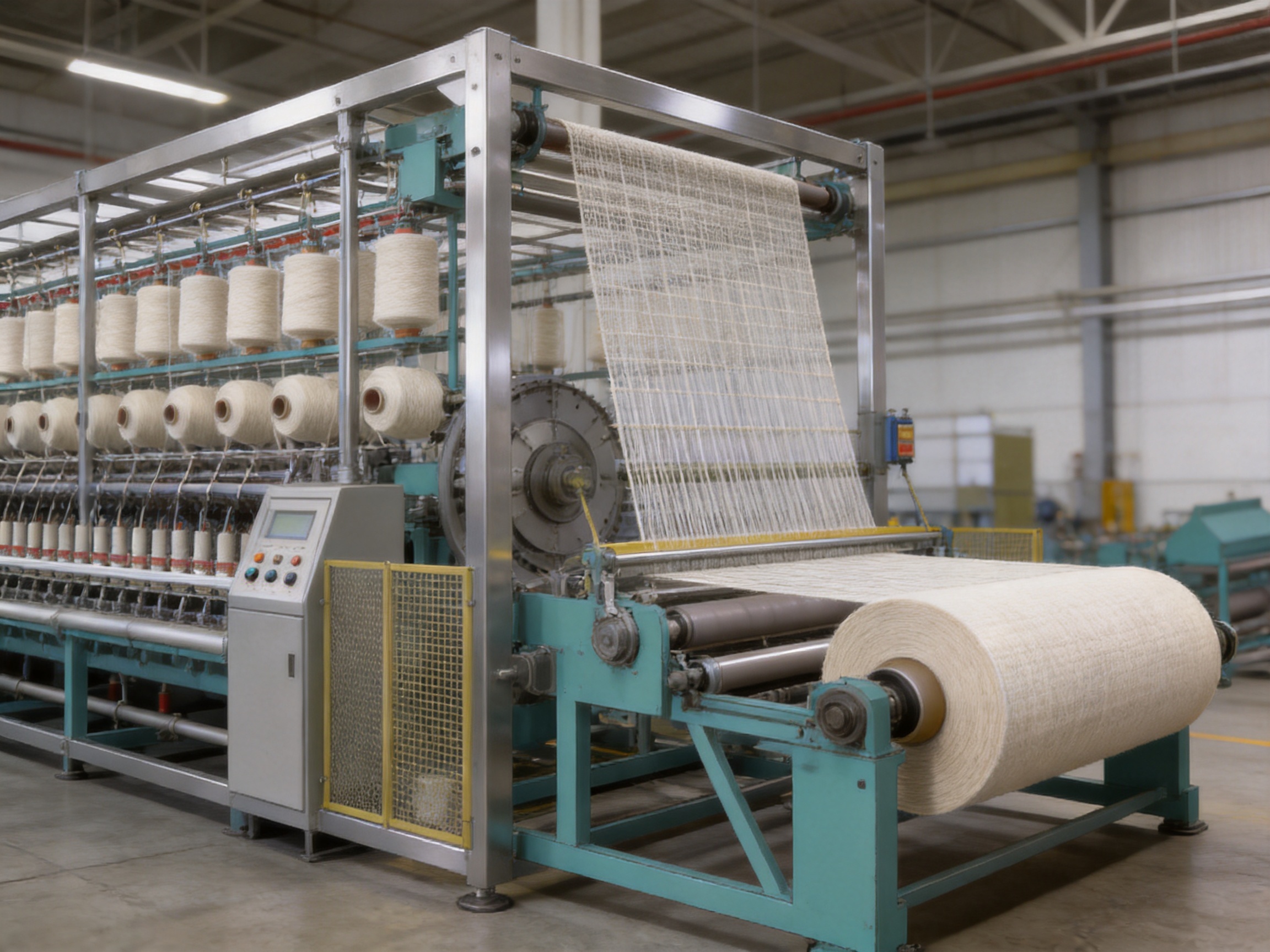
Quality Control from Components to Finished Rolls
Quality control for a laid scrim machine should cover more than visual inspection of the frame. The complete system must be checked against the characteristics of the fabric it is expected to produce.
Yarn path and laying accuracy
The yarn path is inspected for straightness, spacing uniformity and correct routing. Crossed, missing or poorly guided ends can create visible defects and reduce the reinforcement value of the scrim. Guides and tension devices must be correctly positioned so that yarns enter the rotary laying section under stable conditions.
Bonding quality
The bonding section is checked for binder application consistency, node formation and the absence of unset intersections. Chemical bonding must be sufficient to stabilize the grid but compatible with the customer’s downstream process. Excessive binder can increase weight or interfere with lamination, while insufficient binder may allow the grid to move during winding.
Roll construction
The winding section is evaluated for width, tension, roll tightness and edge condition. A roll that is too loose may telescope or deform during transportation. A roll that is too tight may damage the scrim or affect the subsequent laminating process.
Edge quality is especially important for wide rolls. The machine must maintain the required width while avoiding excessive edge fraying, uneven trimming or displacement of the outer yarns.
Machine function and safety
Drive response, stop logic, emergency-stop functions, guards and access points are tested before dispatch. Stable control parameters are important because the machine may operate continuously for extended shifts. Safety functions must also allow operators to thread, clean and inspect the machine without unnecessary exposure to moving components.
| Inspection area | Typical verification |
|---|---|
| Yarn handling | Correct routing, stable tension, regular spacing and absence of missing ends. |
| Rotary laying section | Accurate directional placement, smooth motion and repeatable grid geometry. |
| Binder application | Consistent pick-up, appropriate node formation and compatibility with the process. |
| Setting section | Stable bonding condition at the selected production speed. |
| Winding section | Correct roll build, width, tension, edge quality and core alignment. |
| Controls and safety | Drive response, emergency stop, guarding and operator interface performance. |
Automation and Line Integration
The LS machine is normally part of a wider production route. Its performance must therefore be coordinated with the creel, binder supply, setting equipment, winding section and any downstream coating or laminating line.
Speed coordination is required between the laying section and the take-off. If the winding speed is not matched to the forming speed, the scrim may experience excessive tension or slack. Similar coordination is needed when binder application or setting time limits the maximum line speed.
The control architecture can be selected according to the electrical standard and communication interface used in the customer’s factory. Operator language, access levels and parameter protection can be discussed during the order stage. These details are valuable for plants with multiple production shifts or centralized manufacturing controls.
Where required, the machine can exchange signals with an upstream creel system or downstream coating line. Such communication may include running status, stop conditions, alarm information and speed references. Integration should be planned before installation so that the machine can be positioned correctly within the customer’s complete production system.
Guarding, emergency stops and access points are also considered during line planning. Operators need practical access for threading, cleaning and routine inspection, while moving components must remain protected during normal operation.
Installation, Commissioning and Training
Installation is an important part of the equipment project because the machine must be aligned with the customer’s floor, utilities and surrounding production line. The manufacturer provides engineering support during installation and commissioning at the customer’s factory.
Commissioning normally includes mechanical inspection, electrical connection checks, yarn threading, parameter setup and trial operation. The machine is gradually brought to the agreed operating condition while operators observe the grid structure, bonding behavior, roll formation and control response.
Training is provided for operators and maintenance personnel. Operators learn how to thread the yarn, set operating parameters, identify common defects and respond to alarms. Maintenance personnel receive guidance on inspection points, lubrication or service routines, wear-part replacement and fault diagnosis.
Training can also extend to production management topics such as process records, quality control and production planning. This broader support helps customers move from machine installation to stable commercial operation more efficiently.
Maintenance and Long-Term Reliability
Routine maintenance is necessary to protect fabric quality and machine availability. The rotary laying head, yarn guides, binder application unit, setting section and winding system should be reviewed according to the customer’s shift pattern and fiber type.
Yarn guides and contact surfaces should be checked for wear or contamination. Small changes in guide condition can influence yarn tension and spacing. The binder application unit should be inspected for blockage, uneven delivery or deposits that could affect node formation.
The winding system should be checked for alignment, tension response and roll hardness. Regular inspection can help prevent telescoping, loose edges and variations in roll density. Drive components and control systems should be reviewed according to the manufacturer’s maintenance schedule.
The after-sales team supports spare-parts identification, troubleshooting and long-term production questions. Customers can provide information about the fabric, machine condition and operating parameters so that technical support is based on the actual production situation rather than a general assumption.
Information Required for Configuration and Quotation
A reliable technical proposal begins with accurate project information. The following inputs help determine whether the LS rotary type laid scrim machine is suitable and how it should be configured.
- Fiber type, yarn count and package format.
- Target mesh weight, grid pitch and directional orientation.
- Required working width and trim allowance.
- Finished roll width, core size, roll diameter and winding direction.
- Binder chemistry, application method and setting requirements.
- Downstream coating, laminating, foil or paper-converting process.
- Available floor space, foundation condition and utility supply.
- Electrical standard, control interface and operator language.
- Target production volume, shift pattern and expected operating hours.
- Required acceptance criteria for mesh regularity, bonding and roll quality.
Fabric samples, drawings or photographs can also help the engineering team understand the target product. If a customer has not finalized every value, the manufacturer can propose a starting configuration and refine it during trial production.
Why Choose a Specialized Technical Textile Machinery Manufacturer?
A general machine builder may be able to fabricate a frame or assemble standard drives, but technical textile equipment requires deeper knowledge of yarn behavior, fabric formation and downstream converting requirements. The value of a specialized manufacturer lies in its ability to connect mechanical design with actual textile production.
The manufacturer of the LS machine focuses on warp knitting equipment, stitch-bonding machines, biaxial and multiaxial warp knitting machines, carbon fiber textile equipment, powder scattering machines and web-laying systems. This product range provides experience with a variety of technical yarns, fabric architectures and process conditions.
That experience supports several practical advantages. The engineering team can discuss fabric construction rather than only machine dimensions. The company can evaluate non-standard materials and special production requirements. It can also coordinate related equipment when a customer needs more than one machine for a complete textile line.
The company’s manufacturing and service activities cover research and development, production, sales, installation, commissioning and after-sales support. This allows the project to be managed through a single technical relationship instead of requiring the customer to coordinate several unrelated equipment suppliers.
Quality control is supported by structured procurement, assembly, testing and debugging procedures. Every machine is tested before dispatch, while the acceptance run is agreed with the customer to verify mesh weight, grid regularity, bonding quality and machine function against the target product.
Recommended Project Development Process
Step one: Define the target scrim
The customer should first identify the fiber, yarn count, mesh pitch, target weight, width and intended application. This information defines the basic production window.
Step two: Review the downstream process
The scrim should be evaluated together with the material it will reinforce. The adhesive, coating, foil, paper, insulation board or composite line may impose requirements on binder type, surface condition, roll tension and edge quality.
Step three: Confirm the layout
Available floor space, operator access, utility connections and material flow should be reviewed before the equipment is released for production. Three-dimensional layout drawings can help confirm the machine position and service clearances.
Step four: Conduct trials or sample evaluation
Where the product is new or the material is difficult to process, trial production can be used to confirm the mesh structure, bonding condition and roll behavior. This provides a more reliable basis for final configuration than theoretical calculations alone.
Step five: Manufacture and test the machine
After configuration approval, components are procured, the machine is assembled and the control system is tested. Factory debugging checks the principal functions before shipment.
Step six: Install and train at the customer’s factory
Site commissioning brings the equipment to the agreed production condition. Operators and maintenance personnel are trained while the machine produces the target scrim or an approved trial equivalent.
Step seven: Support continuous improvement
Once production begins, operating data can be used to refine speed, binder application, tension, winding and maintenance intervals. Continuous review is especially useful when the customer introduces new yarn counts, mesh designs or downstream products.

Frequently Asked Questions
What materials can the LS rotary type laid scrim machine process?
The machine is designed primarily for glass fiber and polyester yarns. The final configuration depends on yarn count, package format, tension behavior, mesh design and binder requirements. Customers should provide material information before ordering so that the yarn path and process sections can be reviewed properly.
What type of fabric does the machine produce?
The machine produces lightweight, open-grid scrim with directional yarn orientation. It uses rotary web laying followed by chemical bonding and setting. The structure is intended for reinforcement applications rather than conventional woven-fabric production.
What is the standard working width?
The reference working width is 2,000 millimeters, or approximately 79 inches. The final useful width depends on edge treatment, trim allowance and the customer’s required roll format. These details should be confirmed during technical discussions.
What is the expected daily output?
The reference daily output is approximately 15,000 square meters. Actual output depends on mesh construction, yarn type, binder chemistry, setting requirements, operating speed, production schedule and quality criteria. A project-specific output estimate should be prepared using the customer’s fabric specification.
How does the rotary type differ from a weft insertion type?
The rotary type uses a rotary laying motion and is intended for lightweight, directionally oriented grid fabrics formed in one coordinated process. A weft insertion type uses a different yarn placement principle and may be more appropriate for other scrim constructions. The best choice depends on the target mesh, yarn arrangement and downstream process.
Can the machine be customized?
Yes. Customization may include the machine structure, line arrangement, functional modules, material adaptation, winding format, control interface and process-related improvements. The manufacturer can review drawings, samples and production objectives before preparing the final configuration.
Can the machine be integrated with a coating or laminating line?
Yes. The LS machine is often used as the forming section of a broader scrim production line. Speed signals, stop conditions, control interfaces, roll format and binder compatibility can be reviewed so that the machine works effectively with downstream coating, laminating or paper-converting equipment.
What quality checks are performed before shipment?
Testing covers yarn routing, laying accuracy, machine movement, binder-related functions, winding performance, drive response, stop logic, guarding and control stability. The acceptance criteria can also include mesh regularity, bonding quality, roll width, tension and edge condition.
Does the manufacturer provide installation and training?
Yes. Installation, commissioning and operator training are provided at the customer’s factory. Training can include threading, parameter adjustment, routine maintenance, fault recognition, quality inspection and production planning.
Which machine areas require the most maintenance?
The rotary laying head, yarn guides, binder application section, setting area and winding unit should receive regular attention. Inspection intervals depend on the fiber type, binder system, operating hours and production environment. A planned maintenance schedule helps preserve mesh accuracy and roll quality.
What information is needed to request a quotation?
The main information includes fiber type, yarn count, package format, target mesh weight, grid pitch, working width, roll dimensions, binder system, downstream process, factory layout, utilities, electrical standard, target output and shift pattern. Samples or drawings are helpful when the product has a special structure.
Is the machine suitable for new scrim products?
It can be suitable for new products when the proposed fiber, mesh geometry and bonding system fall within the machine’s practical operating range. Trial production is recommended for unfamiliar materials or demanding applications. Sample evaluation can confirm the structure before commercial production.
Conclusion
The LS rotary type laid scrim machine provides an integrated approach to lightweight reinforcement textile production. Its rotary web-laying principle forms an open, directionally oriented grid, while chemical bonding and setting stabilize the yarn intersections in the same coordinated process.
Its main advantages include compatibility with glass fiber and polyester, one-time forming, low-weight scrim production, controlled working width, integration with downstream coating and laminating lines, and configuration flexibility for different yarn and mesh specifications. Compared with conventional woven or separated forming systems, it offers a focused solution for manufacturers that need a lightweight, straight-yarn reinforcement structure.
The machine’s value is strengthened by the manufacturer’s broader experience in warp knitting and technical textile equipment. Research and development capability, customized engineering, structured assembly, pre-shipment testing, installation support and after-sales service provide a complete basis for industrial projects.
For the best result, the machine should be selected as part of a complete production plan. Fiber type, mesh design, binder chemistry, line speed, roll format and downstream processing all influence the final configuration. When these factors are reviewed together, the LS rotary type laid scrim machine can provide a reliable foundation for producing consistent reinforcement materials for insulation, packaging, paper, foil, board, marble and composite applications.
References
1. Changzhou Yuanyang Electromechanical Technology Co., Ltd. Product information for rotary type laid scrim machinery.
2. Changzhou Yuanyang Electromechanical Technology Co., Ltd. Technical information concerning warp knitting, stitch-bonding and web-laying equipment.
3. Industrial technical textile production principles for laid scrim, chemical bonding and composite reinforcement structures.
4. General engineering practices for yarn tension control, web formation, winding and textile machinery acceptance testing.
5. Application guidelines for glass fiber and polyester reinforcement in insulation, paper, foil, packaging and building-material composites.
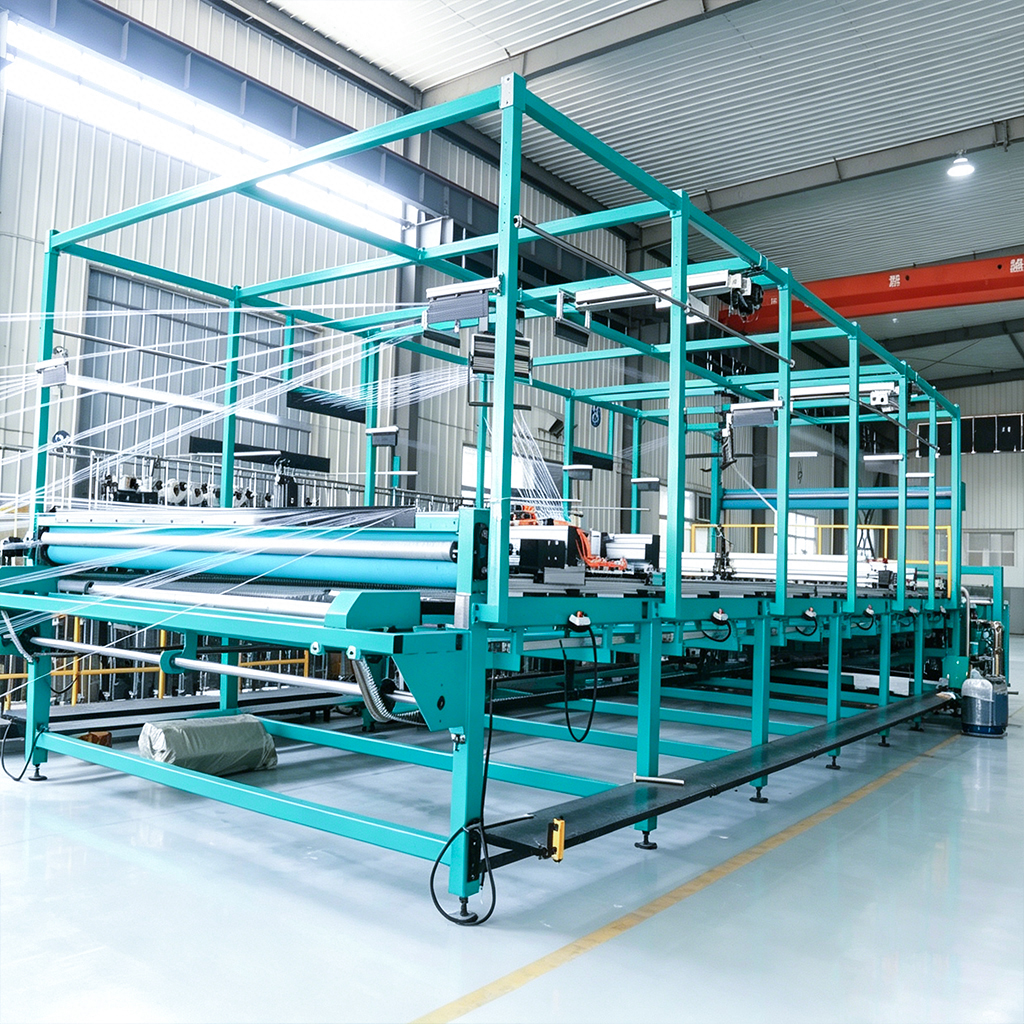
Product: LS Rotary Type Laid Scrim Machine

News
-
What a Warp Knitting Machine Does A warp knitting machine turns hundreds or thousands of parallel yarns into a continuous fabric by looping each yarn around a needle and linking it to its neighbours a...
READ MORE -
A plant manager in Coimbatore sends the same specification to three suppliers: a 2.5 m biaxial warp knitting machine for glass fiber scrim, 0/90 laydown, 96-end creel, 2,200 m/hr target, installation...
READ MORE -
Which Machine Category Matches Each Technical Fiber and Fabric Goal A warp knitting machine is the primary production platform for technical fiber textiles across fiberglass, chemical fiber, and carbo...
READ MORE -
Have you ever wondered why some weaving looms operate flawlessly for decades, while others seem to suffer from constant breakdowns and quality issues? The secret isn’t luck; it’s a disciplined and str...
READ MORE
-
Contact Info.
+86-198 5534 1617
+86-134 0158 3002yuanyang@yywarpknitting.com 699#, Shengzhi West Rd, Lvcheng Town, Danyang City, Zhenjiang City, Jiangsu Province, China

-
QR Code
-
Quick Links
Home About Products Manufacturing Customization News Contact -
Product List
Machine for Chemical Fiber Textile Machine for Fiberglass Textile Machine for Carbon Fiber Textile -
About Us
Company Profile Factory Gallery Value-added Service
Copyright © 2026 Changzhou Yuanyang Electromechanical Technology Co., Ltd. All Rights Reserved.
Custom Warp Knitting Machine Manufacturers
