

 English
 中文简体
 русский
 Français
 Español
 Deutsch

Double Chopped Stitch Bonding Technology for High-Performance Fiberglass Composites
2026-11-02
Content
- 1 1. The Role of Stitch-Bonded Fiberglass in Composite Manufacturing
- 2 2. What the FCD Double Chopped Stitch Bonding Machine Does
- 3 3. Product Types Supported by the Platform
- 4 4. Key Technical Specifications
- 5 5. Advantages of the Double Chopping Configuration
- 6 6. Comparison with Alternative Production Approaches
- 7 7. Applications in Major Industrial Sectors
- 8 8. How the Production Process Works
- 9 9. Manufacturing Strengths Behind the Equipment
- 10 10. Quality Control from Assembly to Commissioning
- 11 11. Customization and Engineering Configuration
- 12 12. Information Required for a Technical Proposal
- 13 13. Installation and Commissioning
- 14 14. Operator and Maintenance Training
- 15 15. Maintenance Priorities
- 16 16. Safety Considerations
- 17 17. Commercial and Operational Value
- 18 18. Recommended Evaluation Procedure for Buyers
- 19 19. Frequently Asked Questions
- 19.1 What is the main difference between a double chopped stitch-bonding machine and a single chopped machine?
- 19.2 Can the machine produce sandwich mats with PP or PET cores?
- 19.3 Is the cut length fixed?
- 19.4 Can the upper and lower chopped layers be different?
- 19.5 What is the standard working width?
- 19.6 What is the expected daily output?
- 19.7 Can the machine produce products other than chopped strand mat?
- 19.8 Does the machine use chemical adhesive for bonding?
- 19.9 What industries use the resulting materials?
- 19.10 Can the line be connected to existing equipment?
- 19.11 What information is needed for a quotation?
- 19.12 Is installation and operator training available?
- 19.13 How should the machine be maintained?
- 19.14 Can the machine be customized for a special fiberglass product?
- 20 20. Conclusion
- 21 References
- 22 Product: FCD Double Chopped Stitch Bonding Machine
The production of reinforced fiberglass materials is becoming increasingly demanding. Composite manufacturers must deliver lighter structures, higher mechanical performance, reliable dimensional stability, and efficient processing while controlling labor, material waste, and energy consumption. These requirements have encouraged the development of continuous production equipment that can combine fiber placement, material lamination, and mechanical bonding in one coordinated process.
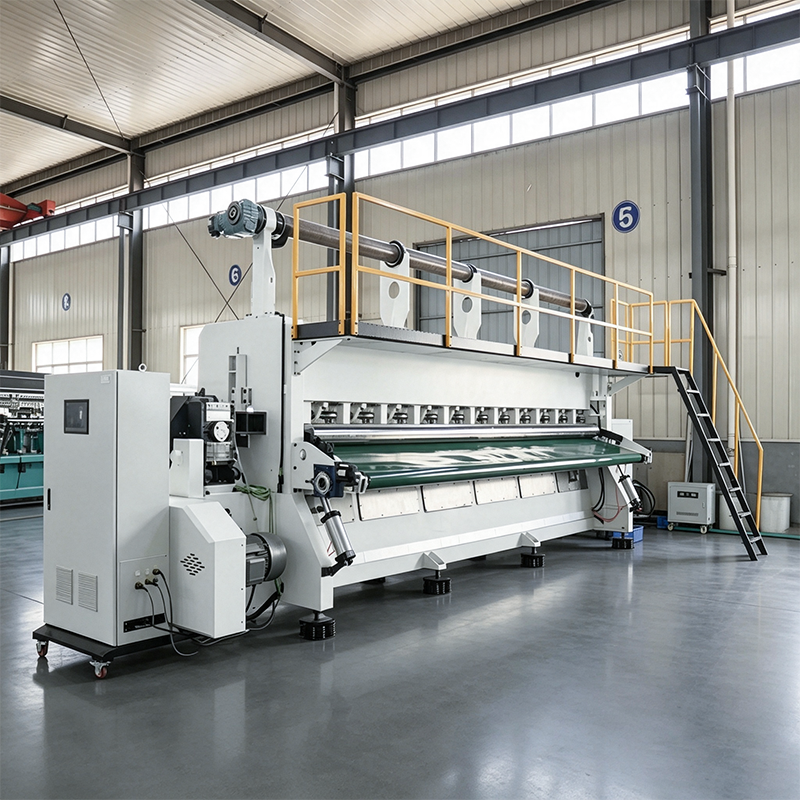
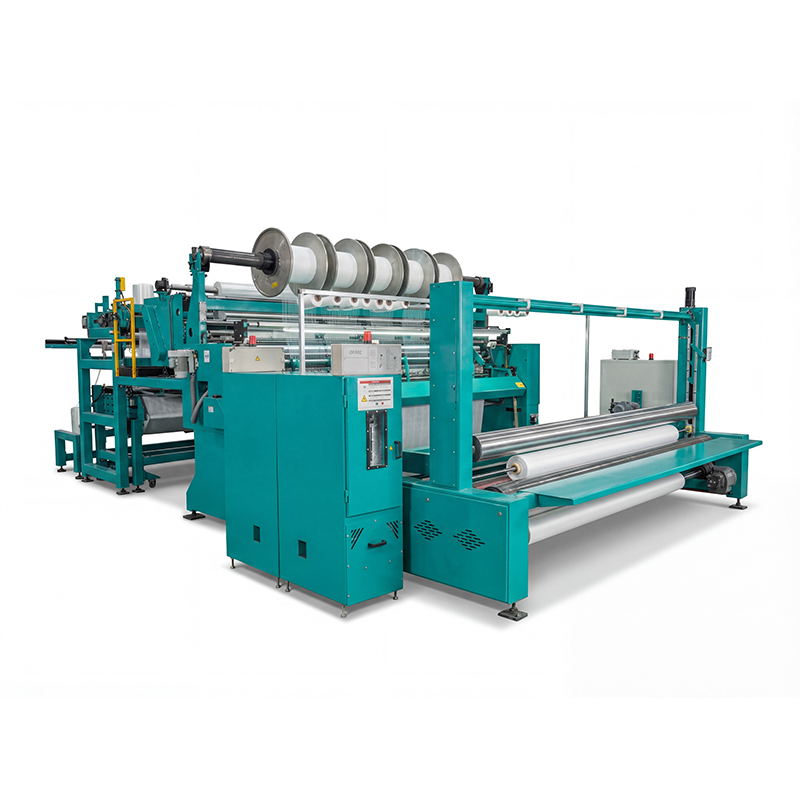
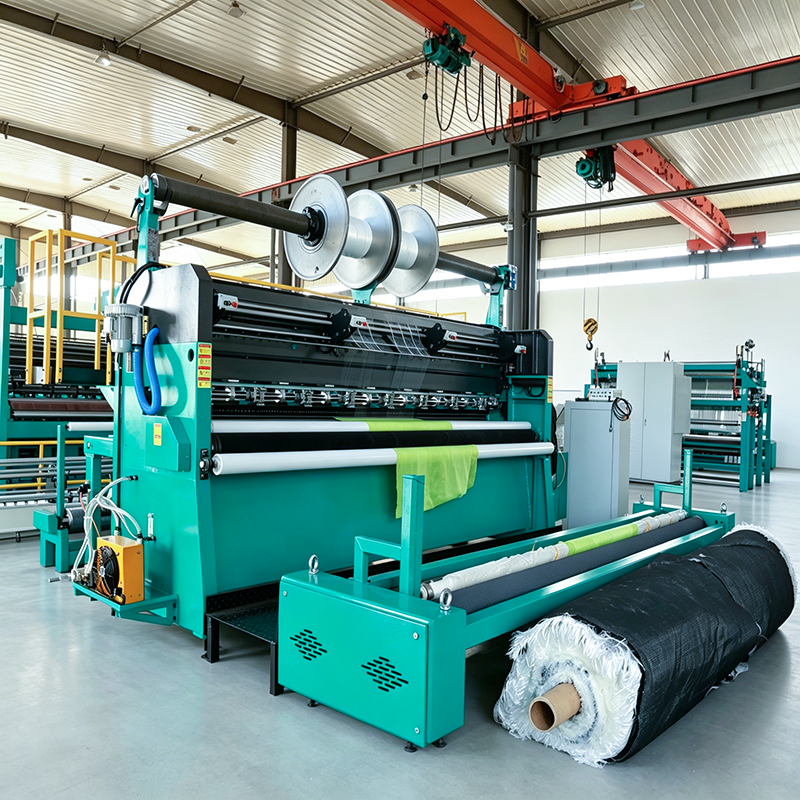
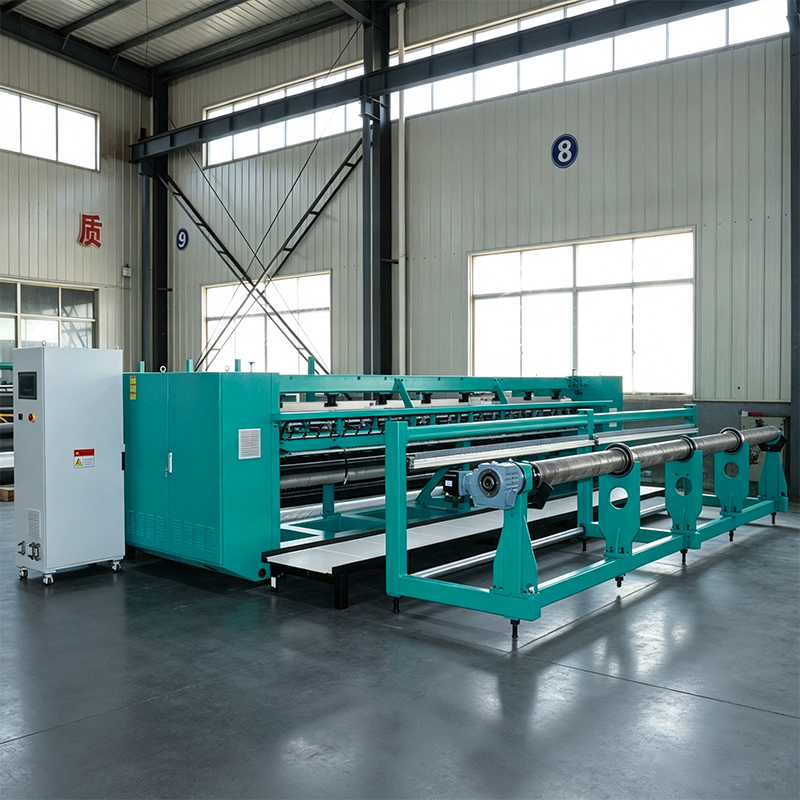
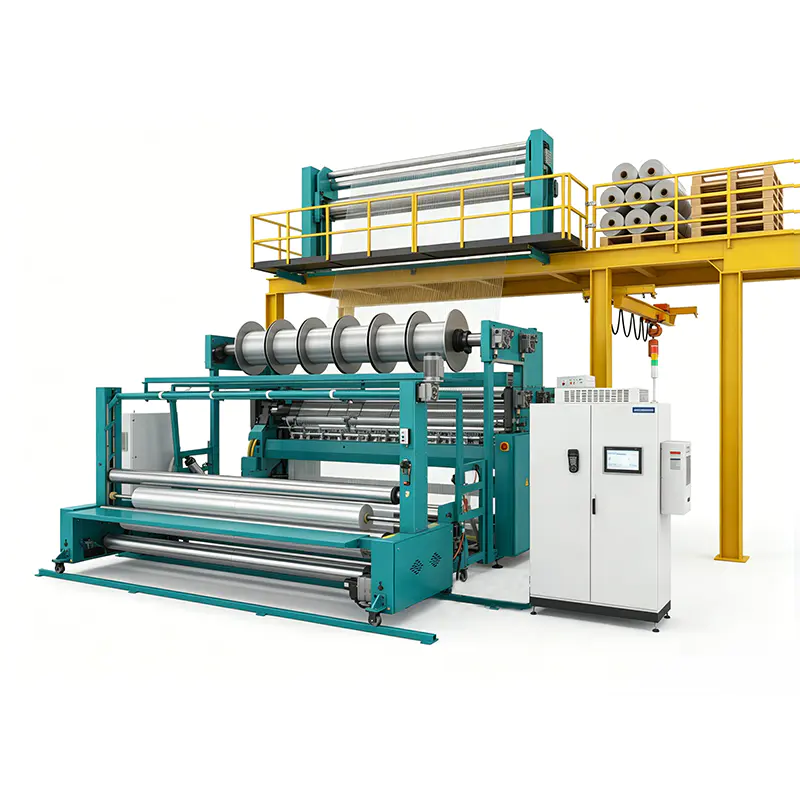
The FCD Double Chopped Stitch Bonding Machine is designed for this production environment. It is a specialized machine for fiberglass textile manufacturing that uses two independent chopping units to place chopped glass fiber on both sides of a carrier or core layer. The assembled layers are then mechanically bonded through a stitch-bonding process. With adjustable cut length, online lamination, and a standard working width of 2800 millimeters, the machine can produce a broad range of reinforcement materials for marine, automotive, rail, container, pipeline, and other composite applications.
Unlike a conventional single-sided chopped mat line, the FCD platform is configured for double-sided chopped fiber structures and sandwich materials. It can combine several layers in one continuous operation, reducing the need for separate lamination, adhesive application, or secondary bonding steps. This integrated approach helps manufacturers improve productivity while maintaining consistent fabric construction and repeatable product quality.
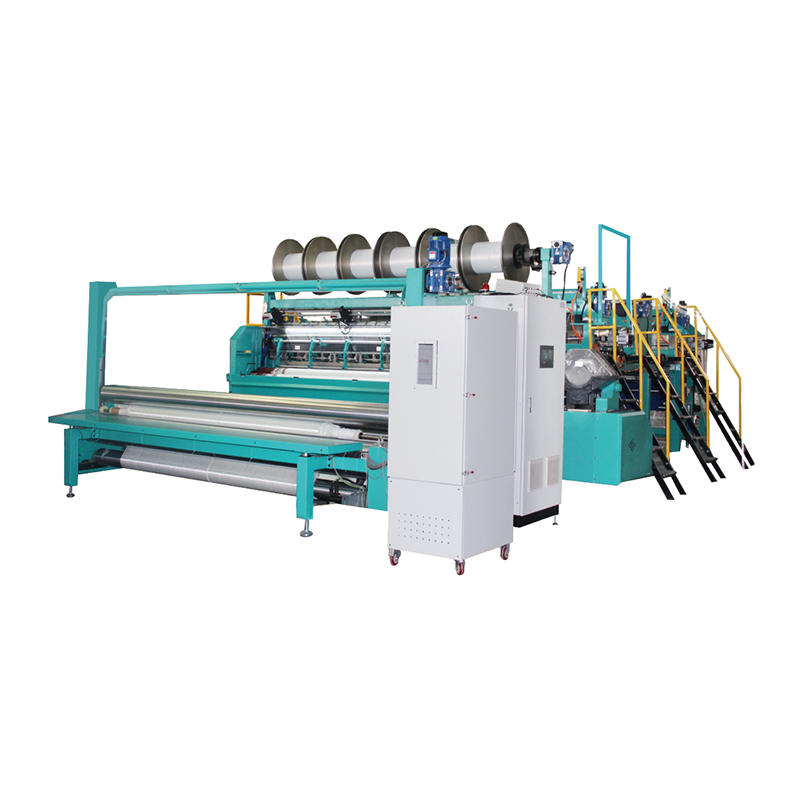
FCD Double Chopped Stitch Bonding Machine
1. The Role of Stitch-Bonded Fiberglass in Composite Manufacturing
Fiberglass reinforcement is widely used because it offers a favorable balance of tensile strength, impact resistance, corrosion resistance, processability, and cost. However, the performance of a finished composite depends not only on the properties of the glass fiber itself. Fiber distribution, orientation, areal weight, layer arrangement, binder content, bonding method, and compatibility with the resin or matrix all affect the final result.
Chopped strand mats are traditionally used where good conformability and relatively uniform reinforcement are required. The short fibers can adapt to curved molds and complex geometries more easily than many continuous-fiber fabrics. They are therefore useful in hulls, covers, interior components, vehicle panels, tanks, pipes, and other molded products.
In many applications, a single chopped layer is not sufficient. The manufacturer may require chopped fiber on both faces of a core, a nonwoven carrier between reinforcement layers, or a composite textile that combines different materials in a controlled sequence. Sandwich construction can improve stiffness-to-weight ratio, increase panel thickness without a proportional increase in mass, and provide useful acoustic, thermal, or impact characteristics depending on the core material.
Stitch bonding is an effective method for stabilizing these structures. Instead of relying only on chemical binders, the machine uses knitting elements to mechanically connect the fiber layers and carrier materials. This creates a flexible textile that can be handled, rolled, cut, transported, and impregnated during a later composite molding operation.
The stitch-bonded structure also provides important processing advantages. It can maintain the relative position of layers during handling, reduce loose fiber movement, and support more consistent resin wet-out. The exact outcome depends on the stitch pattern, bonding density, fiber weight, carrier construction, and downstream process, but the basic principle is suitable for many reinforcement architectures.
2. What the FCD Double Chopped Stitch Bonding Machine Does
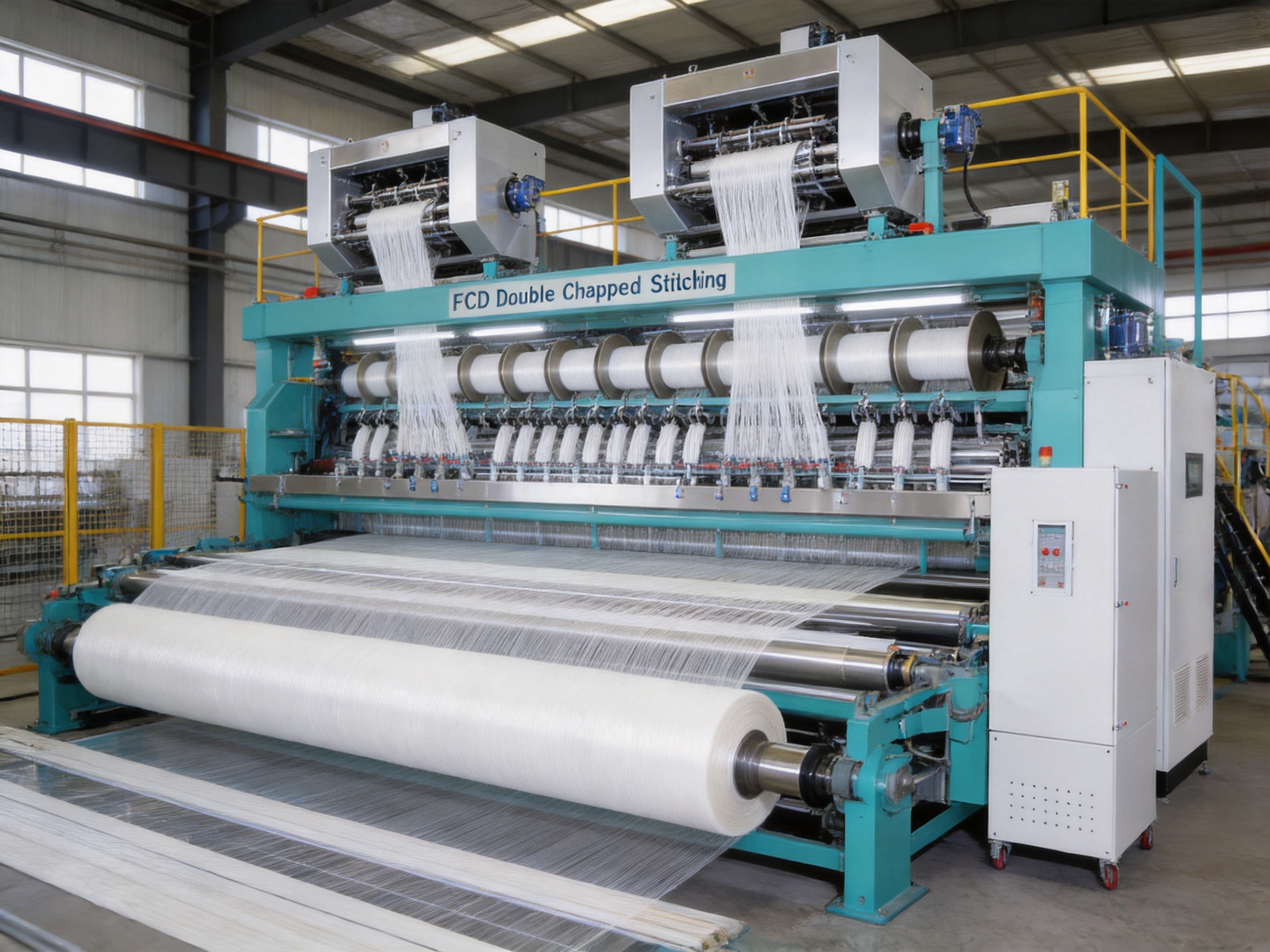
The FCD machine is a continuous production line for manufacturing double-sided chopped and laminated fiberglass textiles. Glass fiber roving is supplied from a creel and directed toward two chopping units. Each chopping unit cuts the roving into an adjustable length and distributes the chopped fibers over the required area of the moving material assembly.
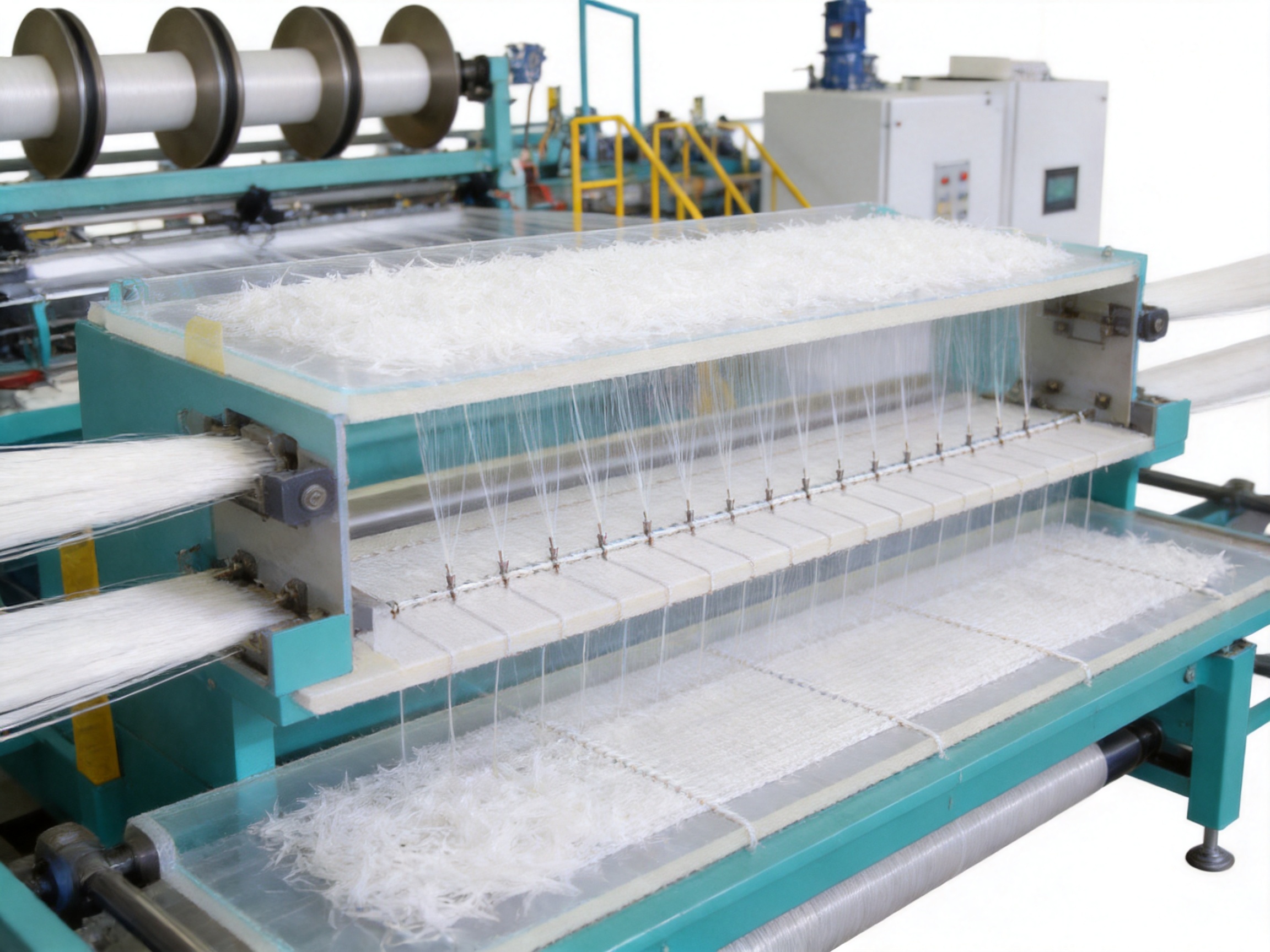
A carrier layer, core material, or pre-laid textile passes through the line. Depending on the product design, the carrier may be a nonwoven fabric, scrim, glass mat, or another compatible layer. For a sandwich product, a PP or PET core can be fed between the upper and lower chopped fiber layers. The assembled material then enters the stitch-bonding zone, where knitting elements mechanically lock the layers together.
The two chopping units can be operated as coordinated or independently adjustable modules. This provides flexibility in designing symmetrical and asymmetrical products. For example, the upper and lower sides may use the same fiber weight and cut length for a balanced structure, or different settings may be selected where one face requires a different reinforcement level or surface characteristic.
The line is intended to perform several operations in one production sequence:
- Feeding glass fiber roving from a controlled creel system.
- Chopping the roving into a selected cut length.
- Depositing chopped fiber across the working width.
- Feeding carrier, scrim, nonwoven, or core layers.
- Combining multiple material layers online.
- Mechanically bonding the assembly by stitch knitting.
- Delivering the finished textile to winding, cutting, or downstream handling equipment.
This integrated construction is the defining feature of the FCD platform. Rather than treating chopping, lamination, and bonding as isolated operations, the machine coordinates them as a continuous textile-forming process.
3. Product Types Supported by the Platform
The machine can be configured for several product families. The actual product range depends on fiber specification, target areal weight, cut length, layer arrangement, stitch pattern, production speed, and downstream requirements.
3.1 Chopped Strand Mat
Chopped strand mat consists of short glass fibers distributed over a carrier or formed into a stable mat structure. The material is valued for its ability to conform to molds and irregular surfaces. It is commonly used with thermoset resins in hand lay-up, spray-up, compression molding, and related composite processes.
With the appropriate configuration, the machine can produce a consistent chopped fiber distribution and a stitch-bonded structure that is easier to handle than loose chopped fibers. The adjustable chopping system allows the manufacturer to select a cut length appropriate to the desired conformability, surface quality, and reinforcement behavior.
3.2 Composite Mat
Composite mat combines glass fiber with one or more additional layers. The added layer may provide dimensional stability, surface smoothness, reinforcement in another direction, separation from a core, or improved compatibility with a specific molding process.
Online lamination helps the manufacturer control layer alignment and reduce intermediate handling. It can also support a more organized production flow because several material components are combined before winding rather than being laminated manually after separate production.
3.3 Sandwich Mat
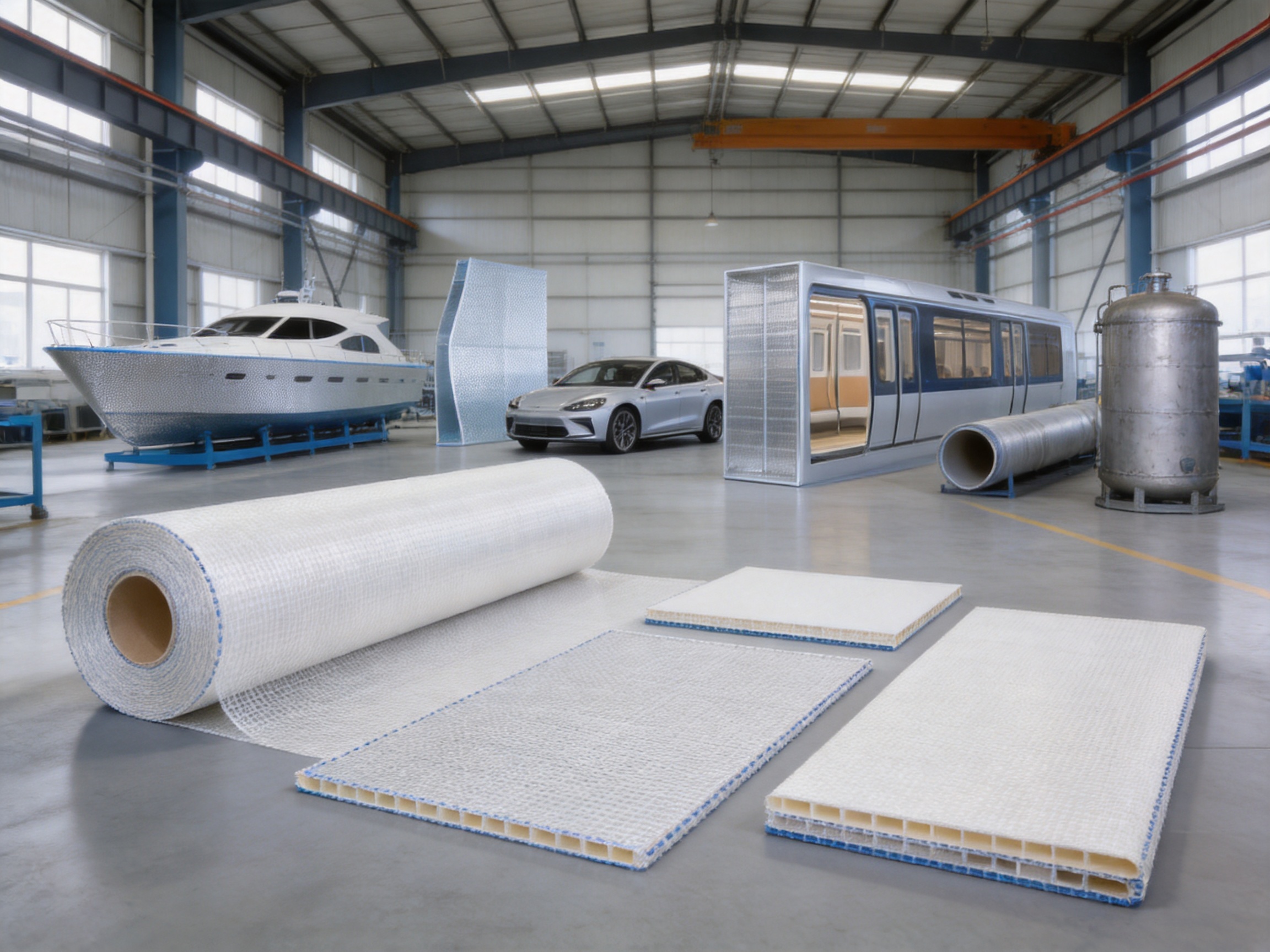
Sandwich mats contain reinforcement layers around a lightweight core. PP and PET are identified as suitable core materials for the FCD configuration. The core helps increase thickness and bending stiffness while limiting weight growth. The two chopping units can place glass fiber on both sides of the core, after which the stitch-bonding mechanism stabilizes the complete assembly.
The resulting textile is useful where a manufacturer needs a lightweight panel with an engineered layer structure. Product performance will depend on the core density, fiber weight, stitch construction, resin system, and final molding conditions, but the machine provides the production architecture required to make these combinations in one continuous pass.
3.4 Stitch-Bonded Composite Fiberglass Fabric
Stitch-bonded composite fiberglass fabric can combine chopped glass fiber with a scrim, nonwoven, or another reinforcement layer. The stitch structure holds the components together and gives the material handling integrity before resin impregnation or molding.
This type of textile is particularly useful when a manufacturer needs a material that is flexible enough to conform to a mold but stable enough to be supplied in rolls and processed at industrial scale.
3.5 Double-Sided Chopped Mat
Double-sided chopped mat is one of the key product advantages of a two-chopper configuration. Chopped glass fibers can be deposited on both faces of a carrier or central layer. Compared with a single-sided structure, this arrangement can offer more balanced reinforcement and may reduce the number of separate lay-up operations required by the composite processor.
4. Key Technical Specifications
| Parameter | Specification | Production Significance |
|---|---|---|
| Applicable fiber | Glass fiber | Suitable for chopped glass roving reinforcement |
| Machine speed | 50–900 r/min | Adjusted according to fabric construction and process conditions |
| Standard working width | 2800 mm, approximately 110 inches | Suitable for broad industrial rolls and panel materials |
| Reference daily output | Approximately 5000 square meters | Actual output varies with product design and operating conditions |
| Chopping units | Two independent units | Enables chopped fiber placement on both faces |
| Cut-length control | Adjustable | Allows adaptation to product requirements |
| Layer handling | Online lamination | Combines carrier and core materials during continuous production |
| Bonding method | Stitch bonding | Mechanically stabilizes the assembled textile |
The stated speed and output figures should be treated as engineering references rather than universal production guarantees. Actual capacity depends on the fabric construction, chopped fiber weight, cut length, stitch density, number and type of layers, roll-handling requirements, machine settings, operator experience, and process stability.
A proper technical proposal should therefore be based on the customer’s target product rather than on speed alone. A line configured for a heavy sandwich mat may operate at a different practical speed from a line producing a lighter single-carrier textile. The important objective is to match machine settings with the required quality, productivity, and process reliability.
5. Advantages of the Double Chopping Configuration
5.1 Production of Double-Sided Structures in One Pass
The most direct advantage of the FCD machine is its ability to place chopped fiber on both sides of a carrier or core layer. A single-sided line normally requires an additional operation if the customer needs reinforcement on the opposite face. The double chopping arrangement can reduce this additional handling and make the production sequence more efficient.
Producing both sides in one pass can also help maintain layer registration. When separate operations are used, the intermediate roll must be unwound, aligned, and processed again. Each additional handling step creates opportunities for wrinkles, contamination, tension variation, or misalignment. Online construction reduces the number of such transitions.
5.2 Flexible Sandwich-Mat Production
The machine is designed to accommodate PP and PET core layers between chopped glass fiber layers. This allows composite manufacturers to develop lightweight sandwich products without purchasing a separate lamination line for every layer combination.
The online core-feeding arrangement is particularly valuable for applications where the reinforcement textile must be delivered as a stable roll. The stitch-bonded assembly can be wound or cut after production, allowing the material supplier to provide a semi-finished textile that is ready for the customer’s molding process.
5.3 Adjustable Cut Length
Chopped fiber length affects handling, conformability, distribution, and the behavior of the final reinforcement. Shorter fibers may improve adaptation to complex contours, while longer fibers can contribute to a different balance of reinforcement continuity and mat integrity. The appropriate selection depends on the intended product and processing method.
The FCD’s adjustable chopping units allow the production line to respond to different product specifications. This is more useful than a fixed-cut system when a manufacturer supplies several markets or must develop products for different resin and molding processes.
5.4 Balanced or Asymmetrical Construction
Because the two chopping units operate as separate modules, the machine can support balanced and asymmetrical layer designs. A balanced product may use similar chopped fiber weight on both faces. An asymmetrical product may require a heavier face, a different cut length, or a different surface layer.
This capability gives product engineers more control over the structure. It can be used to adapt the material to a particular mold surface, impact direction, finishing requirement, or core design.
5.5 Reduced Secondary Lamination
When different layers are combined online, the manufacturer may reduce the need for separate adhesive lamination or manual assembly. This can shorten the production route, lower work-in-process inventory, and reduce labor associated with aligning separate rolls.
Online lamination does not eliminate the need for process development. Layer tension, feeding accuracy, material compatibility, and stitch parameters must still be established. However, once the settings are validated, the continuous arrangement can provide a more repeatable manufacturing process than a sequence of disconnected operations.
5.6 High Conformability and Lightweight Potential
Chopped fiberglass textiles are often selected for their ability to conform to complex shapes. A stitch-bonded structure can preserve this flexibility while providing improved handling integrity. When combined with a lightweight PP or PET core, the product can support designs that seek lower mass without abandoning a reinforced composite architecture.
For lightweight transportation components, the combination of glass fiber reinforcement and a lightweight core can be particularly attractive. The final component still requires validation through mechanical testing, but the machine provides a suitable basis for developing such materials.
6. Comparison with Alternative Production Approaches
The FCD machine should be evaluated against the complete production route rather than compared only by nominal machine speed. Its advantages become most visible when the target product requires two chopped surfaces, multiple layers, or a sandwich architecture.
| Production Approach | Typical Characteristics | FCD Advantage |
|---|---|---|
| Single-sided chopped mat line | One chopping unit and one primary chopped surface | Adds a second chopping unit for double-sided products and sandwich structures |
| Separate lamination and bonding operations | Layers are produced or handled in separate stages | Combines layer feeding and stitch bonding online |
| Manual layer assembly | High dependence on labor, alignment, and operator consistency | Provides a continuous and more controlled layer-forming process |
| Needle-punched assembly | Uses needle penetration to stabilize layers | Uses stitch bonding for a textile structure with selectable stitch construction |
| Adhesive-laminated structure | Requires adhesive application, drying, and process control | Mechanically bonds layers without relying solely on chemical adhesive |
| Separate core lamination line | Requires additional equipment and intermediate handling | Supports online PP/PET core feeding in the double-chopped structure |
These comparisons do not mean that one production method is suitable for every composite product. Needle punching, adhesive lamination, continuous filament fabrics, and other textile technologies each have their own applications. The FCD is most appropriate when the product calls for chopped fiberglass, a flexible stitch-bonded structure, and efficient integration of two reinforcement faces or a central core.
7. Applications in Major Industrial Sectors
7.1 Shipbuilding
Marine structures require materials that can provide strength, impact resistance, corrosion resistance, and good moldability. Chopped strand mats and sandwich mats are used in hulls, decks, internal panels, covers, and other fiberglass-reinforced components.
The FCD machine can produce broad rolls of double-sided chopped mat and composite sandwich material. Such materials can help shipbuilders reduce manual lay-up steps and improve the consistency of reinforcement placement. For curved hull sections, the conformability of chopped fiber textiles can be valuable during molding.
Product selection must consider resin compatibility, water exposure, fire requirements, impact performance, and the specific construction rules applicable to the vessel. The machine supplies the textile platform, while the final marine material must be validated through the appropriate design and testing program.
7.2 Lightweight Automotive Components
Automotive manufacturers continue to investigate lightweight composite panels and semi-structural components. Fiberglass composites can be used in underbody panels, interior modules, covers, battery-related structures, storage components, and other parts where weight, corrosion resistance, and shape flexibility are important.
Sandwich mats with PP or PET cores can support the development of lightweight panels with increased thickness and stiffness. The FCD line allows reinforcement suppliers to tailor the upper and lower chopped layers to the desired panel construction. Depending on the molding method, the finished textile may be processed by compression molding, resin transfer methods, or other composite technologies.
Automotive production places strong demands on repeatability and cycle-time control. The continuous stitch-bonding process can help create a more consistent semi-finished material, but the final component still requires dimensional, mechanical, acoustic, thermal, and aging evaluation.
7.3 Rail Transportation
Rail vehicles use composite materials in interior panels, seat structures, equipment covers, ceiling components, fairings, and selected exterior parts. Weight reduction is important because lower vehicle mass can support improved energy efficiency and operating performance.
In rail applications, fire, smoke, toxicity, impact, and durability requirements are especially important. The FCD machine can support the production of glass fiber composite textiles with carefully controlled layer arrangements. When combined with an appropriate resin and core system, the textile can become part of a lightweight panel designed for transportation applications.
7.4 Containers and Pipelines
Fiberglass reinforcement is also used in containers, tanks, pipes, linings, and related infrastructure products. These applications may require resistance to corrosion, pressure, impact, chemicals, or environmental exposure.
A stitch-bonded composite textile can provide a stable reinforcement layer for lining structures or molded shells. Double-sided chopped reinforcement may be useful where the product requires consistent material distribution around a carrier or core. The exact textile design should be selected according to the medium being contained, operating temperature, pressure, resin system, and required service life.
8. How the Production Process Works
8.1 Roving Preparation and Creel Feeding
Production begins with the preparation of glass fiber roving. The roving specification, package condition, tension, and creel arrangement influence the stability of the chopping process. The feeding system must deliver the roving smoothly to the chopping units without excessive tension fluctuation or entanglement.
Before production, operators should confirm the fiber type, linear density, package arrangement, and required number of ends. The creel layout should correspond to the target fabric width and chopped fiber weight. Stable feeding is essential because a variation at the creel can appear later as an uneven chopped layer.
8.2 Chopping and Fiber Distribution
Each chopping unit cuts the roving to the selected length and distributes the chopped fibers across the moving web. The cut length is selected according to product requirements. Blade condition, feed consistency, rotational synchronization, and fiber tension all influence the quality of the chopped layer.
The two units may be adjusted to create identical or different conditions on the upper and lower faces. A symmetrical structure generally requires matching settings, while a customized product may use different cut lengths or material weights.
8.3 Carrier and Core Layer Feeding
The carrier or core layer is introduced into the material path with controlled tension and alignment. A carrier may be a nonwoven, scrim, glass mat, or another textile. A sandwich construction may use PP or PET as the core.
Feeding accuracy is important because the core must remain centered and stable between the chopped layers. Edge guidance, tension control, roll quality, and splice management all affect the finished product. For high-volume production, the material-feeding system should be planned together with the customer’s roll dimensions and raw-material supply method.
8.4 Stitch Bonding
After the layers are assembled, the material enters the stitch-bonding zone. Knitting elements penetrate and interconnect the layers according to the selected stitch construction. The stitch pattern and bonding density determine how strongly the layers are held together and how the finished textile behaves during handling and molding.
A lower bonding density may preserve flexibility, while a higher density may improve dimensional stability. The correct setting depends on the product’s required drape, tensile handling strength, core retention, surface behavior, and downstream process.
8.5 Winding and Finishing
The finished textile can be directed to a winding or cutting system. Roll diameter, web tension, edge alignment, splice design, and packaging requirements should be established before commissioning. A stable winding process protects the fabric during storage and transport.
Where the product is supplied as cut sheets, the downstream line can be configured around the required sheet length, stack arrangement, and packaging format. The interface between the stitch-bonding machine and downstream equipment should be considered during the original engineering stage.
9. Manufacturing Strengths Behind the Equipment
The quality of a textile machine depends on more than its basic design. Manufacturing organization, component control, testing, engineering experience, service capability, and the ability to customize the line all affect long-term production results.
The equipment manufacturer operates a production base of more than 12,000 square meters in Danyang, Jiangsu Province. The facility has an annual production capacity of more than 200 sets and employs more than 50 skilled staff members. This scale supports the manufacture of standard machines while retaining the flexibility needed for specialized textile equipment.
9.1 Integrated Research and Development
The engineering team focuses on warp knitting machinery, stitch-bonding equipment, biaxial and multiaxial machines, carbon fiber textile machinery, powder scattering systems, web laying machines, and related special equipment. This broader technical background is valuable because the FCD machine combines several disciplines: roving feeding, chopping, web formation, layer handling, knitting, drive systems, controls, and roll processing.
Experience across related textile technologies helps the manufacturer understand how machine settings influence fabric construction. It also supports the development of non-standard configurations for difficult materials, unusual fabric designs, and production lines that must operate consistently for extended periods.
9.2 Trial Production and Design Verification
A design trial production workstation allows new configurations to be built and tested before entering regular production. This is an important advantage for customers whose products cannot be produced successfully with a standard machine setting.
Trial work can be used to evaluate cut length, layer compatibility, stitch construction, core feeding, web tension, winding, and the interaction between machine speed and fabric quality. It also provides an opportunity to identify engineering changes before the equipment is shipped to the customer’s factory.
9.3 Standardized Production Zones
The production base is organized into standard manufacturing areas. A structured workshop arrangement helps coordinate component preparation, mechanical assembly, electrical integration, testing, debugging, and final inspection.
Standardized production does not mean that every machine is identical. Instead, it creates a controlled foundation for repeatable construction while allowing customer-specific modules and layouts to be incorporated where necessary.
9.4 Component and Warehouse Management
The company maintains an intelligent warehouse with digital control of receiving, storage, picking, and delivery. Organized material management can reduce the risk of misplaced components, improve preparation efficiency, and support more predictable delivery schedules.
For export projects, warehouse control is especially important because equipment may contain many mechanical, electrical, and consumable components. Clear identification and organized packing simplify installation and reduce the possibility of missing parts during commissioning.
9.5 Pre-Delivery Testing
Every machine is tested before dispatch. Testing may include mechanical operation, electrical functions, drive coordination, chopping performance, stitch-bonding operation, safety controls, and interface checks. The specific test plan should be aligned with the ordered configuration and the customer’s intended product.
Pre-delivery testing reduces commissioning risk. It allows the engineering team to correct assembly or control issues in the manufacturing facility, where tools, technicians, and replacement components are readily available.
10. Quality Control from Assembly to Commissioning
Quality control begins with component procurement and continues through machining, assembly, electrical installation, testing, debugging, packing, and installation at the customer’s site. Each stage affects the reliability of the final line.
Mechanical alignment is particularly important in a machine that combines rotating chopping units, a moving material web, knitting elements, and winding equipment. Misalignment can contribute to uneven fabric formation, abnormal wear, tension variation, or unstable operation.
Electrical and control-system inspection ensures that motors, sensors, drives, emergency stops, guards, and operating interfaces work as intended. The machine should be tested under conditions that represent the customer’s production process as closely as possible.
Process quality must also be evaluated. A machine can operate mechanically while still producing an unacceptable textile if the chopped fiber distribution, layer alignment, stitch pattern, or winding tension is incorrect. For this reason, commissioning should include actual material trials and inspection of the resulting fabric.
Typical quality checks may include:
- Working width and edge alignment.
- Chopped fiber cut length and distribution.
- Upper and lower layer weight balance.
- Core position and layer registration.
- Stitch pattern and bonding density.
- Fabric areal weight and thickness.
- Roll hardness and winding appearance.
- Machine speed stability and drive synchronization.
- Safety guard and emergency-stop performance.
11. Customization and Engineering Configuration
Composite textile production rarely follows a single universal specification. A customer may require a particular cut length, core thickness, roll diameter, stitch pattern, working width, fabric weight, or downstream handling method. The FCD platform can be customized through machine structure, functional modules, material interfaces, and process parameters.
Customization may include:
- Adjustment of the two chopping units for different fiber cut lengths.
- Carrier feeding for nonwoven, scrim, or glass mat.
- Core-layer feeding for PP or PET sandwich structures.
- Selection of stitch pattern and bonding density.
- Adaptation of working width to target panel or roll dimensions.
- Integration with creels, winding units, cutters, or existing equipment.
- Modification of line layout to suit the customer’s workshop.
- Process optimization for special fiber or fabric constructions.
For a reliable configuration, the customer should provide drawings, fabric samples, target specifications, raw-material information, and expected production volumes. Three-dimensional design confirmation can be used before manufacturing to review machine layout, access areas, material flow, and interface dimensions.
12. Information Required for a Technical Proposal
| Required Input | Reason It Is Important |
|---|---|
| Target fabric construction | Determines layer arrangement, chopped fiber weight, core selection, and stitch design |
| Fiber type and roving specification | Influences creel design, chopping parameters, and feeding conditions |
| Required cut length | Determines the chopping-unit setup and blade configuration |
| Working width | Confirms machine width, edge control, and material utilization |
| Required roll diameter | Determines winding and downstream handling requirements |
| Production target | Allows speed and capacity to be matched to the product |
| Workshop dimensions | Confirms equipment footprint, access, and material flow |
| Utility supply | Supports electrical and installation planning |
| Downstream equipment | Ensures compatibility with cutting, winding, packaging, or molding preparation |
| Quality requirements | Defines inspection, testing, and process-control expectations |
Providing complete technical information at the beginning of a project can shorten the engineering cycle and improve the accuracy of the quotation. It also reduces the risk that the delivered line will require major changes after installation.
13. Installation and Commissioning
The FCD machine can be installed as a standalone line or integrated with existing creels, feeding systems, winding units, and material-handling equipment. Installation begins with checking the workshop foundation, access route, utilities, equipment position, and safety requirements.
Assigned engineers can support mechanical installation, electrical connection, machine alignment, chopping-unit calibration, stitch-bonding trials, and production adjustment. The objective is not only to start the machine but also to establish stable operating conditions for the agreed product.
Commissioning normally includes:
- Positioning and leveling of major machine sections.
- Connection of electrical and control systems.
- Inspection of drives, sensors, guards, and emergency devices.
- Installation and adjustment of chopping units.
- Threading and preparation of the stitch-bonding area.
- Loading and alignment of carrier or core materials.
- Trial production at controlled speed.
- Adjustment of tension, cut length, stitch density, and winding.
- Operator instruction and maintenance handover.
Production trials should be performed with the customer’s actual raw materials whenever possible. This provides a more meaningful basis for setting machine parameters than a demonstration using materials that differ from the intended production specification.
14. Operator and Maintenance Training
Proper training is essential for a line that combines chopping, layer handling, knitting, and winding. Operators must understand not only how to start and stop the machine but also how to identify the causes of fabric defects.
Operator training can cover material loading, roving threading, cut-length adjustment, carrier and core feeding, tension control, stitch setting, speed selection, roll changing, production inspection, and safe response to abnormal conditions.
Maintenance personnel require additional instruction in blade inspection, knitting-element wear, drive systems, lubrication, sensor checks, tension components, electrical troubleshooting, and replacement procedures. Training at the manufacturer’s factory is available, typically for one to two months depending on the program and customer requirements.
Workshop management training may include production planning, quality documentation, process-parameter control, preventive maintenance scheduling, and the establishment of standard operating procedures. Assistance with quality-system documentation can help the customer formalize inspection records and production traceability.
15. Maintenance Priorities
Routine maintenance supports stable production and protects the machine from avoidable wear. The most important maintenance areas are the chopping units, knitting elements, roving-feeding system, drive components, tension devices, sensors, and lubrication points.
15.1 Chopping Unit Inspection
Blades and counter surfaces should be inspected regularly. Worn or damaged cutting components may produce inconsistent cut lengths, fiber fuzz, poor distribution, or increased process waste. Blade replacement intervals depend on the glass fiber specification, production hours, operating speed, and maintenance practice.
15.2 Knitting Element Inspection
Knitting elements must be kept in good condition because wear can affect stitch formation, fabric stability, and machine noise. Broken or damaged elements should be replaced according to the maintenance procedure. Operators should monitor changes in fabric appearance that may indicate developing wear.
15.3 Tension and Feeding Control
Uneven roving tension can create variations in chopped fiber weight. Carrier and core tension must also be controlled to prevent wrinkles, lateral movement, or unstable layer registration. Regular inspection of guides, rollers, sensors, and tension devices helps prevent these problems.
15.4 Lubrication and Cleaning
Lubrication should follow the recommended schedule and use suitable materials. Glass fiber debris and dust should be removed from relevant areas because accumulation can affect moving parts, sensors, and electrical cabinets. Cleaning procedures should be performed with attention to operator safety and equipment protection.
16. Safety Considerations
The FCD machine contains chopping zones, rotating components, knitting elements, moving webs, drive sections, and winding equipment. These areas require guarding, controlled access, emergency-stop devices, clear operating procedures, and suitable personal protective equipment.
Operators should be trained to stop the machine before clearing material jams, replacing blades, entering guarded areas, or performing maintenance. Lockout and isolation procedures should be established for electrical and mechanical energy sources.
Glass fiber handling can generate dust and loose filaments. The workshop should provide appropriate housekeeping, ventilation, protective clothing, gloves, eye protection, and respiratory protection where required by the risk assessment. Safety procedures must be adapted to the customer’s local regulations and production environment.
17. Commercial and Operational Value
The business value of the FCD machine comes from its ability to support several related product types on one platform. A manufacturer can produce standard chopped mat, double-sided mat, composite mat, and sandwich structures by changing material inputs and process settings rather than purchasing an entirely separate line for each product.
This flexibility can support market diversification. Suppliers serving shipbuilding, transportation, construction, containers, and pipelines may use the same basic equipment to develop different product families. The machine can therefore serve not only a single established product but also future composite-textile opportunities.
Online lamination can reduce intermediate storage and handling. When layers are combined during continuous production, the customer may be able to simplify material flow, reduce the number of separate rolls requiring storage, and shorten the route from raw material to finished reinforcement.
The actual return on investment depends on utilization, labor costs, raw-material prices, product mix, selling price, quality yield, energy consumption, maintenance, and market demand. A detailed feasibility study should use the customer’s own production assumptions rather than relying only on the reference output figure.
18. Recommended Evaluation Procedure for Buyers
A buyer considering this equipment should begin with the product rather than the machine name. The first step is to define the required fabric construction, including the number of layers, glass fiber type, chopped fiber weight, cut length, core material, stitch density, width, roll diameter, and intended molding process.
The second step is to provide samples or drawings. A trial can then be arranged to verify fiber distribution, layer alignment, fabric handling, conformability, stitch stability, and winding quality.
The third step is to review the complete line configuration. This includes the creel, chopping units, carrier and core feeders, stitch-bonding section, drive and control system, winding or cutting equipment, safety provisions, spare parts, and installation requirements.
The fourth step is to establish acceptance criteria. These may include output, fabric width, areal weight, cut-length tolerance, layer position, stitch appearance, roll quality, machine availability, and operator training. Clear criteria make the commissioning process more objective.
The final step is to plan long-term support. Spare parts, maintenance schedules, remote assistance, engineer visits, factory training, and process optimization should be discussed before the purchase order is finalized.
19. Frequently Asked Questions
What is the main difference between a double chopped stitch-bonding machine and a single chopped machine?
A single chopped machine generally uses one chopping unit and produces a chopped fiber layer on one side or in one primary material path. The FCD machine uses two independent chopping units, allowing chopped glass fiber to be placed on both sides of a carrier or core. This makes it suitable for double-sided chopped mats and sandwich products.
Can the machine produce sandwich mats with PP or PET cores?
Yes. The FCD configuration supports online feeding of PP or PET core layers between the upper and lower chopped glass fiber layers. The complete assembly is then stabilized by stitch bonding. The final product specification depends on core density, thickness, fiber weight, cut length, stitch design, and downstream processing.
Is the cut length fixed?
No. The chopping units are designed with adjustable cut-length settings. The suitable range and final adjustment should be confirmed according to the glass roving specification and the required product construction.
Can the upper and lower chopped layers be different?
Yes. The two chopping units can be configured for balanced or asymmetrical structures. Depending on the product design, the two sides may use different fiber weights, cut lengths, or operating settings.
What is the standard working width?
The standard working width is 2800 millimeters, approximately 110 inches. Other width requirements can be reviewed during engineering configuration according to the target roll, panel, or downstream process.
What is the expected daily output?
The reference daily output is approximately 5000 square meters. Actual output varies according to fabric construction, chopped layer weight, stitch density, cut length, operating speed, material changes, roll handling, and process conditions.
Can the machine produce products other than chopped strand mat?
Yes. The platform can be configured for composite mat, sandwich mat, stitch-bonded composite fiberglass fabric, double-sided chopped mat, and sandwich structures with PP or PET core layers. Product feasibility should be confirmed through technical review and material trials.
Does the machine use chemical adhesive for bonding?
The primary layer-stabilizing method is mechanical stitch bonding through knitting elements. Additional binders or downstream resin systems may be used if required by the final product, but the machine itself is designed to mechanically connect the assembled textile layers.
What industries use the resulting materials?
Typical application fields include shipbuilding, lightweight automotive components, rail transportation, containers, pipelines, and related composite products. The final application must be assessed according to mechanical, fire, chemical, environmental, and regulatory requirements.
Can the line be connected to existing equipment?
Yes. The machine can be installed as a standalone line or integrated with existing creels, feeding equipment, winding systems, cutters, or other material-handling units. Interface dimensions, speed matching, controls, and material flow must be reviewed during engineering.
What information is needed for a quotation?
The supplier normally needs the target fabric construction, fiber and roving specification, cut length, working width, roll diameter, production target, workshop layout, utility supply, downstream interface, and desired level of automation. Samples or drawings are also helpful.
Is installation and operator training available?
Yes. Engineering support can cover installation, commissioning, calibration, production trials, and operator training. Additional training for knitters, maintainers, and workshop managers can be arranged at the manufacturing facility, generally for one to two months depending on the program.
How should the machine be maintained?
Maintenance should focus on chopping blades, counter surfaces, knitting elements, roving tension, carrier and core feeding, drive components, sensors, lubrication points, and cleaning. A preventive-maintenance schedule should be established during commissioning.
Can the machine be customized for a special fiberglass product?
Yes. Customization may include machine structure, layout, layer-feeding modules, core handling, stitch design, width, downstream interfaces, and process optimization. Engineering should begin with product drawings, samples, raw-material data, and production objectives.
20. Conclusion
The FCD Double Chopped Stitch Bonding Machine is designed for manufacturers that require more than a conventional single-sided chopped mat line. Its two independent chopping units, adjustable cut length, online lamination capability, and stitch-bonding process create a flexible platform for producing double-sided chopped mats, composite mats, sandwich mats, and stitch-bonded fiberglass fabrics.
The machine’s principal advantages are its ability to combine several production stages, support PP and PET core layers, reduce secondary handling, and adapt to balanced or asymmetrical textile structures. These features can help composite-material suppliers improve production efficiency, stabilize quality, and expand their product range.
Its value is further supported by an established manufacturing base, research and development capabilities, trial-production facilities, structured quality control, digital warehouse management, pre-delivery testing, installation assistance, and long-term technical support. These manufacturing and service strengths are important because the performance of a specialized textile line depends on the entire engineering process, not only on the machine’s individual modules.
For buyers, the most effective approach is to define the required fiberglass product first, then confirm the machine configuration through samples, trials, technical drawings, and clear acceptance criteria. When matched correctly with the fiber, core, stitch, width, and downstream process, the FCD platform can provide a practical production solution for lightweight and high-performance composite reinforcement materials.
References
1. Changzhou Yuanyang Electromechanical Technology Co., Ltd., FCD Double Chopped Stitch Bonding Machine Product Information.
2. Changzhou Yuanyang Electromechanical Technology Co., Ltd., Technical Information on Stitch-Bonding, Biaxial Warp Knitting, and Composite Textile Machinery.
3. American Society for Testing and Materials, Standard Practices and Test Methods for Glass Fiber-Reinforced Polymer Composites.
4. International Organization for Standardization, Guidance on Textile Machinery Safety and Composite Material Testing.
5. Hull, D. and Clyne, T. W., An Introduction to Composite Materials, principles of fiber reinforcement and composite structures.
6. Mallick, P. K., Fiber-Reinforced Composites: Materials, Manufacturing, and Design.
7. Campbell, F. C., Manufacturing Processes for Advanced Composites.
Product: FCD Double Chopped Stitch Bonding Machine

News
-
The 29th China International Composites Industry Technology Exhibition Location: National Exhibition and Convention Center (Shanghai) Dates: September 1-3, 2026
READ MORE -
Which Machine Category Matches Each Technical Fiber and Fabric Goal A warp knitting machine is the primary production platform for technical fiber textiles across fiberglass, chemical fiber, and carbo...
READ MORE -
Two quotations land on the same desk. Both offer a multiaxial warp knitting line, both list the same working width, both promise high output. One buyer signs and discovers six months later that the f...
READ MORE -
What a Stitch Bonding Machine Does A stitch bonding machine is a warp knitting type machine that uses knitting needles and a stitching yarn to hold a web of fibers, a layer of chopped strands, or a la...
READ MORE
-
Contact Info.
+86-198 5534 1617
+86-134 0158 3002yuanyang@yywarpknitting.com 699#, Shengzhi West Rd, Lvcheng Town, Danyang City, Zhenjiang City, Jiangsu Province, China

-
QR Code
-
Quick Links
Home About Products Manufacturing Customization News Contact -
Product List
Machine for Chemical Fiber Textile Machine for Fiberglass Textile Machine for Carbon Fiber Textile -
About Us
Company Profile Factory Gallery Value-added Service
Copyright © 2026 Changzhou Yuanyang Electromechanical Technology Co., Ltd. All Rights Reserved.
Custom Warp Knitting Machine Manufacturers
