

 English
 中文简体
 русский
 Français
 Español
 Deutsch

FC Chopped Stitch Bonding Machine for High-Uniformity Glass Fiber Mat Production
2026-11-14
Content
- 1 Purpose and Position of the FC Chopped Stitch Bonding Machine
- 2 Core Operating Principle
- 3 Advantages of the Integrated Three-in-One Design
- 4 Fabric Characteristics and Product Range
- 5 Working Width, Speed, and Reference Output
- 6 Uniformity Control and Production Stability
- 7 Applications in Pipeline Rehabilitation
- 8 Comparison with Other Reinforcement Machine Concepts
- 9 Advanced Manufacturing and Engineering Capabilities
- 10 Configuration and Customization Options
- 11 Project Information Required Before Quotation
- 12 Installation, Commissioning, and Acceptance
- 13 Maintenance and Long-Term Production Support
- 14 Operator and Technical Training
- 15 Quality Management Throughout the Build
- 16 Why Manufacturers Choose This Machine Architecture
- 17 Selection Guidance for Different Customer Needs
- 18 Frequently Asked Questions
- 18.1 What fibers can the FC Chopped Stitch Bonding Machine process?
- 18.2 What fabric weight can the machine produce?
- 18.3 What is the standard chopped fiber length?
- 18.4 How is the chopped fiber web made uniform?
- 18.5 What working widths are available?
- 18.6 What output can the machine achieve?
- 18.7 Is the machine suitable for pipeline rehabilitation fabric?
- 18.8 How does this machine differ from a biaxial warp knitting machine?
- 18.9 Can the machine layout be customized?
- 18.10 Can the equipment be integrated with an existing production line?
- 18.11 What installation support is provided?
- 18.12 What training is available?
- 18.13 Which parts require the most maintenance?
- 18.14 How should machine acceptance be defined?
- 19 Conclusion
- 20 References
- 21 Product: FC Chopped Stitch Bonding Machine
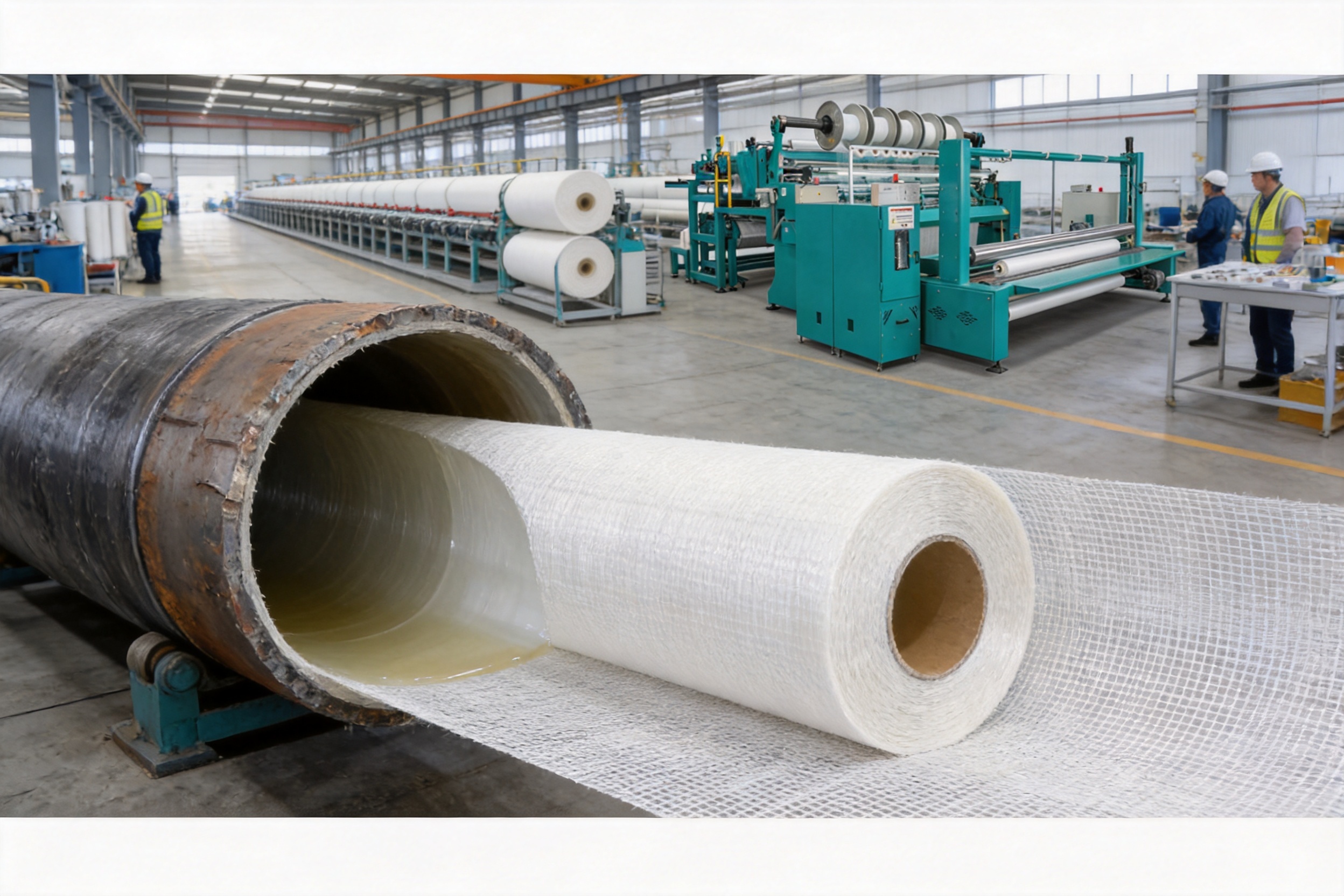
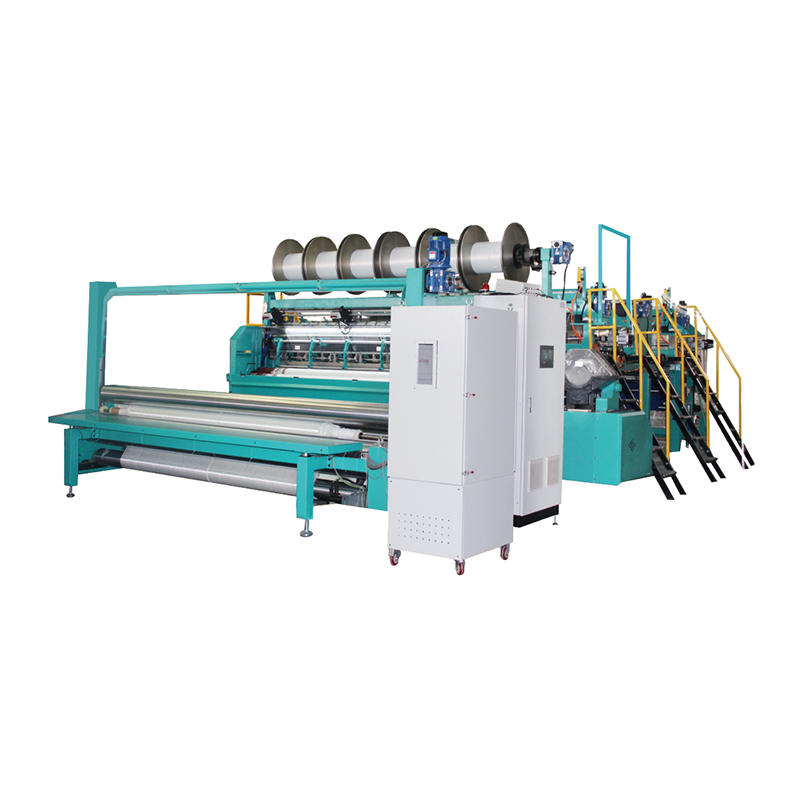
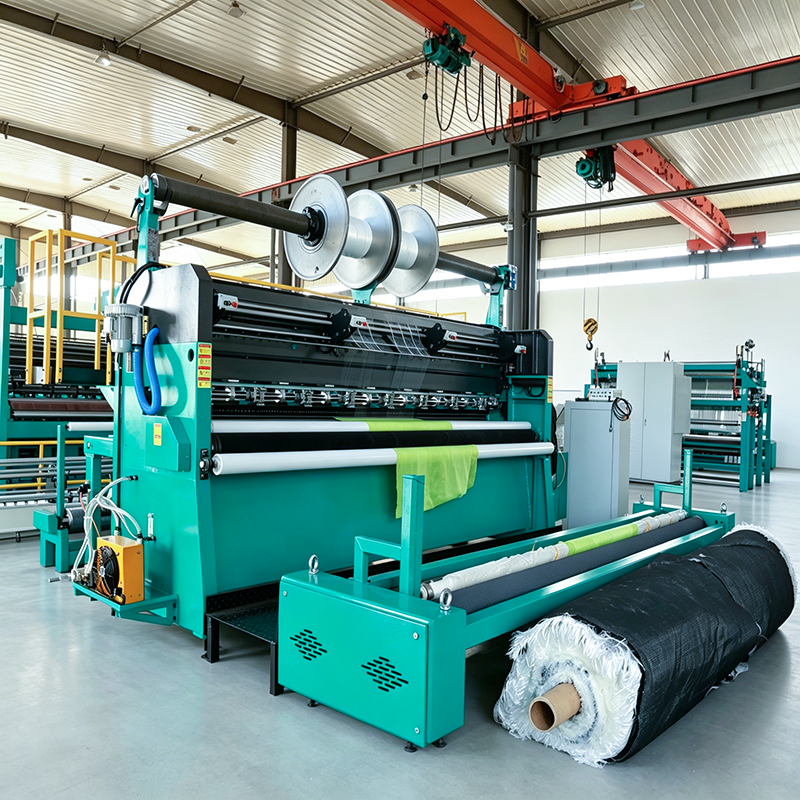
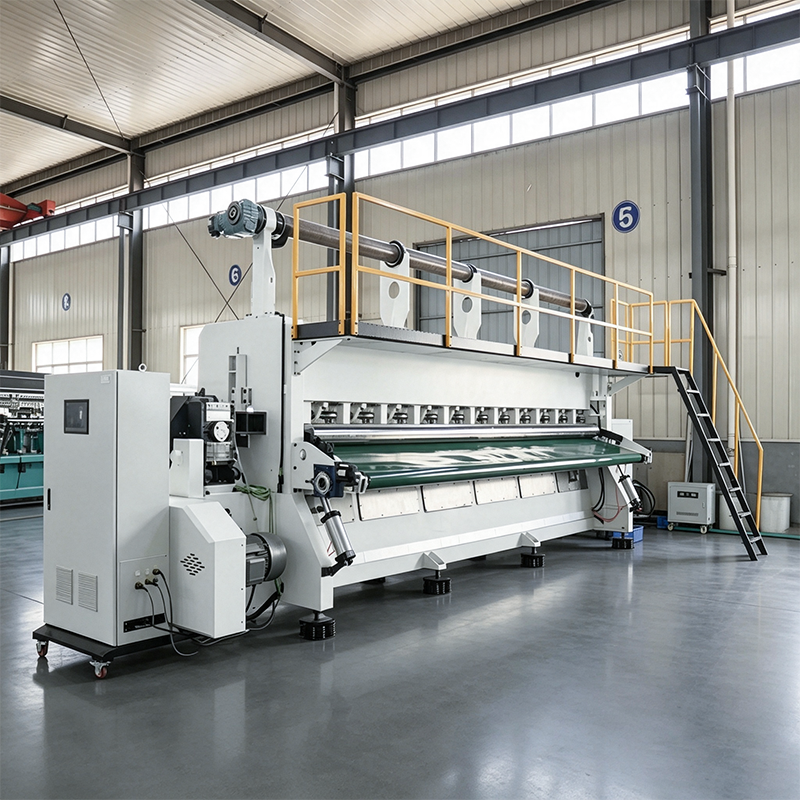
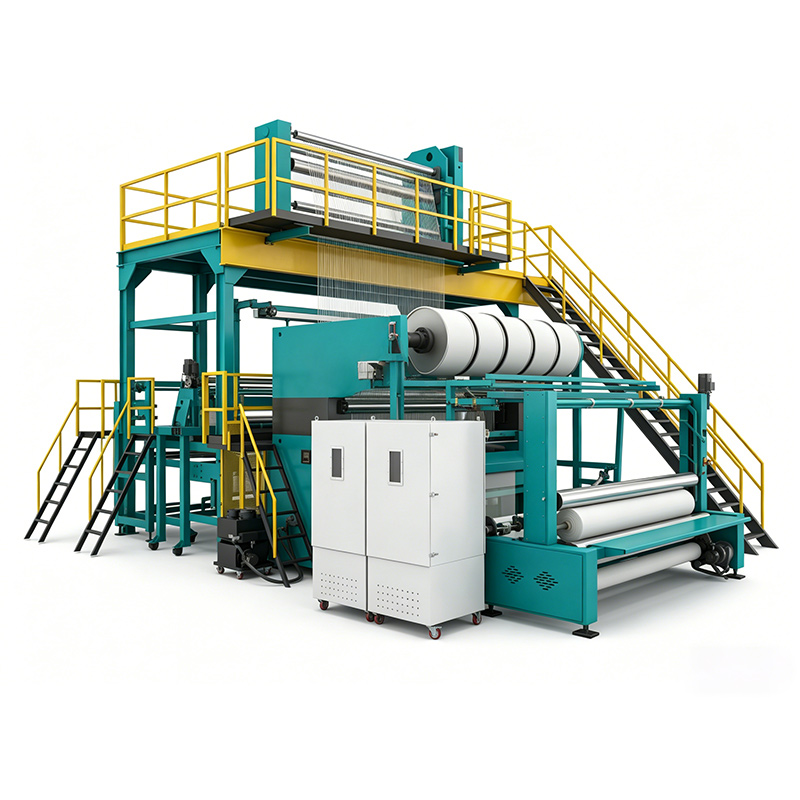
The FC Chopped Stitch Bonding Machine is an integrated production system for manufacturing glass fiber chopped strand mats, grid composite mats, and pipeline rehabilitation fabrics. It combines three essential operations—fiber chopping, web conveying, and stitch bonding—within one continuous machine architecture. By integrating these processes, the equipment reduces material handling, improves production continuity, and gives manufacturers closer control over fabric weight, fiber distribution, and finished-mat quality.
Designed for fiberglass textile applications, the machine converts glass fiber roving into controlled 50 mm chopped strands. These strands are evenly distributed into a non-oriented web and reinforced with knitting yarn through single-guide-bar loop formation. The resulting fabric offers a practical combination of uniformity, handling strength, conformability, and resin compatibility for composite and pipeline rehabilitation applications.
The machine is manufactured by Changzhou Yuanyang Electromechanical Technology Co., Ltd., a Jiangsu-based textile machinery enterprise specializing in warp knitting equipment, stitch-bonding machines, multiaxial and biaxial warp knitting machines, web-laying systems, powder scattering equipment, and customized textile production lines. Its engineering and manufacturing capabilities support projects that require more than a standard catalogue machine, including special fiber inputs, non-standard fabric structures, customized layouts, and integration with downstream production equipment.
Purpose and Position of the FC Chopped Stitch Bonding Machine
Many composite manufacturers require a reinforcement material that can be produced at a stable weight, handled efficiently, and adapted to resin impregnation or lining processes. A traditional operation may use separate equipment for chopping, fiber distribution, web transport, and reinforcement. While this arrangement can work, it often creates additional transfer points, greater floor-space requirements, more complex synchronization, and more opportunities for fiber segregation or weight variation.
The FC machine addresses these challenges through a three-in-one process. An independent chopping unit cuts the roving into the required length. A servo-controlled conveying system transports and distributes the chopped fiber across the working width. A stitch-bonding unit then reinforces the web using knitting yarn and single-guide-bar loop formation.
This architecture is particularly suitable for non-oriented chopped strand mats. Unlike woven fabrics or biaxial warp-knitted reinforcements, the chopped fibers are not arranged primarily along fixed machine or cross-machine directions. Instead, the cut fibers are distributed throughout the web, creating a flexible and conformable material. The stitch-bonding structure holds the fiber network together and provides sufficient integrity for winding, transport, cutting, lamination, and installation.
The standard application range includes chopped strand mat, grid composite mat, and pipe rehabilitation fabric. The machine is also suitable for composite reinforcement projects where the customer needs an even chopped-fiber layer rather than a strongly directional reinforcement architecture.
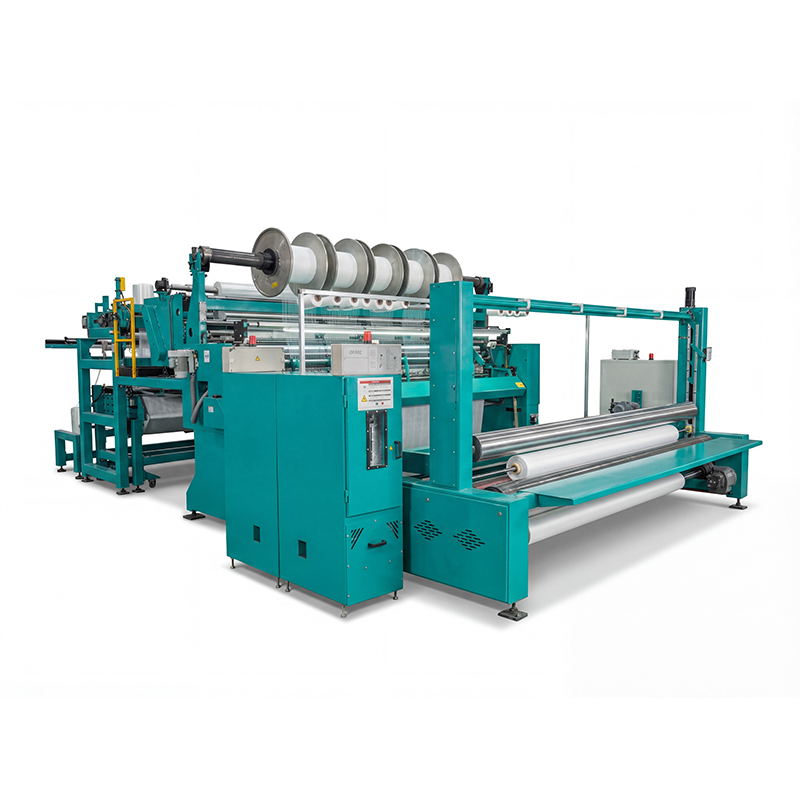
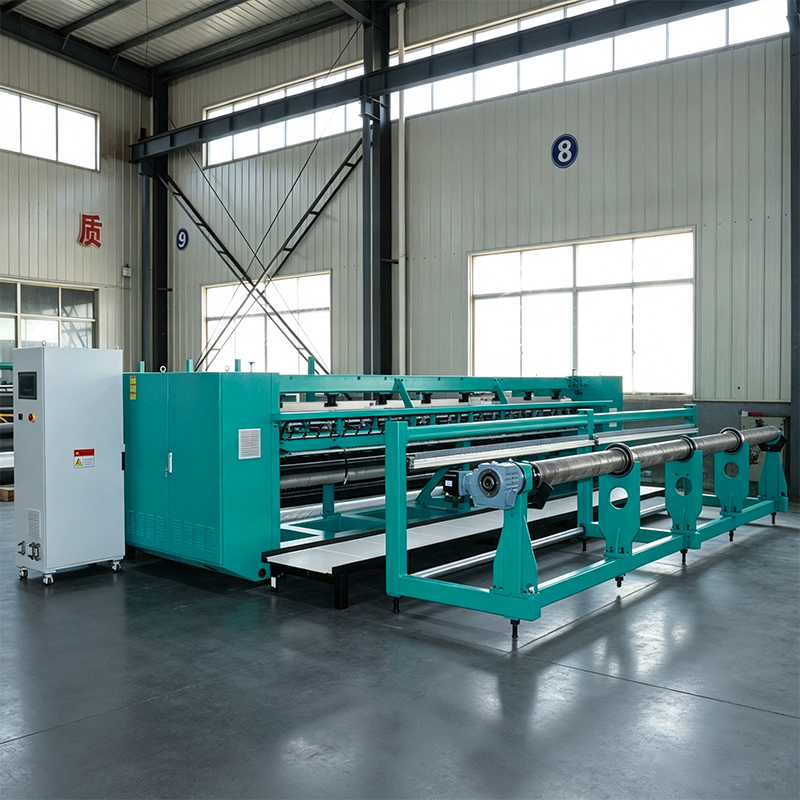
FC Chopped Stitch Bonding Machine
Core Operating Principle
The FC production process begins with glass fiber roving supplied from the creel or fiber input system. The roving is guided into the independent chopping unit, where it is cut into standard 50 mm lengths. Cutting quality is important because excessive variation in strand length can influence the distribution, appearance, handling characteristics, and resin uptake of the finished mat.
After cutting, the chopped fibers are transferred to the web-forming and conveying section. The servo-controlled conveying system regulates the movement of the web and supports even distribution across the working width. Accurate conveying is essential because the same mass of fiber can produce very different fabric quality if it is concentrated in some areas and sparse in others.
The distributed fibers then enter the stitch-bonding zone. A single guide bar forms loops with knitting yarn, locking the chopped fiber web into a coherent fabric. The reinforcement yarn gives the product handling strength while retaining the flexible character expected from a chopped strand mat.
The production concept can be summarized as follows:
- Glass fiber roving is supplied to the machine.
- The roving is cut into controlled 50 mm chopped strands.
- The chopped strands are conveyed and distributed into a web.
- The web is reinforced by single-guide-bar stitch bonding.
- The finished fabric is collected, wound, transferred, or prepared for the next process.
Because these operations are coordinated within one production line, the machine can offer a more consistent process than a loosely connected arrangement of independent units. The system also provides a clearer basis for process adjustment because chopping rate, conveying behavior, stitch parameters, and output can be evaluated as part of one integrated production system.
Advantages of the Integrated Three-in-One Design
Reduced Process Transfers
Separate chopping, laying, and bonding stages require intermediate material transfer. Every transfer can introduce fiber loss, contamination, web disturbance, or uneven distribution. The FC machine reduces these transitions by connecting the main operations into one continuous process. This can simplify factory planning and help operators maintain a more stable material path.
Improved Fiber Distribution
The independent chopping unit and servo-controlled conveying system are designed to work together. The chopping unit provides a controlled supply of cut fibers, while the conveying system helps distribute the fibers evenly. This coordinated design supports the stated uniformity tolerance of within ±5% when the machine is correctly configured and operated with suitable materials and process parameters.
More Direct Process Control
An integrated machine gives production personnel a more direct relationship between settings and fabric results. Adjustments to the chopping rate, transport speed, stitch formation, yarn specification, and target fabric weight can be evaluated without coordinating multiple unrelated machines. This makes production trials and parameter optimization more systematic.
Efficient Use of Workshop Space
A combined machine can reduce the footprint associated with separate chopping, web-forming, and bonding lines. The final layout still depends on the creel, take-up, winding, inspection, and downstream equipment, but the integrated core process provides greater flexibility when planning a new workshop or upgrading an existing line.
Stable Mat Handling
A chopped fiber web without reinforcement can be difficult to transport, wind, cut, and feed into subsequent processes. Stitch bonding creates a coherent structure that improves handling strength. This is especially useful for pipeline rehabilitation fabrics and composite reinforcement materials that must be moved through several production or installation stages.
Adaptability to Customer Production Targets
The machine is not limited to one fixed fabric specification. It can be configured around the required fabric weight, roving tex, working width, knitting yarn, stitch density, output target, and downstream process. This approach is more suitable for manufacturers that produce several grades of mat or require a custom fabric for a particular lining, composite, or rehabilitation project.
Fabric Characteristics and Product Range
The FC machine is designed for glass fiber applications. Standard production uses glass fiber roving cut into 50 mm lengths. The chopped fibers are distributed without a required directional orientation, which gives the resulting mat a flexible and relatively isotropic reinforcement character compared with strongly oriented textile structures.
The supported fabric weight range is approximately 50–900 g/m². The achievable specification depends on the fiber tex, chopping rate, conveying condition, stitch density, knitting yarn, machine width, and production speed. A low-weight fabric and a high-weight composite mat place different demands on fiber feeding, web formation, reinforcement, winding, and line stability.
Typical products include:
- Glass fiber chopped strand mat.
- Grid composite mat.
- Pipe rehabilitation fabric.
- Non-oriented reinforcement layers for resin-based composite systems.
- Customized chopped-fiber fabrics for special industrial applications.
Chopped strand mats are often selected when a manufacturer needs good conformability and broad-area reinforcement. The absence of a fixed fiber orientation allows the fabric to adapt to curved surfaces and irregular profiles. In pipeline rehabilitation, the fabric can be incorporated into lining systems where consistent resin wet-out and reliable handling are important.
The machine can also be considered for composite structures that use a chopped-fiber layer together with other reinforcement types. For example, a chopped mat may be combined with a grid, directional textile, or additional resin-compatible layer to achieve a balance between surface coverage, flexibility, impact resistance, and structural performance.
Working Width, Speed, and Reference Output
Two standard working widths are available: 3300 mm, equivalent to approximately 130 inches, and 3800 mm, equivalent to approximately 150 inches. Both configurations have a listed machine speed range of 50–1300 r/min. Actual production speed should be established through material trials and fabric acceptance testing rather than selected solely from the maximum speed figure.
| Working Width | Machine Speed | Reference Product | Daily Output |
|---|---|---|---|
| 3300 mm (130 inches) | 50–1300 r/min | 300 g felt | 2000 kg |
| 3800 mm (150 inches) | 50–1300 r/min | 300 g felt | 2250 kg |
| 3300 mm (130 inches) | 50–1300 r/min | 300 g mat plus 400 g fabric | 4000 kg |
| 3800 mm (150 inches) | 50–1300 r/min | 300 g mat plus 400 g fabric | 4600 kg |
The output figures are reference values rather than guaranteed production results. Actual output may change according to fabric construction, fiber type, roving tex, knitting yarn, stitch density, speed, operator practice, material availability, machine uptime, and the required quality level.
The 3800 mm machine provides a wider production path and higher reference output at the same listed speed. However, a wider machine is not automatically the best option for every factory. Selection should consider the finished product width, trim allowance, available floor space, creel capacity, winding method, transport route, and downstream equipment. A 3300 mm machine may be more appropriate where the customer’s product width or workshop layout does not justify the wider configuration.
Output calculations should also include realistic allowances for start-up, material changeover, maintenance, quality inspection, roll changes, and production trials. A machine that runs at a sustainable speed with stable quality can provide greater commercial value than a machine operated at a theoretical maximum with frequent stoppages or excessive waste.
Uniformity Control and Production Stability
Uniformity is one of the key performance considerations in chopped-fiber mat production. Weight variation across the width can affect resin consumption, impregnation behavior, mechanical performance, curing consistency, and the appearance of the final composite. In pipe rehabilitation, inconsistent material can also make it more difficult to control the installed lining structure.
The FC machine is designed to maintain a uniformity tolerance within ±5%. This performance depends on the complete process rather than one individual component. The chopping unit must deliver a consistent supply of strands. The conveying system must distribute the fiber evenly. The stitch-bonding section must maintain stable loop formation. The operator must also use suitable roving, knitting yarn, speed, tension, and stitch parameters.
During commissioning, uniformity can be evaluated through fabric sampling and weight measurement. Measurements may be taken across the width and along the production direction. The results help establish whether the machine is correctly adjusted for the target product and whether further calibration is required.
Important factors affecting uniformity include:
- Roving tex and incoming material consistency.
- Condition and adjustment of the chopping blades.
- Chopped strand length and cutting quality.
- Fiber feed tension and roving alignment.
- Servo conveying speed and synchronization.
- Web formation conditions across the working width.
- Knitting yarn tension and stitch density.
- Machine speed and take-up stability.
- Workshop temperature, humidity, and material storage.
- Operator response to changes in the fiber supply.
Compared with a system relying mainly on manual distribution or loosely synchronized machines, the integrated servo-controlled arrangement gives the operator a stronger technical basis for controlling web formation. It does not eliminate the need for process discipline, but it can reduce the causes of avoidable variation and make quality control more repeatable.
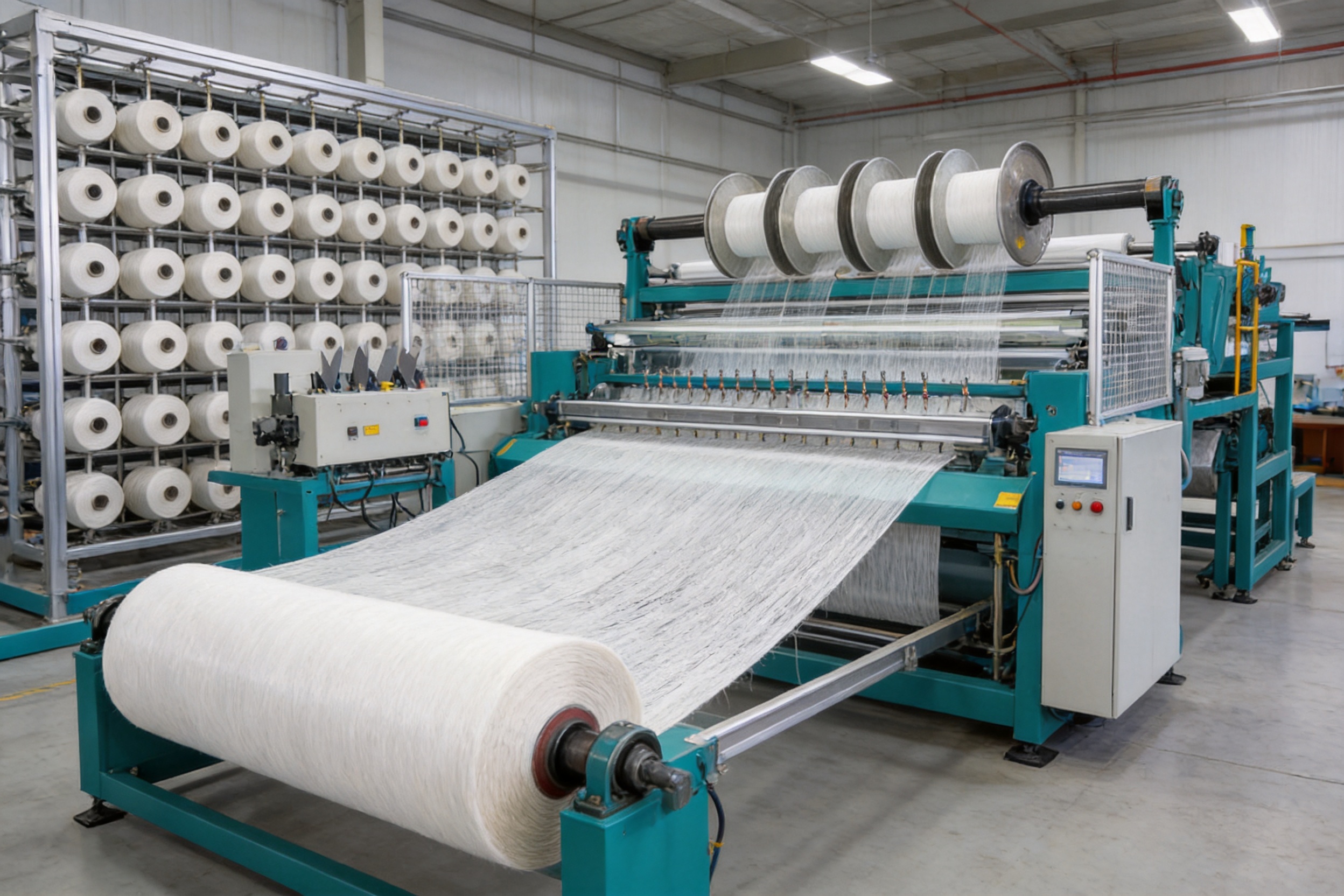
Applications in Pipeline Rehabilitation
Pipeline rehabilitation is a principal application for the FC Chopped Stitch Bonding Machine. Rehabilitation systems often use resin-impregnated textile materials to create a new structural or protective layer inside an existing pipe. The textile must be supplied in a form that can be impregnated, folded, transported, positioned, and cured while maintaining the required continuity and reinforcement characteristics.
A stitch-bonded chopped glass fiber mat can be useful in this context because it combines a distributed fiber structure with improved handling integrity. The non-oriented arrangement helps the material conform to pipe geometries and irregular surfaces. The knitting yarn provides reinforcement to the web, making the fabric easier to move and process than an unbonded loose fiber layer.
Uniformity is also important in pipeline rehabilitation. A significant change in areal weight can influence local resin demand and may create differences in the cured lining. By controlling the chopped web and verifying the finished fabric during commissioning, the production line can be aligned with the requirements of the intended rehabilitation system.
The final suitability of the fabric depends on the complete rehabilitation design, including resin chemistry, curing method, pipe diameter, pressure conditions, installation technique, service temperature, and required mechanical performance. The FC machine produces the reinforcement fabric; the customer’s engineering process determines how that fabric is incorporated into the completed lining system.
Comparison with Other Reinforcement Machine Concepts
The FC machine should be selected according to the required reinforcement architecture. It is not intended to replace every type of warp knitting or textile reinforcement machine. Its principal advantage is the efficient production of a non-oriented chopped-fiber mat with integrated stitch bonding.
| Machine Concept | Primary Reinforcement Structure | Typical Application | Reason to Select |
|---|---|---|---|
| FC Chopped Stitch Bonding Machine | Non-oriented chopped strand mat | Pipeline rehabilitation, chopped mat, grid composite mat | Integrated chopping, conveying, and stitch bonding |
| Double Chopped Stitch Bonding Machine | Dual chopped-fiber layer construction | Higher areal weight and multilayer mats | Suitable for projects requiring additional chopped-fiber build |
| Chopped Fiber Biaxial Warp Knitting Machine | Chopped fiber combined with biaxial yarn | Composites requiring directional reinforcement and chopped fill | Provides a combination of directional yarn and chopped fiber |
| High-Strength Biaxial Warp Knitting Machine | 0-degree and 90-degree biaxial reinforcement | Structural composite laminates | Designed for directional load-bearing reinforcement |
Compared with a biaxial machine, the FC machine is better suited to applications where a non-oriented mat is more important than fixed directional strength. Compared with a double-layer chopped system, it offers a more straightforward single-layer configuration for customers whose product specification does not require a heavier multilayer build. Compared with a basic standalone chopping system, it adds stitch bonding and therefore produces a fabric with stronger handling integrity.
The comparison should not be understood as a claim that one machine is universally superior. Each reinforcement type serves a different engineering purpose. The practical advantage of the FC machine is that it aligns the machine architecture with the requirements of chopped strand mat and related fiberglass fabrics.
Advanced Manufacturing and Engineering Capabilities
The manufacturer operates from an engineering and production base in Jiangsu, China, covering more than 12,000 square meters and supporting an annual production capacity of more than 200 sets. This scale provides a foundation for engineering, machining, assembly, testing, customer support, and spare-parts management within one organization.
The company’s manufacturing strength is supported by a professional research and development team with experience in textile machinery design and industrial equipment engineering. Its product range includes standard warp knitting equipment as well as specialized and customized systems. This is important for customers whose production requirements do not fit a fixed machine specification.
Manufacturing control extends across the complete build process. Component procurement, material inspection, machining, mechanical assembly, electrical integration, control-system testing, production trials, and final debugging are handled as connected quality stages. The purpose is to ensure that the final machine is not only assembled correctly but also tested under operating conditions that reflect the customer’s intended fabric.
Advanced equipment manufacturing is particularly important for a stitch-bonding machine because the quality of the final fabric is influenced by the relationship between many mechanical and control elements. Chopping, conveying, loop formation, yarn tension, take-up, and machine speed must remain synchronized. A small mechanical or control deviation can appear as a fabric defect, weight variation, broken yarn, uneven fiber distribution, or unstable operation.
Component and Material Inspection
Incoming components and materials are inspected before entering the production process. This helps identify dimensional, electrical, mechanical, or material problems at an early stage. Inspection is especially valuable for components that influence drive performance, machine alignment, fiber movement, and stitch formation.
Precision Machining and Assembly
Machined components and structural parts are prepared according to engineering requirements. During assembly, alignment, fastening, drive connection, and moving-part clearance are checked. Stable machine geometry supports consistent operation across the full working width.
Electrical and Control Integration
Electrical wiring, drive systems, sensors, and control functions are integrated and tested before dispatch. The servo-controlled conveying system is a central part of the machine’s ability to manage web movement. Control integration therefore has a direct relationship with product uniformity and line stability.
Factory Testing
The machine undergoes no-load and load running tests before delivery. Where applicable, fabric trials are carried out to assess cutting, web formation, stitch bonding, output, and fabric uniformity. Testing before shipment reduces the risk of discovering basic assembly or control problems only after installation at the customer’s site.
Configuration and Customization Options
Customer requirements vary according to product width, fiber material, output, workshop structure, and downstream processing. The FC machine can be configured around several important production inputs rather than treated as a fixed one-size-fits-all unit.
- Working width of 3300 mm or 3800 mm.
- Glass fiber roving input with defined tex and feed requirements.
- Standard 50 mm chopped strand length.
- Single-guide-bar stitch-bonding configuration.
- Servo-controlled conveying system.
- Independent chopping unit and drive arrangement.
- Customized frame and line layout.
- Adaptation to creel, take-up, winding, and transfer arrangements.
- Integration with customer utilities and downstream equipment.
- Potential adaptation for synthetic or carbon fiber inputs subject to engineering evaluation.
Customization may involve mechanical structure, layout redesign, functional-module integration, fiber-path adaptation, take-up direction, or control-system coordination. The machine can be planned around the available floor area, the position of the creel, the material loading route, the finished-roll transfer route, and the requirements of the following production stage.
For non-standard projects, the engineering process may begin with customer drawings, product samples, fabric specifications, or application information. The manufacturer can then develop a preliminary configuration, confirm the machine concept through drawings or three-dimensional design, prepare a quotation, and proceed to production after technical approval.
Project Information Required Before Quotation
A reliable proposal requires more than a requested machine width or a general product name. The machine must be matched to the actual working point. The following information helps determine the appropriate configuration:
| Customer Input | Engineering Significance |
|---|---|
| Target fabric and weight range | Determines chopping rate, web density, stitch parameters, and trial conditions. |
| Fiber type and roving tex | Influences cutting-head setup, fiber path, tension, and feeding requirements. |
| Required working width | Guides the selection between the 3300 mm and 3800 mm configurations. |
| Daily or annual output target | Supports speed selection, line balancing, and production planning. |
| Knitting yarn specification | Influences guide-bar operation, loop formation, and fabric handling strength. |
| Workshop floor plan | Determines machine orientation, creel position, service access, and roll transfer. |
| Downstream process | Defines take-up, winding, cutting, inspection, and transfer interfaces. |
| Utilities and site conditions | Supports planning for power supply, compressed air, foundation, and environmental conditions. |
Providing accurate information at the beginning reduces the risk of a machine being selected only by nominal speed or working width. It also helps the engineering team evaluate whether the proposed machine can achieve the intended fabric weight, roll format, output, and quality criteria.
Installation, Commissioning, and Acceptance
Installation is an important part of machine performance. Even a well-built machine may not produce stable fabric if the foundation, leveling, alignment, fiber path, electrical connection, or take-up arrangement is incorrect. For this reason, the service process includes technical support for installation, commissioning, and operator training.
The normal commissioning sequence includes:
- Checking the foundation and machine position against the approved layout.
- Leveling and aligning the main frame and connected modules.
- Completing mechanical assembly and drive connections.
- Installing electrical and control wiring.
- Conducting a no-load running test.
- Threading the glass fiber roving and knitting yarn.
- Calibrating chopping and conveying conditions.
- Running a fabric trial at the target weight.
- Checking fabric weight, appearance, distribution, and uniformity.
- Training operators and maintainers in production and adjustment procedures.
Acceptance should be connected to the customer’s target product. Relevant criteria may include fabric weight, uniformity within the agreed tolerance, stable running at the intended production speed, acceptable stitch formation, and the ability to produce the specified fabric construction. Defining acceptance around the actual product is more meaningful than relying only on an unloaded machine-speed demonstration.
Maintenance and Long-Term Production Support
Regular maintenance helps preserve machine accuracy, production stability, and fabric quality. The chopping blades, knitting elements, yarn-guiding components, web transport parts, drive elements, and take-up system require particular attention because they are directly involved in material movement and fabric formation.
Typical maintenance activities include inspection of blade condition, cleaning of fiber accumulation, checking of fasteners, lubrication where specified, examination of yarn guides, verification of conveying components, inspection of electrical connections, and review of drive-system performance. Maintenance intervals should be established according to production hours, fiber type, material contamination, machine speed, and the manufacturer’s technical instructions.
Spare parts planning is also important. Chopping blades and selected knitting elements are wear-related components. Keeping appropriate spares available can reduce downtime and prevent a minor component issue from interrupting an entire production schedule.
The manufacturer provides long-term production support and spare-parts service. After-sales engineers can assist with troubleshooting, process adjustments, technical documentation, and production issues throughout the working life of the equipment.
Operator and Technical Training
Machine performance depends on the knowledge of the people who operate, maintain, and manage the line. Training is therefore treated as part of the complete equipment solution rather than as an optional final demonstration.
Maintainer Training
Maintenance personnel can receive practical training in the factory workshop. The program covers installation participation, mechanical inspection, lubrication, component replacement, electrical and drive-system awareness, and routine troubleshooting. The stated training period is generally one to two months, depending on the project and personnel requirements.
Knitter and Operator Training
Operators receive hands-on training in fiber threading, yarn preparation, machine starting, parameter adjustment, fabric weight control, roll handling, shutdown, and routine production inspection. Practical training helps operators understand how changes in material and machine settings affect the finished mat.
Workshop Management Training
Supervisors and production managers can receive guidance on quality control, production planning, process documentation, efficiency monitoring, and parameter management. This helps the customer create a repeatable production system instead of relying only on individual operator experience.
The manufacturer can also assist with quality-system documentation and production procedures. Such support is valuable for customers supplying industrial markets where traceability, process records, inspection results, and repeatability are important.
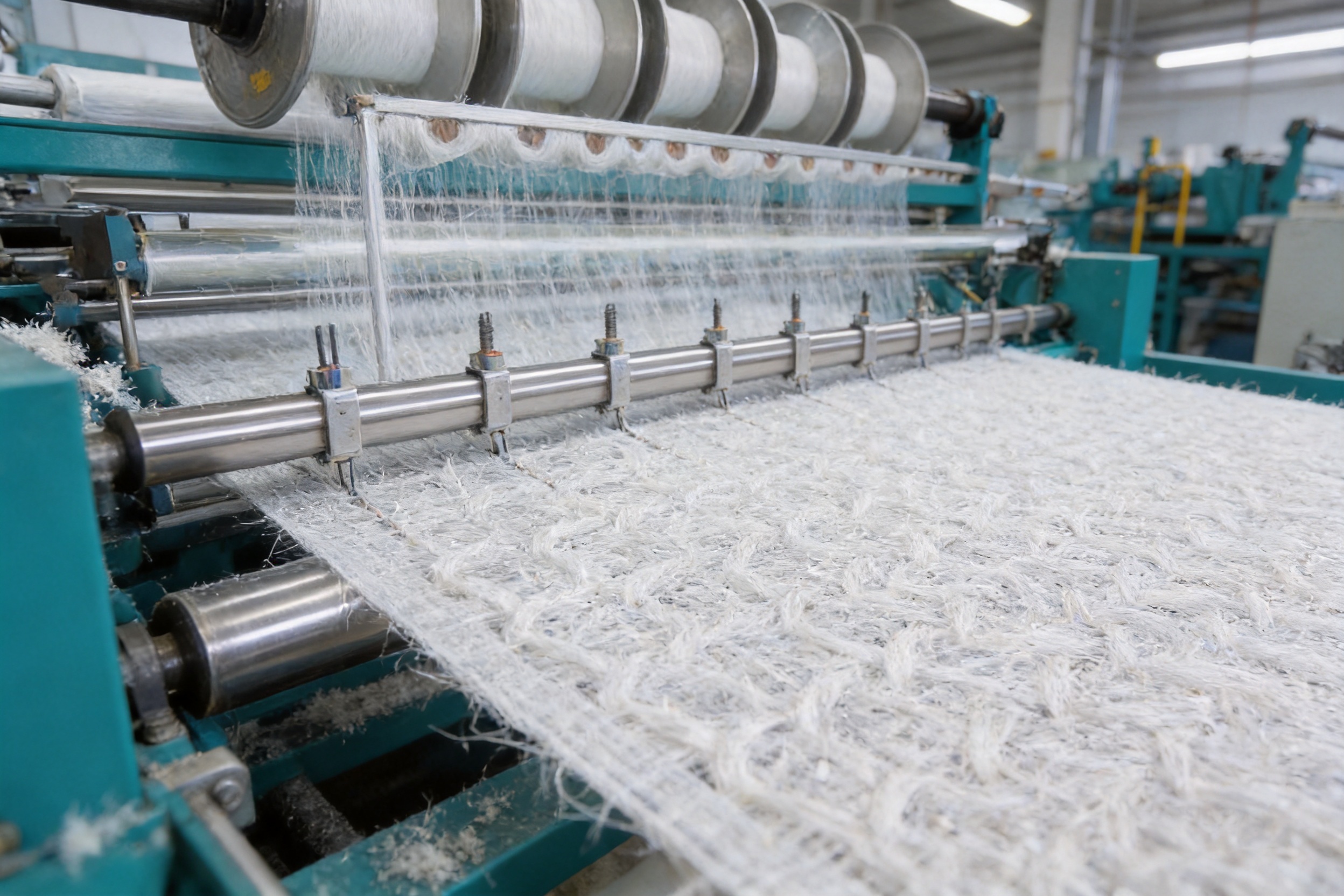
Quality Management Throughout the Build
The company applies quality management principles across procurement, machining, assembly, testing, and delivery. A complete quality approach is especially valuable for custom machinery because the final result depends on the interaction between standard components and project-specific engineering.
Quality control activities may include incoming inspection, in-process machining checks, assembly verification, no-load testing, load testing, electrical and control testing, fabric trials, and final inspection before dispatch. Intelligent warehouse management also supports parts storage, identification, and dispatch accuracy.
Factory testing provides an opportunity to identify issues before shipment. The machine can be checked for mechanical noise, drive response, control operation, fiber movement, yarn movement, loop formation, and output behavior. When customer materials or specifications are available, trial production can provide additional confidence that the final configuration is appropriate.
This manufacturing discipline distinguishes an engineering-oriented equipment supplier from a simple machine assembler. The customer receives not only a mechanical frame but a coordinated production solution that has been evaluated through multiple stages of manufacturing and testing.
Why Manufacturers Choose This Machine Architecture
Manufacturers generally consider the FC machine when their priority is the reliable production of chopped glass fiber fabric rather than a directional reinforcement textile. The integrated architecture provides several practical advantages.
- It combines three core operations in one continuous production concept.
- It supports a broad fabric weight range from approximately 50 to 900 g/m².
- It uses controlled 50 mm chopped glass fiber strands.
- It incorporates servo-controlled conveying for web distribution.
- It provides single-guide-bar stitch bonding for fabric reinforcement.
- It is available in two useful working widths.
- It is suitable for pipeline rehabilitation and composite reinforcement.
- It can be engineered around customer materials and production targets.
- It includes installation, commissioning, training, and after-sales support.
- It is manufactured by a supplier with experience in specialized textile equipment.
The strongest competitive advantage is not necessarily a single speed or output figure. It is the combination of integrated process control, customization capability, manufacturing discipline, and application support. A machine with the correct process architecture and a well-designed installation can offer more dependable value than an apparently lower-cost system that requires extensive modification after delivery.
Selection Guidance for Different Customer Needs
Customers Producing Standard Chopped Strand Mat
Customers focused on standard glass fiber chopped strand mat should begin with the target fabric weight, finished width, roving tex, daily output, and roll format. The FC machine can then be configured for the desired production range and working width.
Customers Serving Pipeline Rehabilitation Markets
Pipeline rehabilitation producers should provide information about the intended lining system, fabric dimensions, resin process, installation method, and required handling characteristics. This allows the machine configuration and acceptance trial to reflect the fabric’s actual use.
Customers Requiring Higher Areal Weight or Multiple Layers
Where the desired construction requires a heavier or dual chopped-fiber build, the customer should compare the FC machine with a double chopped stitch-bonding configuration. The correct selection depends on the number of layers, target weight, stitch structure, and desired production rate.
Customers Requiring Directional Composite Strength
Where the final composite needs strong 0-degree and 90-degree reinforcement, a biaxial or multiaxial warp knitting machine may be more appropriate. The FC machine is best suited to non-oriented chopped-fiber reinforcement and should not be selected simply because it has a similar general textile application.
Customers Planning a Customized Production Line
Customers with unusual materials, special widths, limited workshop space, or complex downstream interfaces should engage the manufacturer early. Engineering review can address layout, fiber input, take-up, winding, process integration, and utility requirements before the final machine specification is fixed.
Frequently Asked Questions
What fibers can the FC Chopped Stitch Bonding Machine process?
The standard application is glass fiber roving. The machine is designed around glass fiber chopped strand mat production and uses a standard chopped length of 50 mm. Adaptation for synthetic fiber, carbon fiber, or other materials may be considered as an engineering project because different fibers can require changes to the cutting unit, fiber path, tension control, web formation, and machine protection.
What fabric weight can the machine produce?
The stated fabric weight range is approximately 50–900 g/m². The actual achievable range depends on the roving tex, chopping rate, conveying condition, stitch density, knitting yarn, machine speed, and required quality level. A production trial is recommended when the customer requires a particularly low or high fabric weight.
What is the standard chopped fiber length?
The standard chopped length is 50 mm. If a customer requires a different length, the cutting system and final fabric behavior must be evaluated before confirmation. Strand length affects distribution, entanglement, handling, resin uptake, and the appearance of the finished mat.
How is the chopped fiber web made uniform?
An independent chopping unit supplies controlled chopped fiber, while a servo-controlled conveying system transports and distributes the material across the working width. The web is then reinforced by stitch bonding. Under suitable material and process conditions, the machine is designed to achieve a uniformity tolerance within ±5%.
What working widths are available?
The standard working widths are 3300 mm, or approximately 130 inches, and 3800 mm, or approximately 150 inches. The selection should be based on the finished fabric width, trim requirements, production output, workshop dimensions, creel arrangement, and downstream winding or transfer equipment.
What output can the machine achieve?
Reference output for the 3300 mm model is 2000 kg per day for 300 g felt and 4000 kg per day for a 300 g mat plus 400 g fabric. Reference output for the 3800 mm model is 2250 kg per day for 300 g felt and 4600 kg per day for a 300 g mat plus 400 g fabric. These figures are planning references only. Actual output depends on fabric construction, material, machine settings, uptime, and quality requirements.
Is the machine suitable for pipeline rehabilitation fabric?
Yes. Pipeline rehabilitation fabric is one of the primary applications of the FC machine. Its non-oriented chopped glass fiber structure and stitch-bonded integrity can be suitable for reinforcement layers used in lining and rehabilitation systems. Final suitability must be confirmed against the customer’s resin, pipe, curing, installation, and mechanical requirements.
How does this machine differ from a biaxial warp knitting machine?
The FC machine produces a non-oriented chopped-fiber mat, while a biaxial warp knitting machine produces reinforcement with defined yarn directions, commonly 0 degrees and 90 degrees. The FC machine is therefore more appropriate for flexible chopped mat applications, while a biaxial system is generally selected when directional structural strength is the main requirement.
Can the machine layout be customized?
Yes. Layout customization can account for workshop dimensions, creel position, material loading direction, take-up arrangement, winding direction, service access, and downstream transfer. Structural and functional changes should be reviewed during the engineering stage and confirmed through technical drawings before production.
Can the equipment be integrated with an existing production line?
Integration is possible subject to a review of the existing line. Important interface information includes incoming roving supply, fiber path, power and utility conditions, take-up and winding equipment, finished-roll dimensions, transfer direction, control signals, and available space. The manufacturer can use this information to develop a compatible layout.
What installation support is provided?
An engineer can attend the customer’s factory for installation, commissioning, process adjustment, and training. The commissioning process includes foundation and leveling checks, mechanical and electrical connection, no-load testing, fiber threading, chopping calibration, web uniformity evaluation, and production trials.
What training is available?
Training can cover maintenance, machine operation, fabric production, quality inspection, production planning, and workshop management. Maintainer, operator, and management training is generally arranged at the manufacturer’s factory and may last one to two months depending on the project and customer requirements.
Which parts require the most maintenance?
Chopping blades, knitting elements, yarn guides, web transport components, drive elements, and take-up parts require regular inspection. Fiber accumulation should be removed, wear should be monitored, and replacement parts should be kept available for components that directly influence production continuity.
How should machine acceptance be defined?
Acceptance should be based on the agreed target fabric rather than only on a machine-speed demonstration. Appropriate criteria can include fabric weight, uniformity, stitch formation, stable running, output at the intended production speed, and compatibility with the customer’s downstream process.
Conclusion
The FC Chopped Stitch Bonding Machine provides an integrated solution for glass fiber chopped strand mat and related fiberglass textile production. Its three-in-one architecture combines controlled chopping, servo-based web conveying, and single-guide-bar stitch bonding. This design supports uniform fiber distribution, stable fabric handling, flexible product development, and efficient production of materials used in pipeline rehabilitation and composite reinforcement.
With working widths of 3300 mm and 3800 mm, a listed speed range of 50–1300 r/min, and a fabric weight range of approximately 50–900 g/m², the machine can be configured for a broad range of production targets. Its stated uniformity tolerance of within ±5% provides a clear quality objective for commissioning and fabric acceptance.
The equipment’s value also comes from the manufacturer’s broader strengths. Research and development, precision manufacturing, assembly, control integration, factory testing, installation, training, customization, spare-parts supply, and long-term technical service are treated as parts of one engineering process. This approach helps customers obtain a production line matched to their actual material, workshop, output, and application requirements.
For manufacturers seeking a non-oriented glass fiber reinforcement fabric with reliable handling strength and controlled production, the FC machine offers a practical alternative to separate chopping and bonding operations. The final configuration should be selected through a technical review of fabric structure, fiber type, weight, working width, output, layout, utilities, and downstream requirements.
References
1. Product technical information for the FC Chopped Stitch Bonding Machine, including working width, machine speed, fabric weight, application range, and reference output data.
2. Manufacturer-provided information on glass fiber chopped strand mat, grid composite mat, and pipeline rehabilitation fabric production.
3. Manufacturer-provided engineering information concerning independent chopping units, servo-controlled conveying systems, and single-guide-bar stitch bonding.
4. Manufacturer-provided quality-control and service information covering component inspection, assembly, factory testing, installation, commissioning, training, and after-sales support.
5. General technical principles of glass fiber textile reinforcement, stitch-bonded fabrics, chopped strand mats, and resin-based composite manufacturing.
6. General production-planning principles for textile machinery output, fabric-weight control, line balancing, maintenance, and process acceptance.
Product: FC Chopped Stitch Bonding Machine
News
-
Three quotations land on the same desk for the same polyester nonwoven line, and on paper they look interchangeable. Each is priced per metre of working width. Each quotes a similar top speed. Each c...
READ MORE -
Which Machine Category Matches Each Technical Fiber and Fabric Goal A warp knitting machine is the primary production platform for technical fiber textiles across fiberglass, chemical fiber, and carbo...
READ MORE -
What a Stitch Bonding Machine Does A stitch bonding machine is a warp knitting type machine that uses knitting needles and a stitching yarn to hold a web of fibers, a layer of chopped strands, or a la...
READ MORE -
Two quotations land on the same desk. Both offer a multiaxial warp knitting line, both list the same working width, both promise high output. One buyer signs and discovers six months later that the f...
READ MORE
-
Contact Info.
+86-198 5534 1617
+86-134 0158 3002yuanyang@yywarpknitting.com 699#, Shengzhi West Rd, Lvcheng Town, Danyang City, Zhenjiang City, Jiangsu Province, China

-
QR Code
-
Quick Links
Home About Products Manufacturing Customization News Contact -
Product List
Machine for Chemical Fiber Textile Machine for Fiberglass Textile Machine for Carbon Fiber Textile -
About Us
Company Profile Factory Gallery Value-added Service
Copyright © 2026 Changzhou Yuanyang Electromechanical Technology Co., Ltd. All Rights Reserved.
Custom Warp Knitting Machine Manufacturers
